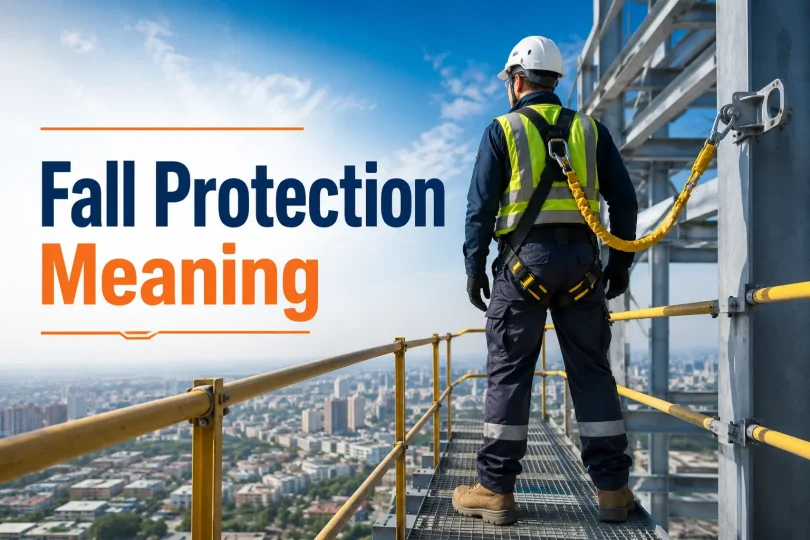

Fall Protection Meaning
Fall protection is the combination of systems, equipment, and procedures used to keep workers safe when exposed to fall hazards at height. It covers both measures that prevent a fall from happening in the first place, like guardrails, and measures that limit harm when a fall does occur, like a full-body harness and lanyard. Under OSHA regulations, fall protection is a legal requirement for most elevated work in the United States.
Falls are the leading cause of death in construction. Not one of the leading causes. The leading cause. Every year, roughly 400 construction workers die from a fall on the job, and tens of thousands more are seriously injured. The sobering part? Most of those incidents were preventable.
This guide cuts through the confusion: what fall protection actually means, where it ends and fall prevention begins, what OSHA requires, and what choices you have when designing a worksite safety program.
1. Fall Prevention vs. Fall Protection: They Are Not the Same Thing
You May Also Like It:
Guardian Fall Protection: The Complete Guide to Staying Safe at Heights
Portable Fall Protection Systems: The Complete Safety Guide
Skylight Fall Protection: A Complete Guide to OSHA Compliance and Keeping Workers Safe
This distinction trips up experienced safety professionals, not just newcomers. The two terms are often used interchangeably, but they describe fundamentally different things.
What Is Fall Prevention?
Fall prevention means stopping a fall before it starts. These are passive systems — once installed, workers benefit from them automatically without wearing or connecting anything.
Common fall prevention systems include:
- Guardrails: Physical barriers along open edges, platforms, and elevated walkways
- Hole covers: Rigid covers over floor openings, skylights, and confined space entries
- Safety netting: Mesh barriers that catch falling workers before they reach a lower level
- Restraint lifelines: Tethers short enough that workers physically cannot reach an unprotected edge
- Warning lines: Perimeter markers at least 6 feet from a roof edge that signal hazard boundaries
The key feature of every passive system: they work whether or not the worker does anything at all.
What Is Fall Protection?
Fall protection, in the strict sense, refers to active equipment a worker must wear or connect to in order for it to work. A full-body harness and lanyard only protect you if you put them on and tie off correctly. If a worker forgets to clip in, the harness does nothing.
Which Comes First?
OSHA’s hierarchy of controls is clear: passive prevention always takes priority over active protection. You only reach for the harness when installing a guardrail is not feasible for the task. This is not a preference. It is the required order of operations.
2. The Real Numbers Behind the Risk
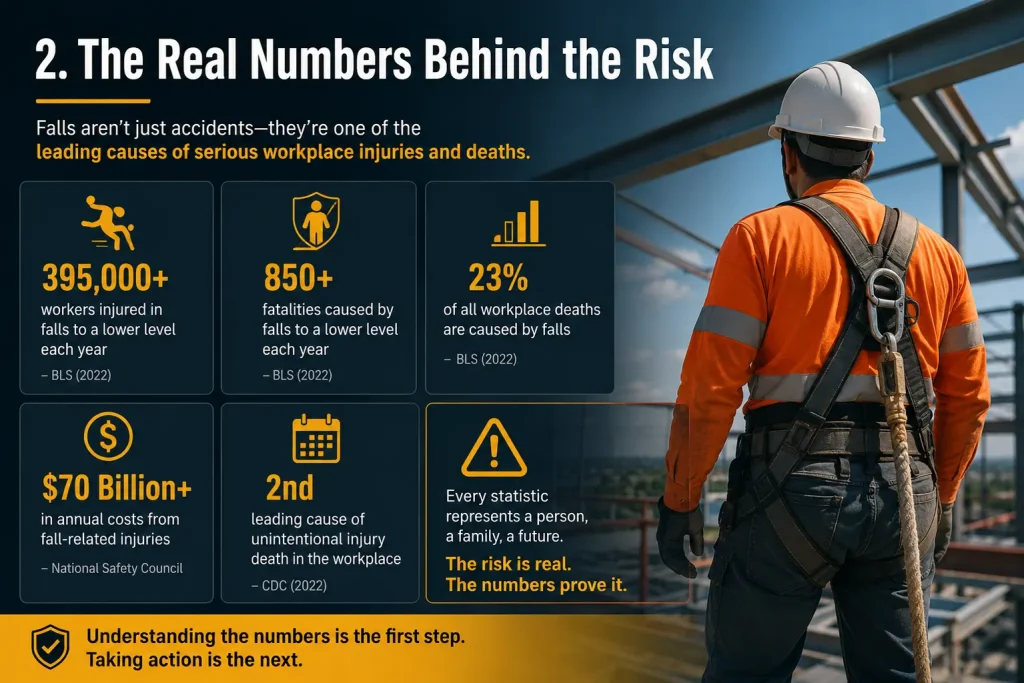
Before getting into equipment and regulations, the statistics deserve a moment.
Fatality Data
According to the Bureau of Labor Statistics (BLS):
- 395 out of 1,069 construction fatalities in 2022 were caused by falls
- That is 37% of all construction deaths from a single hazard category
- Falls are the leading cause of construction fatalities for over a decade running
The Financial Cost
The National Safety Council estimates the average cost of a single medically consulted fall injury at over $47,000, factoring in:
- Lost wages and productivity
- Medical and rehabilitation costs
- Administrative and investigation expenses
- Employer liability and insurance impact
A workplace fatality, including litigation, regulatory response, and replacement training, can easily exceed seven figures.
Why OSHA Keeps Coming Back to It
In fiscal year 2023, fall protection in construction (29 CFR 1926.501) was the single most frequently cited OSHA standard for the 13th consecutive year. That is not a coincidence. It reflects how often worksites still get this wrong.
3. OSHA Fall Protection Requirements: The Rules by Industry
You May Also Like It:
Skylight Fall Protection: A Complete Guide to OSHA Compliance and Keeping Workers Safe
Construction Safety: A Complete Guide to Staying Safe on Every Job Site
Construction Safety Products: A Complete Guide to Protecting Your Crew
Construction Safety Solutions: A Complete Guide for Modern Construction Sites
Temporary Construction Safety Railing: The Complete Guide for Job Site Safety
OSHA does not use a single height threshold for everyone. The required trigger height depends on where the work takes place.
Height Thresholds by Industry
| Industry | Required Fall Protection Height |
|---|---|
| General Industry | 4 feet |
| Shipyards | 5 feet |
| Construction | 6 feet |
| Longshoring | 8 feet |
The Dangerous Equipment Exception
Height thresholds do not apply when a worker could fall into or onto dangerous equipment or machinery. If a worker could land on a conveyor belt, into a vat of chemicals, or onto any hazardous surface, OSHA requires fall protection at any height. This exception catches many employers off guard.
Key OSHA Standards to Know
- 29 CFR 1926.501 — Fall protection in construction (duty to have fall protection)
- 29 CFR 1926.502 — Fall protection systems criteria and practices
- 29 CFR 1926.503 — Training requirements for construction fall protection
- 29 CFR 1910.28 — General industry fall protection requirements
All four standards require employers to provide a compliant fall protection system, maintain equipment in safe condition, and train workers before exposure. Ignorance of these standards is not a defense OSHA accepts.
4. Types of Fall Protection Systems
Every fall protection system falls into one of two categories: passive (prevention) or active (arrest). Here is a full breakdown of both.
Passive Fall Protection Systems
Guardrails
Guardrails are the most widely used passive fall protection system. An OSHA-compliant guardrail on a construction site must meet all of the following specs:
- Top rail height: 42 inches (plus or minus 3 inches)
- Mid-rail: Required at the midpoint between the top rail and the floor
- Toe-board: Required to prevent tools and materials from rolling off
- Strength: Must withstand 200 pounds of outward or downward force at any point
Hole Covers
Hole covers eliminate the hazard by physically sealing floor openings, skylight openings, and confined space entries. Requirements:
- Must support at least twice the maximum intended load of workers and equipment
- Must be secured against displacement — a cover that slides off is not a compliant cover
- Must be marked with the word “HOLE” or “COVER” so workers do not mistake it for a safe surface
Restraint Lifelines
A restraint lifeline connects a worker to an anchor point using a tether short enough that the worker physically cannot reach an unprotected edge. Since the worker can never get to the edge, there is no fall to arrest.
Warning Lines
Warning lines are used primarily on low-slope roofs. Key rules:
- Must be positioned at least 6 feet from every roof edge
- Must be rigged and supported so the line stays between 34 and 39 inches above the walking surface
- Must be used in combination with a safety monitor — a designated person watching for workers who wander outside the line
Active Fall Protection Systems (Personal Fall Arrest Systems)
When a passive solution is not feasible, personal fall arrest systems (PFAS) become the required line of defense. All active systems require the worker to take deliberate steps to engage them.
Full-Body Harnesses
The full-body harness is the foundation of any active fall protection system. It distributes arrest forces across the chest, thighs, and shoulders. Important facts:
- Body belts were banned by OSHA in 1998 as the sole means of fall arrest. They concentrate all force on the abdomen and cause severe internal injuries.
- The back D-ring must be centered between the shoulder blades at all times
- Fit matters: a loose harness allows the body to slide through during arrest; a harness that is too tight restricts blood flow and mobility
- Each harness is assigned to one worker. Harnesses are not shared equipment.
Lanyards
Lanyards connect the harness D-ring to an anchor point. Two main types:
- Shock-absorbing lanyards: Contain a built-in deceleration pack that deploys during a fall, reducing peak arrest force to below 1,800 pounds. The standard maximum length is 6 feet.
- Fixed-length lanyards: No deceleration device. Only appropriate where fall distance is very limited and arrest forces are already controlled by the anchor system.
Self-Retracting Lifelines (SRLs)
SRLs, also called personal fall limiters, use an internal spool and braking mechanism that:
- Allows free movement while the cable retracts automatically with every step
- Activates and arrests a fall within inches, not feet
- Dramatically reduces the total fall distance and therefore the arrest forces on the body
SRLs are the right choice when fall clearance is limited or when workers need to move across large areas continuously.
Horizontal Lifelines
A horizontal lifeline runs between two anchor points and allows workers to move laterally while remaining continuously connected. Common applications:
- Bridge decks and structural steel erection
- Rooftop HVAC and maintenance work
- Aircraft and wind turbine manufacturing
Vertical Ladder Safety Systems
Required by OSHA on any fixed ladder 24 feet or taller. Two compliant options:
- Cable systems: A vertical cable with a sleeve that the worker clips onto and which locks automatically if the sleeve travels at fall speed
- Rail systems: A rigid rail with a trolley that performs the same arrest function
Ladder cages are no longer considered compliant for fall arrest. Research confirmed that cages can trap falling workers between rungs rather than stopping the fall, making injuries worse.
Confined Space Retrieval Systems
Typically a portable davit crane or tripod with a winch and three-way retrieval unit. These systems serve two functions:
- Entry and egress: Controlled descent and ascent for workers entering confined spaces
- Rescue: Retrieval of a worker who becomes unconscious or incapacitated below, without requiring a rescuer to enter the space
5. The ABCs of Fall Protection
You May Also Like It:
Fire Safety Meaning: What It Is, Why It Matters, and What Most People Get Wrong
What Is Fire Safety? Everything You Need to Know
PASS Fire Safety: The Simple Method That Could Save Your Life
Fire Safety Consultants: What They Do, Why You Need One, and How to Choose the Right Expert
Fire Safety Training Courses: Everything You Need to Know in 2026
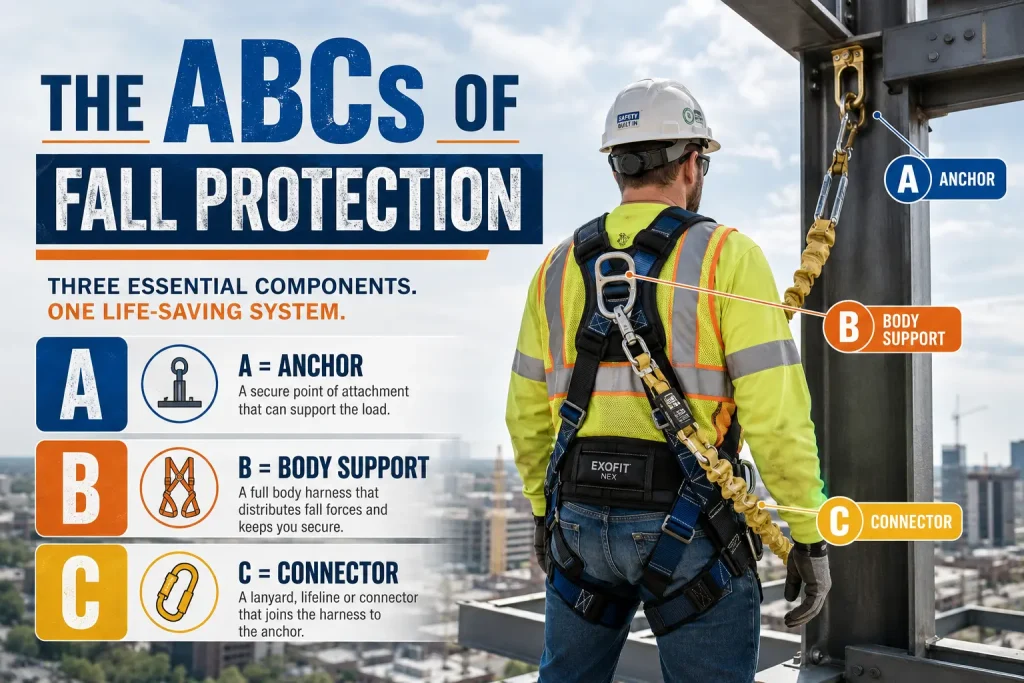
Every personal fall arrest system has exactly three components. All three must be present, compatible, and correctly configured for the system to work. Safety trainers use the ABCs because the framework makes this impossible to forget.
A: Anchorage
The structural connection point the entire system depends on. Requirements:
- Must support at least 5,000 pounds per attached worker, OR
- Must be designed by a qualified person as part of a complete fall arrest system with a safety factor of at least two
What does not qualify as an anchor point:
- Pipes and conduit not designed for lateral load
- Vent stacks and HVAC ducts
- Rebar cages or temporary formwork
- Any “convenient” attachment point that has not been evaluated
A certified anchor is not the same as a convenient one.
B: Body Wear
The full-body harness is the only OSHA-compliant body wear for personal fall arrest. Rules:
- D-ring must sit centered between the shoulder blades
- Leg and chest straps must be snug, with no more than two fingers of slack
- All hardware must be buckled, not just clipped
- Inspect the harness before every use (see Section 7)
C: Connecting Device
The lanyard, SRL, or rope grab linking the harness to the anchor. Critical matching rules:
- The connecting device must be rated for the anchor system it attaches to
- Free-fall distance must be calculated before selecting the device. A 6-foot shock-absorbing lanyard on a platform 8 feet off the ground does not provide enough clearance for full arrest before ground contact
- Connecting devices are single-use in the event of a fall. After arrest, the entire system is removed from service
6. How to Choose the Right Fall Protection System
No single system works everywhere. Run through these four questions before selecting equipment for any task.
Step 1: Identify the Hazard Type
Different hazards require different solutions:
- Leading edge or open-sided floor: Guardrail or PFAS
- Floor hole or opening: Hole cover or guardrail around the perimeter
- Fixed ladder: Vertical ladder safety system (required at 24 feet or taller)
- Confined space entry: Retrieval tripod or davit system
- Roof work: Guardrail, PFAS, or warning line system with safety monitor
Step 2: Calculate Working Height and Clearance
Before choosing a connecting device, calculate:
- Free-fall distance: Distance from D-ring to anchor point
- Deceleration distance: Up to 3.5 feet for shock-absorbing lanyards
- Worker height: Measured from feet to D-ring (approximately 6 feet for an average worker)
- Safety margin: At least 2 feet of clearance between the lowest point of the worker’s feet and any lower level
Total clearance needed = Free-fall distance + Deceleration distance + Worker height + Safety margin
If the total exceeds available clearance, switch to an SRL (which arrests within inches) or reposition the anchor point.
Step 3: Consider Worker Mobility
| Mobility Need | Recommended System |
|---|---|
| Stationary or limited movement | Fixed-length or shock-absorbing lanyard |
| Lateral movement across a long span | Horizontal lifeline |
| Continuous movement in all directions | Self-retracting lifeline (SRL) |
| Descent and rescue from confined space | Davit crane or retrieval tripod |
Step 4: Ask Whether a Passive System Is Feasible First
Before ordering harnesses, ask:
- Can a guardrail be installed here?
- Can this opening be covered?
- Can a restraint system keep workers away from the hazard entirely?
Active PPE is the fallback when passive systems are not feasible. It is never the first choice.
7. What a Written Fall Protection Plan Must Include
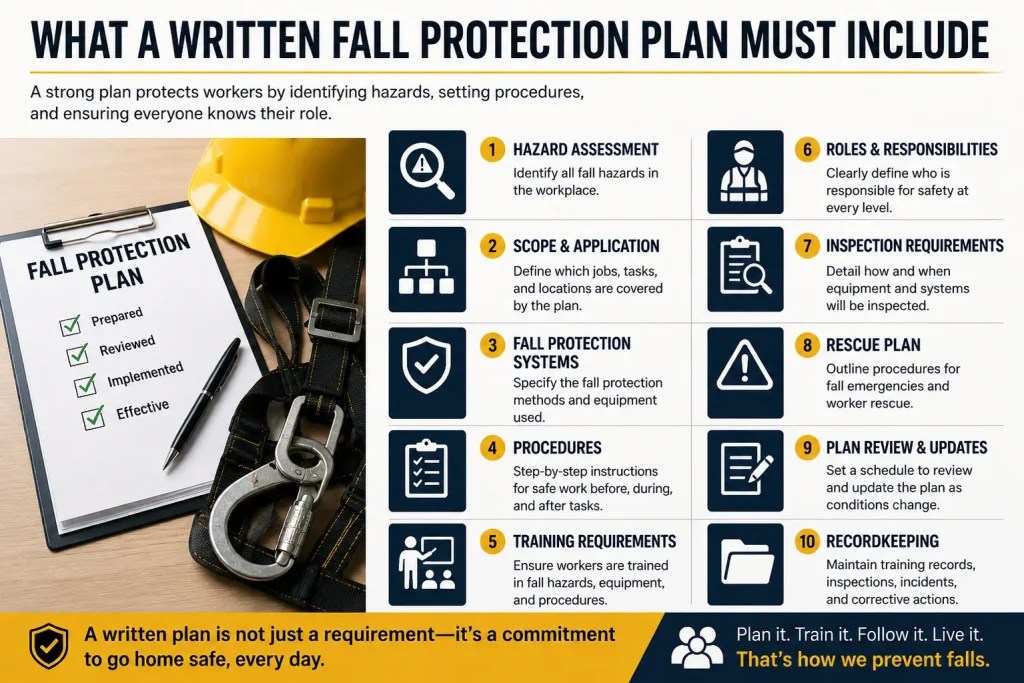
Most employers know they need equipment. Fewer know that OSHA mandates a written fall protection plan in specific situations, including certain residential construction and any worksite where conventional fall protection is not feasible.
When Is a Written Plan Required?
Under 29 CFR 1926.502(k), a written plan is required when:
- Conventional fall protection systems (guardrails, safety nets, or PFAS) are not feasible for the specific task
- Conventional systems would create a greater hazard than they prevent
What the Plan Must Contain
A compliant fall protection plan must document all of the following:
- Hazard locations: Each area where conventional fall protection cannot be used and the specific reason why
- Alternative measures: The exact alternative fall protection method used at each identified location
- Competent Person designation: The name and qualifications of the person responsible for implementing and updating the plan
- Emergency rescue procedure: A detailed step-by-step procedure for retrieving a fallen or suspended worker
- Training records: Documentation confirming each covered worker has been trained on the plan
Who Prepares It and Where It Lives
The plan must be prepared by a qualified person (not just a Competent Person — a qualified person has specific recognized credentials or professional judgment). It must be available on-site for OSHA inspection at any time.
The plan is a living document. If work conditions change, the plan must be updated before workers return to affected areas.
8. Fall Protection Training Requirements
You May Also Like It:
Workplace Safety Equipment: A Complete Guide to Protecting Your Team
What Is PPE? A Complete Guide to Personal Protective Equipment
Personal Protective Equipment: The Complete Guide to Staying Safe at Work
Types of Safety Equipment: A Complete Guide to Workplace Protection
Safety Equipment: The Complete Guide to Workplace Protection and PPE
Welding Safety Equipment: The Complete Guide
Training is not a checkbox. OSHA’s 29 CFR 1926.503 requires that every worker exposed to fall hazards be trained by a qualified person before that exposure occurs.
What Training Must Cover
Training must address all of the following:
- The nature of fall hazards specific to the work area
- Correct procedures for erecting, maintaining, and disassembling fall protection systems
- Correct use and operation of personal fall arrest systems, including donning a harness, connecting a lanyard, and identifying compliant anchor points
- Each employee’s role in the fall protection plan, including emergency rescue procedures
When Retraining Is Required
Retraining is mandatory when:
- A worker demonstrates inadequate understanding or incorrect use of fall protection equipment
- Work conditions change in a way that makes prior training insufficient
- Inspections or incident investigations reveal deficiencies in the fall protection program
Handing someone a harness and getting a signature on a form is not OSHA-compliant training. The training must be documented, task-specific, and delivered by someone with the qualifications to actually assess competence.
9. Inspecting and Retiring Equipment
OSHA requires a pre-use inspection of all fall protection equipment before each shift or use. In practice, this is one of the most consistently skipped safety steps on any worksite.
Pre-Use Inspection Checklist: Full-Body Harness
Webbing
- Run the entire length of webbing through your fingers — feel for cuts, abrasions, stiffness, or soft spots that are not visible
- Check for burns, chemical discoloration, or UV degradation (chalky or faded webbing)
- Any cut or fraying at a load-bearing point is grounds for immediate removal from service
Stitching
- Inspect all stitched connection points for broken threads, pulled stitching, or separation
- Pay extra attention to the D-ring attachment and leg strap junctions — these carry the highest load during arrest
Hardware
- Buckles, D-rings, snaphooks, and carabiners must be free of:
- Corrosion or rust
- Deformation or bending
- Sharp edges or burrs that could cut webbing
- Test each buckle by fastening and releasing under light hand tension
Labels and Tags
- If the manufacturer’s label is illegible, missing, or damaged, the harness is removed from service immediately
- Check the manufacture date against the manufacturer’s stated service life (typically 5 to 10 years)
Pre-Use Inspection Checklist: Lanyards and SRLs
- Check the snap hook for a fully functioning locking gate — test by attempting to open the gate with a single-finger press only
- Inspect the shock pack housing for deployment indicators — most lanyards have a visual indicator that shows if the pack has activated
- For SRLs: pull the cable out fully and release it. It should retract smoothly with consistent tension. Any jerking, sticking, or failure to retract fully means the unit is removed from service
When to Retire Equipment Immediately
Retire any piece of fall protection equipment when:
- It has arrested a fall. The internal deceleration mechanism is single-use by design. The equipment may look fine and still be structurally compromised.
- Webbing is cut, burned, or chemically damaged in any way, including areas that look minor
- Hardware shows deformation, corrosion, or locking failure of any kind
- The manufacturer’s service life has expired — date of manufacture is stamped on the label
- The label is missing or unreadable — there is no way to verify service life or specifications
Retired equipment must be destroyed before disposal. Cut the webbing. Dispose of the hardware. A retired harness left in a storage room will find its way back onto a worker.
10. The Real Cost of Non-Compliance
OSHA fines are not minor administrative penalties. They are calculated per violation, per day, and they escalate fast.
OSHA Penalty Structure (2024)
- Serious violations: Up to $16,131 per violation
- Willful or repeated violations: Up to $161,323 per violation
- Failure to abate: Up to $16,131 per day beyond the correction deadline
What “Per Violation” Actually Means
On a typical construction site, a single OSHA inspection might identify:
- No guardrails on an elevated platform (one violation per location)
- Workers without harnesses on a leading edge (one violation per exposed worker)
- No documented training records (one violation)
- Missing or inadequate fall protection plan (one violation)
Four findings at a mid-size site can reach $60,000 in serious violations before a single repeat or willful citation is added. A willful violation, where OSHA determines the employer knew about the hazard and chose to ignore it, carries the maximum penalty on each finding.
Beyond the Fine
- Stop-work orders: OSHA can halt all work on a project until violations are corrected. On a large commercial construction site, a single day of shutdown can cost more than the maximum OSHA fine.
- Workers’ compensation impact: A single fall fatality can trigger years of increased workers’ comp premiums across a company’s entire portfolio.
- Legal exposure: In serious injury or fatality cases, OSHA citations create a documented record of employer negligence that plaintiffs’ attorneys use in civil litigation.
The math is not close. Proper fall protection equipment and training cost a fraction of a single violation, let alone an injury.
Frequently Asked Questions
What does “fall protection” mean in simple terms?
Fall protection is any system or equipment used to keep workers safe when working at heights. It includes passive barriers like guardrails that stop falls from happening, and personal equipment like harnesses and lanyards that limit harm if a fall does occur.
At what height does OSHA require fall protection?
It depends on the industry: 4 feet in general industry, 5 feet in shipyards, 6 feet in construction, and 8 feet in longshoring. Height thresholds do not apply if a worker could fall onto dangerous machinery or into hazardous materials from any distance.
Is a guardrail considered fall protection or fall prevention?
A guardrail is fall prevention. It passively stops a fall by creating a physical barrier. Fall protection, in the strict sense, refers to active equipment like a harness and lanyard that the worker must engage for it to function.
Do I need a written fall protection plan?
In specific situations, yes. OSHA requires a written fall protection plan under 29 CFR 1926.502(k) when conventional fall protection systems are not feasible or would create a greater hazard. The plan must be written by a qualified person and kept on-site for inspection.
Can workers still use a body belt for fall arrest?
No. OSHA banned body belts as the sole means of personal fall arrest in 1998. They concentrate all arrest force on the abdomen, causing severe internal injuries. Only full-body harnesses are compliant for fall arrest applications.
How often does fall protection equipment need to be inspected?
At minimum, before every use. Any equipment that has arrested a fall must be immediately removed from service, regardless of visible condition. Equipment also has a manufacturer-specified service life, typically 5 to 10 years, after which it must be retired even if it appears undamaged.
Who is responsible for fall protection on a multi-employer worksite?
The employer of the exposed workers is primarily responsible. On multi-employer sites, OSHA can also cite the controlling employer (typically the general contractor) for fall hazards affecting subcontractor workers, even if the GC’s own employees are not exposed.
What is the difference between a lanyard and a self-retracting lifeline?
Both connect a harness to an anchor point. A shock-absorbing lanyard is a fixed-length cord (typically 6 feet) with a deceleration pack that deploys during a fall. A self-retracting lifeline uses an internal spool and braking mechanism that arrests a fall within inches rather than feet. SRLs require significantly less fall clearance and allow more freedom of movement.
Sources: U.S. Bureau of Labor Statistics (2022 Census of Fatal Occupational Injuries), OSHA 29 CFR 1926.501, 29 CFR 1926.502, 29 CFR 1926.503, 29 CFR 1910.28, National Safety Council Injury Facts 2023.
You May Also Like It:
New Balance Safety Shoes: The Complete Buying Guide
Safety Shoes Meaning: What They Are, How They Work, and Why They Matter
What Are Safety Shoes? Types, Standards, and How to Pick the Right Pair
Caterpillar Safety Shoes: The Complete Buyer’s Guide
Most Comfortable Safety Shoes: What Actually Makes a Difference (And What to Buy)
Safety Shoes UK: Everything You Need to Know Before You Buy (2026 Guide)