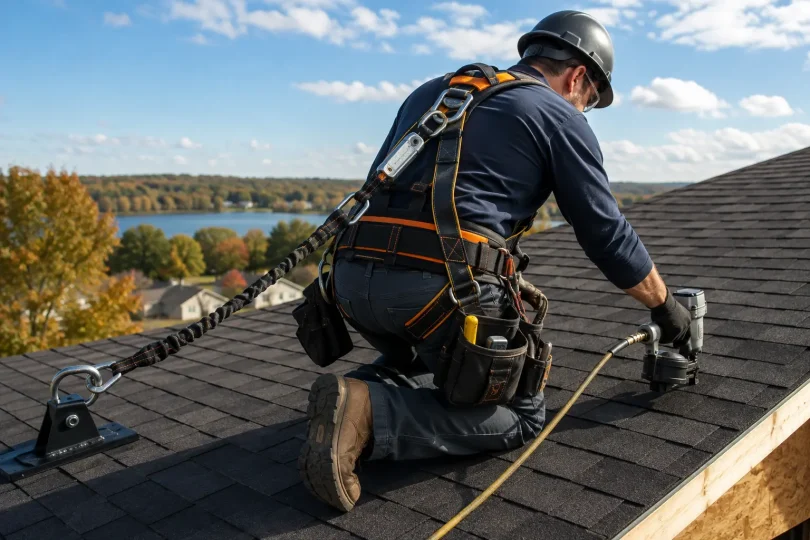

The best fall protection harness for roofers depends on the roof pitch and how long you’re up there. For most steep-slope residential roofers, a harness with a pre-sternal (chest-level) attachment ring, quick-connect leg buckles, and a 400 lb weight rating, such as the FallTech ComforTech or Guardian Fall Protection Series 3, offers the best mix of mobility and safety. For flat or low-slope commercial roofs, a simpler dorsal-ring harness like the DBI-SALA ExoFit is usually enough and costs less.
Ring Position Changes How You Work, Not Just How You Fall
Most buying guides mention “dorsal ring” and “pre-sternal ring” and move on. Here’s what that actually means on a roof.
A dorsal ring sits between your shoulder blades. It’s the standard OSHA-recognized attachment point and it’s what you’ll find on almost every entry-level harness. It works fine if you’re mostly walking a flat or low-slope roof and clipping into a single anchor.
A pre-sternal ring sits at your chest. Roofers working steep pitches prefer it for one practical reason: if you slip, you land facing the roof instead of getting flipped onto your back. That matters because a face-down position lets you grab the roof, brace with your knees, and self-arrest before the rope even goes tight. A dorsal-only harness on an 8:12 or 10:12 pitch often means you slide further before the system catches you.
There’s a tradeoff. Free fall distance with a pre-sternal ring must stay under 2 feet by OSHA rule (1910.140(c)(22)), which means your anchor point and rope length need more planning than a dorsal setup. If you’re not training your crew on this, don’t switch to pre-sternal rings just because a blog told you to. Untrained use of a pre-sternal ring without a tight rope is more dangerous than a properly used dorsal ring.
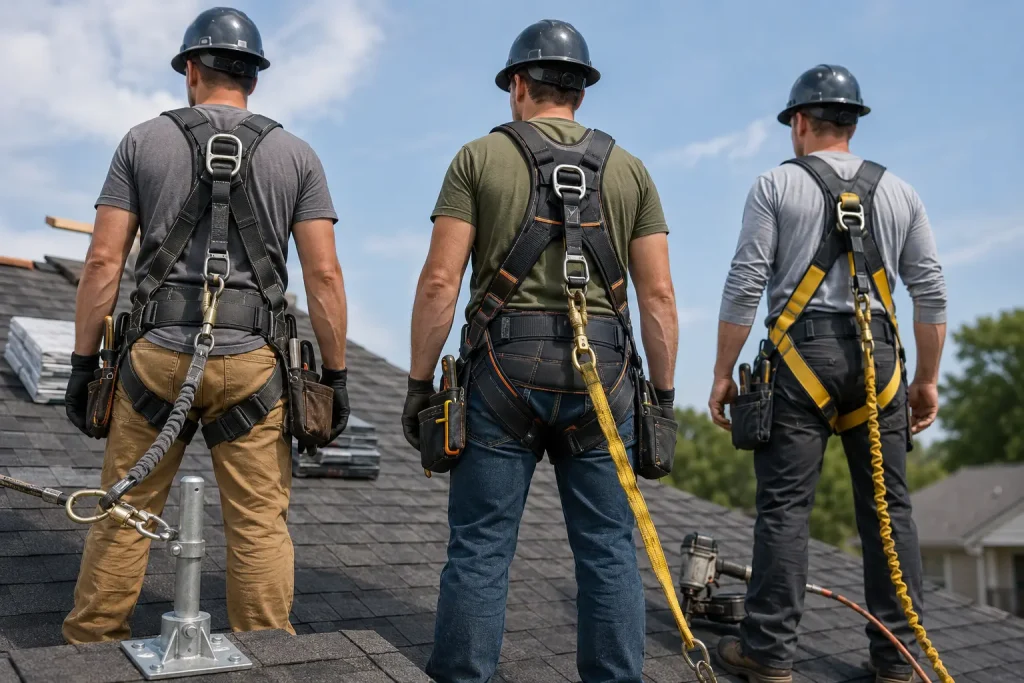
Comparison: Harnesses Built for Roof Work
| Harness | Ring Type | Best For | Price Range | Standard |
|---|---|---|---|---|
| FallTech ComforTech Roofer’s Kit | Dorsal + side D-rings | Steep-pitch residential, all-day comfort | $225-$245 | ANSI Z359.11, OSHA 1926.502 |
| Guardian Fall Protection Series 3 | Dorsal | Budget crews, new hires | $60-$90 | ANSI Z359.11 |
| 3M DBI-SALA ExoFit NEX | Dorsal + hip positioning D-rings | Solar installers, tool-heavy work | $280-$350 | ANSI Z359.11, OSHA 1926.502 |
| Super Anchor Mini MAX | Dorsal | Small-frame or younger workers | $160-$220 | ANSI Z359.11 |
| French Creek RKB | Dorsal | One-and-done kit buyers | $200-$230 | ANSI Z359.11 |
| Petzl Volt (pre-sternal setup) | Pre-sternal | Trained crews on steep or slate roofs | $350-$400 | CE EN 361 (not OSHA-certified alone) |
Picking by Roof Type, Not Just by Brand
Steep Pitch Residential (8:12 and Above)
Go with side D-rings in addition to the dorsal ring. On a steep roof you’ll often position yourself with a restraint lanyard rather than a full fall-arrest line, and side D-rings let you do that without unclipping your main line. The FallTech ComforTech kit includes these as standard, which is why it shows up on more steep-pitch crews than any other model.
Flat or Low-Slope Commercial
Skip the premium features. A basic Guardian or French Creek harness with a single dorsal ring covers you at a fraction of the cost. Commercial roofers usually tie into a horizontal lifeline system anyway, so the harness itself doesn’t need to do much beyond holding you securely if the anchor system does its job.
Solar Installation Work
Solar crews spend hours kneeling, crawling, and reaching to place panels, and a standard harness will dig into your hips after the first few hours. The DBI-SALA ExoFit NEX has padded hip positioning D-rings built for exactly this kind of repetitive, low-angle work. It costs more, but installers who switch rarely go back.
Hot Climate, All-Day Wear
If you’re roofing in Texas or Florida summers, mesh back panels aren’t a nice-to-have, they’re the difference between finishing the day and cutting it short from heat exhaustion. Look specifically for “breathable” or “mesh” in the product name, not just “lightweight,” since lightweight often just means thinner webbing, not better airflow.
The Weight Math Most Guides Skip
A harness rated for 400 lbs doesn’t mean you personally need to weigh under 400 lbs. That number is your body weight plus your tool belt, plus any gear hanging off your harness loops. A framer carrying a nail gun, extra fasteners, and a hammer can add 15-25 lbs before they even clip in. If you’re near the upper end of a harness’s rating, size up to a model rated for 420 or 450 lbs rather than assuming you have margin.
Inspecting Your Harness Before Every Shift
This step gets skipped more than any other part of roof safety, usually because crews are in a hurry to get on the roof. A two-minute check catches most failures before they become an incident.
- Run the webbing through your hands looking for cuts, fraying, or burn marks from rope friction
- Check stitching at every D-ring for pulled or broken threads
- Test every buckle by clicking it closed and pulling hard against it
- Look at the label for the manufacture date; most harnesses need replacement after 5 years even with no visible damage
- Flex the webbing near the leg straps; stiff, glossy sections often mean UV damage that won’t show as an obvious tear
Mistakes That Show Up on Real Job Sites
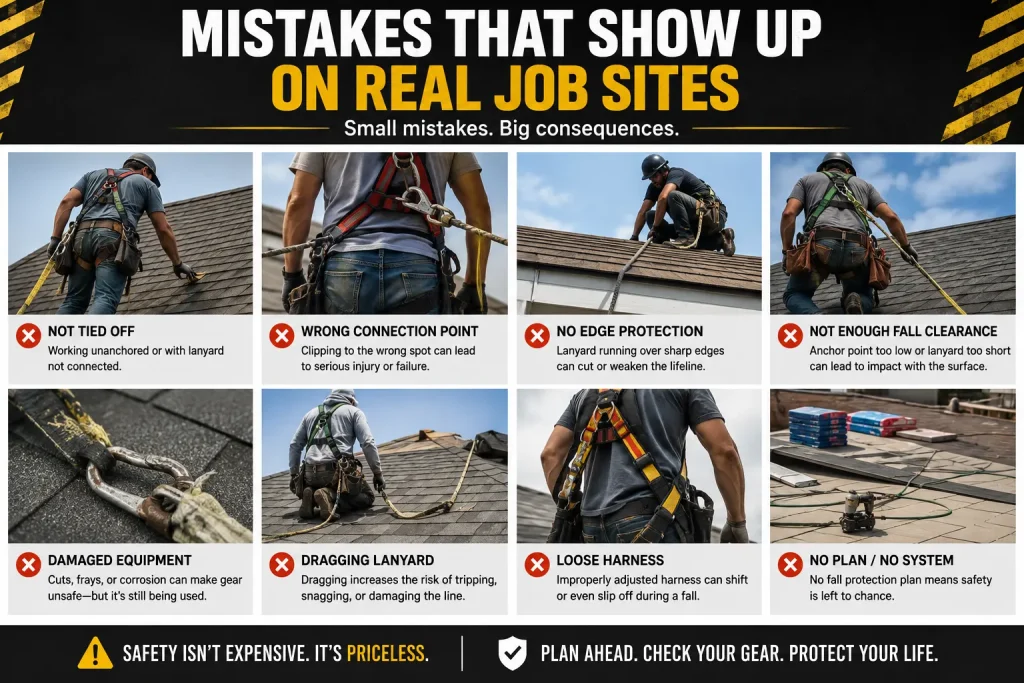
Twisted leg straps are the most common issue I’ve seen on crews that skip training. A twisted strap concentrates force on a narrow band of webbing during a fall instead of spreading it across your thigh, which increases injury risk even if the harness technically holds.
Another one: workers leaving a harness in a hot truck bed for months. UV exposure and heat break down webbing fibers from the inside, and you won’t see it until the harness fails a load test, or worse, fails during an actual fall. Store harnesses in a bag, out of direct sun, and rotate stock if you’ve got a fleet of them.
Last one, and it’s a big one: a dorsal ring attachment without a rescue plan. OSHA doesn’t just require you to stop a fall, it expects a prompt rescue. Hanging in a harness for more than several minutes can cause suspension trauma as blood pools in the legs. If your crew doesn’t have a way to get someone down fast, that’s a gap no harness fixes on its own.
Frequently Asked Questions
How much weight can a fall protection harness hold?
Most roofing harnesses are rated between 310 and 450 lbs, covering the worker’s body weight plus tools and gear. Check the label on the specific harness rather than assuming a standard number, since ratings vary by model.
Do I need a harness on a low-slope or walkable roof?
Under OSHA 1926.501, fall protection is required for construction work at 6 feet or higher regardless of slope. A low-slope roof still needs a harness, guardrail, or safety net system once you’re above that height.
Can I use the same harness for roofing and general construction?
Yes, most ANSI Z359.11 certified harnesses work across roofing, framing, and general fall protection tasks. The difference comes down to added features like side D-rings or hip padding that make specific tasks more comfortable, not the core safety rating.
How long does a safety harness last before it needs replacing?
Most manufacturers set a 5-year service life from the manufacture date, even without visible damage. Heavy daily use, UV exposure, or any harness that’s caught a fall should be retired sooner and inspected by the manufacturer if there’s any doubt.
What’s the difference between a fall arrest harness and a positioning harness?
A fall arrest harness is built to stop a fall in progress and absorb the shock. A positioning harness holds you in place while you work with both hands free, like leaning back against a lanyard on a slope, and isn’t designed to arrest a free fall on its own.
Is a full body harness required, or can I use a belt?
OSHA phased out body belts for fall arrest use decades ago because they concentrate force on the waist and can cause internal injury during a fall. A full body harness is required for any fall arrest application today.
What should I do if a harness has stopped a fall?
Take it out of service immediately, even if it looks undamaged. The webbing and stitching absorb shock in ways that aren’t always visible, and manufacturers generally require a full inspection or replacement after any fall arrest event.
Are cheaper harnesses under $100 actually safe?
If they carry ANSI Z359.11 certification, yes, budget harnesses like the Guardian Series 3 meet the same core safety standard as premium models. What you’re paying extra for in higher-end harnesses is comfort features, padding, and convenience, not a higher safety ceiling.
You May Also Like It:
Safety Equipment Inspection: A Practical Guide to What, When, and Who
What Is PPE? A Complete Guide to Personal Protective Equipment
Personal Protective Equipment: The Complete Guide to Staying Safe at Work