Falls are the leading cause of death in the construction industry. According to OSHA, falls account for roughly one-third of all construction fatalities every year. Yet most of these deaths are preventable with the right equipment, the right training, and the right habits.
Guardian Fall Protection has built a reputation over decades as one of the most trusted names in height safety. But owning Guardian gear is only half the job. Knowing how to choose it, fit it, inspect it, and use it correctly is what actually keeps you safe.
This guide covers everything: the full product lineup, OSHA requirements, step-by-step harness fitting, inspection checklists, and common mistakes that put workers at risk even when they are wearing a harness.
What Is Guardian Fall Protection?
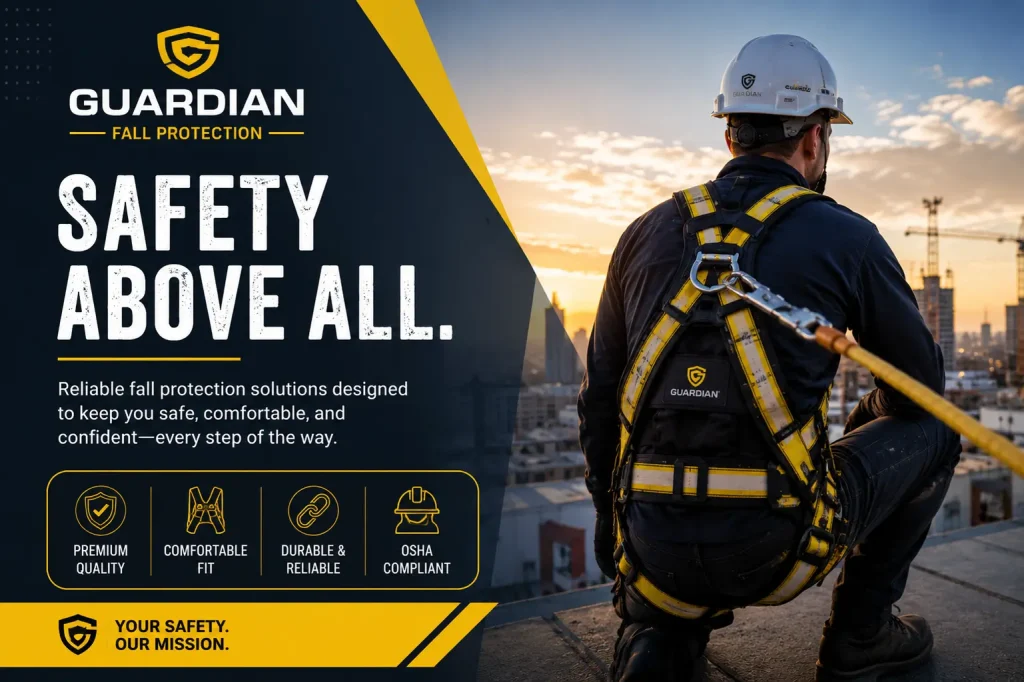
Guardian Fall Protection is an American manufacturer that designs and supplies personal fall protection equipment (PFPE) for workers in construction, roofing, utilities, telecommunications, and general industry. The brand offers one of the broadest product ranges in the fall protection market, from entry-level harnesses and lanyards to sophisticated self-retracting lifelines (SRLs) and digital safety management systems.
Guardian products meet or exceed ANSI Z359 standards and are OSHA-compliant. They are sold through major retailers including Home Depot and Northern Tool, as well as through specialist safety distributors.
What sets Guardian apart from generic fall protection brands is its depth: engineered systems designed to work together, rather than a collection of standalone pieces. That matters because a fall protection system is only as strong as its weakest link.
Understanding Fall Protection: The Basics Before You Buy
Before diving into products, it helps to understand what fall protection actually does and how it works. Most people think of a harness as the whole system. It is not. A complete fall protection system has three components:
- The anchor point: Where the system attaches to the structure. It must support at least 5,000 pounds per attached worker, or twice the maximum arrest force, if engineered.
- The connecting subsystem: The lanyard, SRL, or rope grab that links the harness to the anchor.
- The full-body harness: The garment worn by the worker that distributes arrest forces across the body.
All three must be compatible and properly installed. Guardian designs its products to work as integrated kits, which is one reason its complete systems are popular with site supervisors who want less room for error.
Fall Arrest vs. Fall Restraint: Know the Difference
This distinction trips up a lot of workers and even some supervisors.
Fall restraint: stops you from reaching the fall hazard. The lanyard is short enough that you physically cannot get to the edge. No fall occurs, so no arrest forces are generated. This is the preferred approach where it is feasible.
Fall arrest: catches you after a fall has begun. Arrest forces can reach 1,800 pounds on the body during a fall, which is why proper harness fit and a certified connecting subsystem are non-negotiable.
Guardian offers products for both applications. Choosing the right system for your specific task is not optional: using a fall-arrest lanyard where a restraint lanyard is needed, or vice versa, creates risk rather than eliminating it.
Guardian Fall Protection Product Lines: What Is Available and What It Does
Full-Body Harnesses
Guardian’s harness catalog ranges from basic, single D-ring models to advanced harnesses with built-in padding, tool loops, and multiple connection points. Key product families include:
Seraph Series: Entry-level, designed for general construction. Lightweight and affordable. Good for workers new to height work or occasional-use situations.
Velocity Series: Mid-range with added comfort features including a padded waist belt and back pad. Suited for workers spending extended time in the harness.
Fusion Series: Upper-tier harnesses with a focus on ergonomics and mobility. Popular with iron workers and workers in confined spaces who need full range of motion.
Tux Series: A premium option with a streamlined, low-profile design. Built for workers in elevated aerial lifts and environments with overhead obstacles.
When choosing a harness, consider:
- How long the worker will wear it each day (comfort matters more than you think)
- The number and position of D-rings needed for the task
- Weight capacity (most Guardian harnesses are rated to 310 pounds; heavy-duty models go to 400 pounds)
- The work environment (electrical hazard-rated harnesses exist for utility work)
Self-Retracting Lifelines (SRLs)
SRLs, sometimes called retractable lanyards or fall limiters, automatically take up slack as the worker moves. If a fall occurs, the unit locks within inches and arrests the fall with significantly less force than a shock-absorbing lanyard.
Guardian SRLs come in three broad categories:
Web SRLs: Lighter weight, often used for roofing and general construction. Guardian’s Halo and Rebel series are popular choices.
Cable SRLs: More durable and abrasion-resistant, suited to steel erection and environments where the lifeline may contact sharp edges.
Leading-Edge SRLs: Specifically engineered for use at or near the leading edge of a structure where standard SRLs cannot be used safely. These are a distinct and important category: a standard SRL used at a leading edge can fail catastrophically. Always check the rating before use.
Shock-Absorbing Lanyards
These are the Y-shaped or single-leg lanyards with a built-in deceleration pack. When a fall occurs, the pack tears open in a controlled way, extending the stopping distance and reducing peak arrest force.
Key spec to know: OSHA requires a maximum arrest force of 1,800 pounds. A shock-absorbing lanyard, when properly used, keeps forces well below that. A non-shock-absorbing lanyard does not.
Guardian offers 6-foot single-leg and 6-foot Y-leg (twin-leg) shock-absorbing lanyards in both web and wire rope constructions. Y-leg lanyards allow 100% tie-off, meaning one leg remains connected while the other is being moved to a new anchor. This is required when continuous fall protection is necessary.
Anchor Points and Horizontal Lifelines
A Guardian harness connected to a faulty anchor is no safer than no harness at all. Guardian manufactures a range of anchor devices:
Roof anchors: Temporary anchors that attach to roof sheathing or structural members. Guardian’s Eagle and Peak series roof anchors are among the most widely specified for residential construction.
D-bolt anchors: Permanently installed anchors for concrete, steel, or wood structures.
Portable horizontal lifeline systems: A cable or webbing line stretched between two anchor points, allowing multiple workers to travel along its length. Guardian’s Guardian Glider and Centurion systems are common on commercial construction sites.
Parapet clamps: For work near the edge of flat roofs where no structural penetration is possible.
Fall Protection Kits
For contractors, site supervisors, and workers new to fall protection, Guardian’s pre-configured kits remove much of the guesswork. A typical Guardian kit includes a harness, a lanyard or SRL, and a bag. Some kits also include a roof anchor and instructions.
Kit buyers should verify that all components in the kit are rated for the same use case. A kit that includes a standard SRL but is intended for roofing work near a leading edge, for example, may not be safe for that application without additional review.
OSHA Fall Protection Requirements: What the Law Actually Requires
OSHA’s fall protection standard for construction (29 CFR 1926 Subpart M) requires fall protection whenever a worker is exposed to a fall of 6 feet or more to a lower level. For general industry (29 CFR 1910 Subpart D), the threshold is 4 feet.
Key OSHA requirements that affect Guardian product selection and use:
Anchor strength: Anchor points must support at least 5,000 pounds per attached worker, or be part of a professionally engineered system with a safety factor of at least 2.
Maximum arrest force: No more than 1,800 pounds of force can be applied to a worker during a fall arrest. This is why shock-absorbing lanyards and properly rated SRLs are required for most applications.
Free-fall distance: OSHA limits free fall to 6 feet, or to the point where the worker contacts a lower level, whichever is less. Calculating free-fall distance correctly is critical when selecting a lanyard or SRL.
Swing falls: If a worker is positioned to the side of their anchor rather than directly below it, a pendulum swing can occur during a fall, potentially swinging the worker into a structure. Anchor positioning must account for this.
Competent person: OSHA requires a competent person to supervise fall protection installation and to train workers on the hazards and equipment. Guardian offers training materials and resources to support this requirement.
How to Properly Fit a Guardian Harness: Step-by-Step
An improperly fitted harness can cause serious injury during a fall arrest, even if every other part of the system is correct. Follow these steps every time a harness is put on, especially if it has been adjusted by someone else.
Step 1: Hold the harness by the back D-ring
Shake it out so all straps are untangled. The D-ring should be at the top.
Step 2: Slip both arms through the shoulder straps
The chest strap should sit across the chest, not the throat or the stomach.
Step 3: Connect the leg straps
Thread each leg strap through the appropriate buckle. Do not cross left and right leg straps.
Step 4: Adjust the chest strap
The chest strap should sit at mid-chest level. It should be snug enough that you can slide only two fingers underneath it.
Step 5: Adjust the shoulder straps
The back D-ring should sit between the shoulder blades, not at the base of the neck or in the middle of the back.
Step 6: Adjust the leg straps
Leg straps should be snug but not cutting off circulation. You should be able to fit two fingers between the strap and your thigh.
Step 7: Check all buckle connections
Every buckle should be fully engaged. Tug each strap to confirm the buckle does not release under tension.
Step 8: Perform a buddy check
Have a coworker look at the harness from behind. Confirm the D-ring is centered and at the right height, no straps are twisted, and all buckles are closed.
A harness that fits correctly feels firm but not restrictive. If movement causes the D-ring to drift significantly from center, the shoulder straps need adjustment.
How to Inspect Guardian Fall Protection Equipment
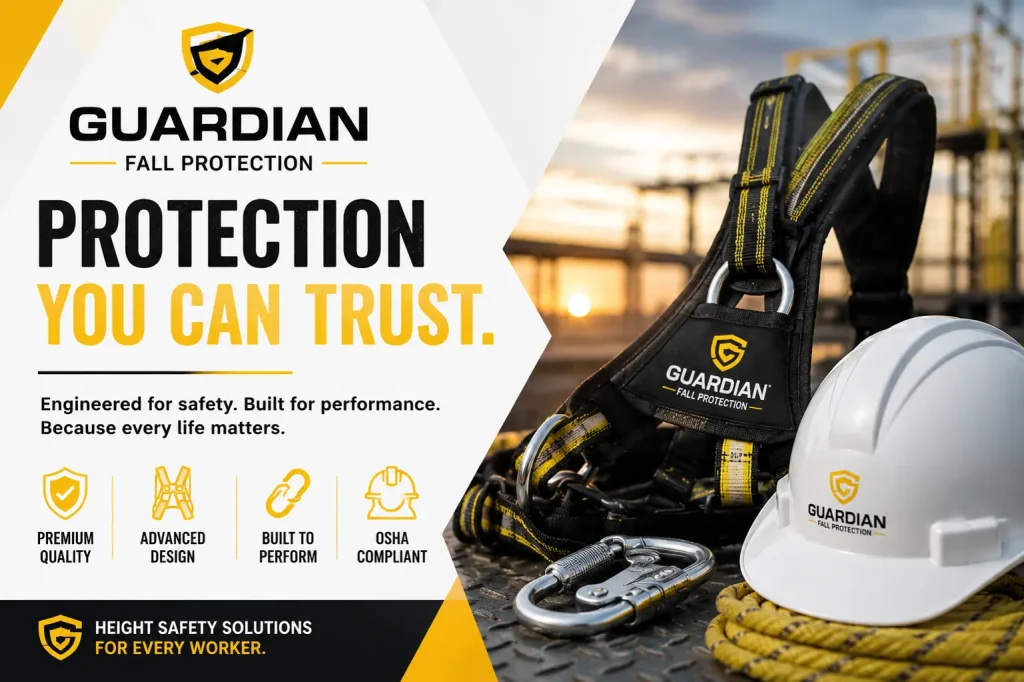
OSHA requires equipment to be inspected before each use by the person wearing it, and periodically by a competent person. Guardian recommends the following pre-use inspection process.
Harness Inspection
Check the webbing by gripping it between your thumbs and bending it into a U shape. Look for:
- Cuts, tears, or abraded areas
- Discoloration from chemical exposure (bleaching or staining can indicate chemical degradation)
- Broken or frayed fibers
- Mold or mildew (a sign of improper storage)
Check all hardware:
- Buckles and rings should move freely and show no cracks, distortion, or corrosion
- D-rings should not wobble excessively or have rough edges that could cut webbing
- Labels should be legible (Guardian harnesses carry manufacture date and inspection records on a label sewn into the harness)
Lanyard Inspection
For web lanyards: inspect the full length of webbing using the same bend-and-examine technique as the harness.
For cable lanyards: look for broken wires, kinks, and corrosion. Run your hand along the cable using a rag or glove to catch broken wire ends.
For shock-absorbing packs: the pack should be intact with no signs of deployment. A partially deployed pack must be removed from service immediately. Do not attempt to repack or reuse a deployed shock absorber.
SRL Inspection
Pull the lifeline out to full extension and inspect for damage. Release it slowly and verify that it retracts smoothly. Tug sharply on the lifeline to confirm the locking mechanism engages.
When to Retire Equipment
Guardian equipment must be removed from service if:
- It has arrested a fall (even if it looks undamaged)
- Inspection reveals any of the defects listed above
- The manufacturer date exceeds the service life limit (typically 10 years from manufacture date for harnesses and lanyards; check the product label and user manual)
- The equipment has been exposed to chemicals or extreme heat
Write the retirement date on retired equipment and store it separately from active equipment to prevent accidental reuse. Cutting the harness straps before disposal is good practice.
Common Mistakes That Make Guardian Gear Less Safe
Good equipment used incorrectly provides a false sense of security. Here are the mistakes safety professionals see most often on job sites.
Not accounting for total fall clearance.
Workers often focus on their lanyard length and forget to add the deployment distance of the shock absorber (up to 3.5 feet), the D-ring height above the ground, and any SRL slack. Total clearance must be calculated before selecting a system. If clearance is insufficient, the worker could contact the lower level even with the system engaged.
Using the wrong SRL for the task.
Standard SRLs are not rated for leading-edge use. Using one in that application can result in the cable cutting on the edge during a fall, destroying the unit before it can arrest the fall.
Attaching to the wrong D-ring.
Full-body harnesses have multiple D-rings for different purposes. The back D-ring is for fall arrest. Chest D-rings are for positioning or confined-space retrieval, not arrest. Side D-rings are for positioning. Attaching a fall-arrest lanyard to the wrong D-ring can cause severe injury.
Clipping a snap hook back to its own lanyard.
This is called back-hooking or rollout, and it can cause the gate to open during a fall. Always connect snap hooks to rated anchor hardware, not to webbing or rope.
Not inspecting equipment after storage.
Harnesses stored in vehicles are exposed to UV, temperature extremes, and chemicals. Many workers inspect equipment at purchase and then assume it is fine indefinitely. Regular inspection is not optional.
Sharing harnesses without readjusting.
A harness adjusted for a 5-foot-8-inch worker will not fit a 6-foot-2-inch worker correctly, even if both are within the rated weight range. Always adjust and check the fit personally before each use.
Choosing the Right Guardian Fall Protection System for Your Job
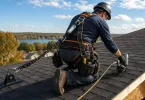
Roofing Work
For residential and commercial roofing, look for:
- A roof anchor that matches the substrate (sheathing, rafter, or structural steel)
- A leading-edge rated SRL if work takes place at the roof edge, or a shock-absorbing lanyard with sufficient clearance
- A harness with a tool belt or tool loops to keep hands free
Guardian’s Own The Roof kit collection is specifically designed for roofers and is a practical starting point.
Steel Erection
Steel work demands durability and 100% tie-off. Look for:
- A cable SRL rated for the span and substrate
- A Y-leg lanyard for continuous attachment during transitions
- A harness with multiple D-rings for positioning as well as arrest
Aerial Lift Work (Scissor Lift, Boom Lift)
OSHA requires workers in aerial lifts to be tied off to the basket, not to an external structure. Specific requirements:
- A body belt or harness (full-body harness preferred)
- A lanyard short enough that the worker cannot be ejected from the basket
- The anchor must be within the basket
Guardian makes scissor-lift specific lanyards and positioning systems for this application.
Confined Space Entry
Confined space rescue involves retrieval, not just fall arrest. Equipment needs include:
- A harness with chest D-ring and shoulder D-rings for vertical retrieval
- A retrieval system (tripod and winch) separate from the fall arrest system
- Confined-space-rated connecting devices
Utility and Electrical Work
Electric utility workers need harnesses rated for electrical hazard (EH). Look for the EH label on the harness and all hardware. Standard construction harnesses are not rated for this environment.
Caring for and Storing Guardian Equipment
Proper storage extends the service life of fall protection equipment and keeps it reliable.
Clean equipment with mild soap and warm water. Do not use solvents, bleach, or abrasive cleaners. Rinse thoroughly and allow to air dry completely before storage.
Store away from UV light
Direct sunlight degrades nylon and polyester webbing faster than almost any other factor. Store harnesses and lanyards in a bag or cabinet, not hanging on a peg in a south-facing window.
Keep away from heat and chemicals
Engine compartments, truck beds in summer, and areas near chemicals or solvents are all bad storage environments.
Do not store wet
Moisture promotes mildew, which degrades webbing. If equipment gets wet on the job, hang it to dry before storing.
Document inspection and use
Guardian harnesses have an inspection and service log on the inside label. Fill it in. It provides a clear record if questions arise about equipment history, and it is required practice for OSHA compliance.
Guardian OS: The Digital Layer Most Articles Miss
Guardian Fall Protection launched Guardian OS, a connected ecosystem that brings data collection and monitoring to height safety. On sites using Guardian OS-compatible SRLs and sensors, site supervisors can track:
- Which workers are tied off at any given time
- How often and for how long fall protection equipment is used
- Equipment inspection records digitally
This is increasingly relevant on large commercial projects where manual compliance tracking is difficult to sustain. It is not a replacement for trained competent persons, but it adds a documentation layer that benefits both workers and employers in the event of an incident investigation.
Not many competitor articles mention this capability, but for site safety managers and general contractors looking at Guardian for large-scale projects, it is worth evaluating.
Frequently Asked Questions
How long does a Guardian harness last?
Guardian harnesses have a maximum service life of 10 years from the date of manufacture, provided the equipment passes inspection. The manufacture date is printed on the label sewn inside the harness. In harsh environments with heavy use, harnesses often need replacement sooner.
Can I use a Guardian harness after a fall?
No. Any harness that has arrested a fall must be removed from service immediately, regardless of visible condition. The webbing and hardware experience stress during arrest that may not be visible but makes the equipment unreliable for future falls. Tag it, bag it, and replace it.
What is the weight limit for Guardian harnesses?
Most Guardian harnesses are rated to 310 pounds. Some models, specifically labeled as heavy-duty or XL/XXL, are rated to 400 pounds. Always check the product label. Exceeding the weight limit is dangerous and voids the equipment warranty.
Do I need a permit to install a permanent anchor point?
In most jurisdictions, permanent anchor installation requires a licensed engineer to design the system and sign off on the installation. Requirements vary by location, so check with your local authority having jurisdiction (AHJ). Guardian supplies engineering data for its anchor products to support this process.
Can I mix Guardian harnesses with non-Guardian lanyards and anchors?
Yes, as long as all components meet ANSI Z359 standards and are rated for the same application. However, using components from the same manufacturer’s system reduces compatibility risk and simplifies inspection and documentation.
What is the difference between a Class I and Class II harness?
Guardian, like most manufacturers, follows ANSI designations. Class II designates a full-body harness suitable for fall arrest. Class I refers to body belts, which OSHA only allows for positioning (not fall arrest) in most construction applications. For fall arrest, always use a full-body harness.
Summary: What to Remember
Guardian fall protection equipment is among the most specified in North America for good reason: the product range is broad, the quality is consistent, and the systems are designed to work together. But no brand name makes bad habits safe.
To use Guardian fall protection effectively:
- Understand the three-component system and ensure all parts are compatible and rated for your task
- Fit the harness correctly every single time, and verify with a buddy check
- Inspect equipment before each use and remove anything questionable from service
- Calculate total fall clearance before selecting a lanyard or SRL
- Train every worker, not just supervisors, on the equipment they use
- Store equipment properly to protect its rated service life
Falls are preventable. The equipment exists. The standards are clear. The only variable is whether workers and employers treat fall protection as a genuine safety system or a compliance checkbox. Guardian provides the tools. The rest is up to the people using them.
You May Also Like It: