
Skylight Screen vs Cover vs Guardrail
Walk into any conversation about rooftop safety and these three terms get used like they mean the same thing. A contractor asks for a “skylight cover,” a supplier sends a screen, and a safety manager writes “guardrail” on the compliance checklist. On paper, all three protect workers from falling through a skylight. In practice, they are built differently, installed differently, and OSHA treats them differently on an inspection.
Mixing these up is not just a vocabulary problem. Ordering the wrong product for your roof can mean paying for a system that does not meet load requirements, blocks light you needed to keep, or does not fit your skylight’s geometry at all. This guide breaks down exactly what separates a screen, a cover, and a guardrail, and which one actually belongs on your roof.
The Short Answer
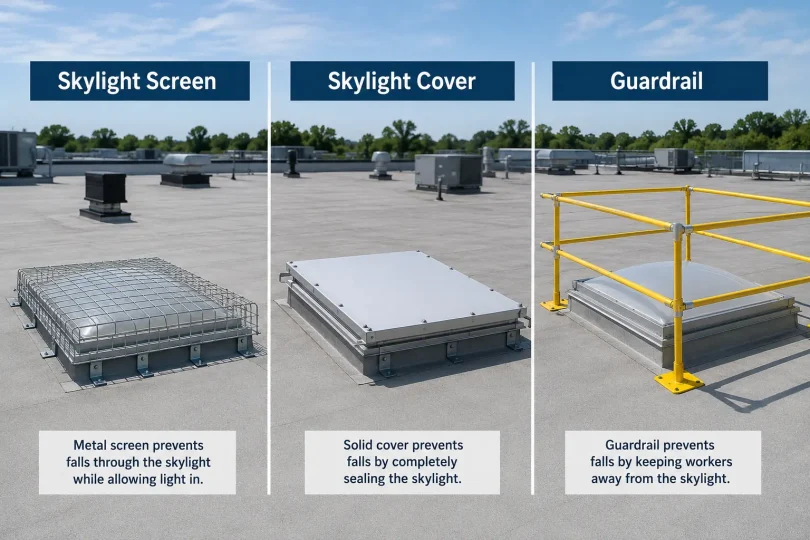
- Skylight screen: A mesh or grillwork barrier installed over or around the skylight. It stops a fall but is not always designed to be walked on.
- Skylight cover: A solid, rated panel placed directly over the opening. It is designed to be walked on and support full weight.
- Skylight guardrail: A perimeter railing installed around the skylight. It keeps workers away from the hazard entirely rather than covering it.
All three can satisfy OSHA’s skylight fall protection requirements under 29 CFR 1926.501(b)(4), but they solve the problem in different ways, and OSHA’s testing requirements differ for each.
Skylight Screens: Barrier, Not Always a Walking Surface
A skylight screen is typically wire mesh or grillwork stretched across a frame and mounted over the skylight curb. It is the most common solution on flat commercial roofs because it lets light through while physically blocking a fall.
What it is built for: Preventing a worker from stepping or falling into the skylight opening. Most screens are not intended as a walking surface for routine foot traffic, even though they can arrest a fall if someone steps on one accidentally.
Construction: Screens use grillwork with openings no more than 4 inches by 4 inches, or slatwork with openings no more than 2 inches wide, matching the strength requirements of a standard cover.
Where it works best: Roofs with multiple skylights where you want a permanent, low-profile, light-preserving solution and workers are not expected to stand directly on the opening as part of their routine tasks.
Where it falls short: If your crew needs to actively work, kneel, or stage equipment directly on top of the skylight opening, a lightweight screen may not be the right call. Check the manufacturer’s load rating before assuming a screen can double as a work platform.
Skylight Covers: Built to Be Walked On
A skylight cover is a solid, rated panel, usually polycarbonate, fiberglass, or steel grating, secured directly over the opening. Unlike a screen, a cover is engineered specifically to support the weight of a worker standing, kneeling, or setting tools on it.
What it is built for: Full weight-bearing protection. Under 29 CFR 1926.502(i), a cover must support at least twice the maximum intended load, be secured against displacement, and be marked with “HOLE” or “COVER.”
Construction: Covers are rigid and solid rather than mesh. Many are opaque or semi-opaque, which means they block more light than a screen, a tradeoff worth considering if the skylight is there for daylighting.
Where it works best: Active maintenance access routes, roofs where crews regularly walk directly over the skylight location, and temporary situations during construction or roof replacement where the skylight itself has not been installed yet.
Where it falls short: Permanent covers block daylight, which defeats the purpose of the skylight for the building’s interior. They also need to be clearly marked and periodically re-inspected for cracking, warping, or loosened fasteners.
Skylight Guardrails: Keep Workers Away From the Hazard Entirely
A guardrail does not touch the skylight opening at all. Instead, it creates a physical perimeter around the skylight, typically 42 inches tall with a mid-rail and toeboard, so a worker cannot reach the hazard zone in the first place.
What it is built for: Preventing access rather than arresting a fall. This makes it the only one of the three options that does not require any load testing on the skylight itself.
Construction: Top rails must withstand 200 pounds of outward or downward force, with mid-rails positioned at the halfway point between the top rail and the walking surface. Non-penetrating, weighted-base versions are available for membrane roofs where drilling is not an option.
Where it works best: Large dome or pyramid skylights where a direct cover or screen is impractical, smoke vents, and areas where workers need regular access near the skylight for maintenance without stepping onto it.
Where it falls short: Guardrails need roof space. On a tightly packed roof with several skylights close together, a guardrail around each one may not physically fit, and you may need to fall back on screens or covers instead.
Side-by-Side Comparison
| Factor | Skylight Screen | Skylight Cover | Skylight Guardrail |
|---|---|---|---|
| Walkable surface | Not always | Yes, when rated | N/A (perimeter, not a cover) |
| Blocks daylight | Minimal | Significant | None |
| Roof space needed | Low | Low | Higher |
| Best for | Passive, permanent barrier | Active foot traffic, temporary work | Large or clustered skylights |
| OSHA marking required | Recommended | Required (“HOLE”/”COVER”) | N/A |
How to Choose Between Them
Three questions usually settle it:
Will workers stand directly on top of the skylight? If yes, you need a rated cover, not a screen. A screen that is not built as a walking surface can still fail under sustained foot traffic even if it stops a straight-down fall.
Does the skylight need to keep letting light through? If daylighting matters for the space below, a screen or guardrail preserves more light than a solid cover.
Is there room around the skylight for a perimeter? Guardrails need clearance. On a crowded roof with skylights spaced close together, screens or covers are usually more practical.
Many facilities end up using a mix. Screens on skylights along walkways, guardrails around large dome units near mechanical equipment, and temporary covers during roof work or replacement.
A Common Misconception
Some crews assume that once a skylight has any barrier over it, they are compliant. That is not accurate. OSHA does not just require the presence of a product, it requires the product to meet the load, marking, and securement standards for its category. A screen sold as a “fall barrier” that has not been rated as a walking surface does not become a cover just because it sits over the hole. If your team plans to walk on it, confirm the manufacturer’s load rating in writing before assuming it qualifies.
Frequently Asked Questions
Q: Can a skylight screen replace a guardrail?
A: Yes, in most cases a screen satisfies the same OSHA requirement as a guardrail because both are recognized methods under 29 CFR 1926.501(b)(4). The choice usually comes down to roof layout and whether you want to preserve daylight, not a compliance gap between the two.
Q: Is a skylight cover always better than a screen?
A: Not necessarily. A cover is better when workers need to walk directly on the opening, but it blocks more light and is heavier to install and maintain. A screen is often the better long-term choice when the goal is passive protection without losing daylight.
Q: Do guardrails need to be inspected as often as covers?
A: Yes. Guardrail posts and bases can loosen or shift over time, especially non-penetrating weighted systems exposed to wind. They need the same monthly and pre-task inspection routine as covers and screens.
Q: Can I combine a screen and a guardrail on the same skylight?
A: Yes, and it is common on high-traffic roofs. A screen provides constant passive protection, while a guardrail around the perimeter adds a visible warning zone before a worker even reaches the skylight.
Key Takeaways
- Screens block a fall but are not always rated to be walked on. Check the manufacturer’s load rating before treating one as a work surface.
- Covers are solid, rated panels meant to be walked on, but they block more daylight than screens.
- Guardrails keep workers away from the skylight entirely and need roof space, which makes them less practical on tightly clustered skylights.
- All three can meet OSHA’s requirements under 29 CFR 1926.501(b)(4), but each has different construction, marking, and inspection standards.
- The right choice depends on foot traffic, daylight needs, and available roof space, not just what a supplier happens to stock.
For the complete breakdown of OSHA’s skylight fall protection requirements, installation steps, and inspection schedules, see our full guide on skylight fall protection.