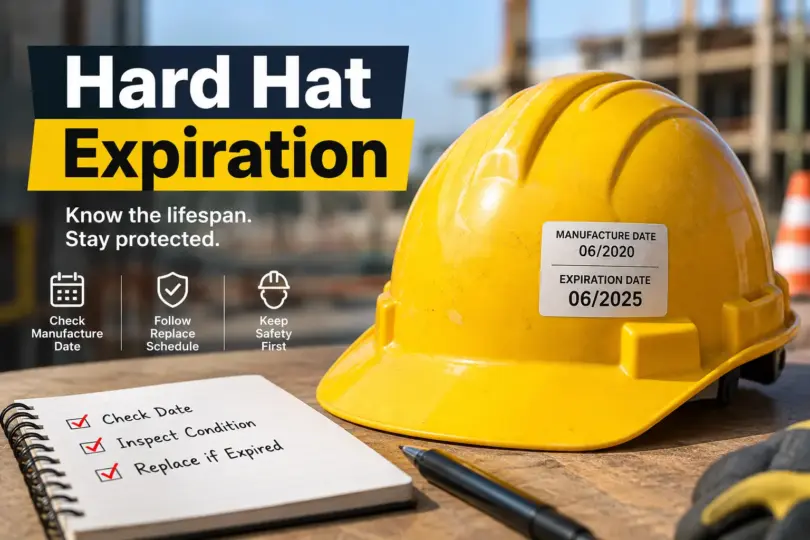

I have picked up plenty of hard hats that looked fine and should have been in the bin years ago. The plastic doesn’t announce when it has gone bad. This guide shows you how to read the date, which clock to trust, and what to look for on the days the calendar can’t help you.
OSHA doesn’t set an expiration date for hard hats, so the manufacturer’s instructions decide. Most makers give the shell a maximum of 5 years and the suspension 12 months. Heavy sun, heat, chemicals or any serious impact can end a hard hat’s life much sooner.
How to Read the Date Stamp Under the Brim
Flip the hat over and look at the underside of the brim. You’ll find a small clock-style dial molded into the plastic.
Here is how I read it:
- Center number: the last two digits of the year the shell was made.
- Arrow: points to the month, numbered 1 to 12 like a clock face.
- Example: a 24 in the middle with the arrow on 3 means March 2024. A 5-year limit would put the end date at March 2029.
The suspension carries its own month and year stamp, usually on the headband or webbing. Check both. I have seen a 2022 shell wearing a suspension from 2019, which means someone swapped parts and never wrote anything down.
Which Clock Do You Follow: Manufacture Date or First Use?
Manufacturers don’t agree on this, and most articles skip it. Some count the 5 years from the manufacture date. Others, MSA among them, count from the day the hat first went into service.
My rule: read the instruction sheet for your exact model. If you can’t find it, count from the manufacture date. That is the safer reading, and it costs you a few months at most.
If your maker does count from first use, write the in-service date inside the shell with a marker or a label. Otherwise you’ll replace good hats early or keep old ones too long.
Why the Shell Ages Out Before the Date Does
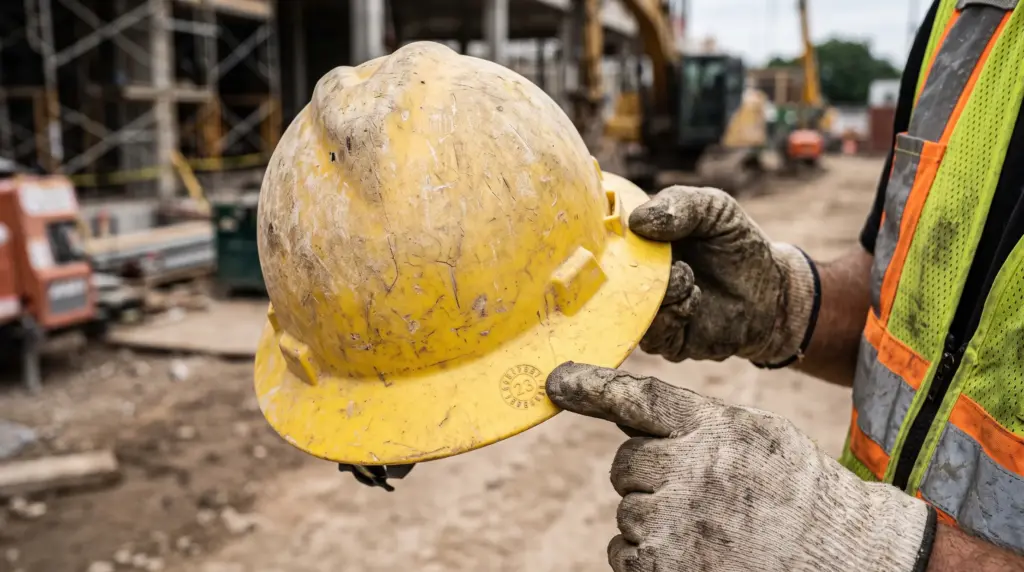
The date on the stamp assumes gentle use. Most sites aren’t gentle.
- UV light: sunlight breaks down polymer chains in the shell. The surface goes chalky, dull or faded, and the brim loses its springiness.
- Heat: a hat left on a dashboard or rear window shelf can sit at temperatures far above anything it sees on a head. I see this constantly in site trucks.
- Chemicals: solvents, fuel, paint thinner and some cleaners soften or craze the plastic, often without any obvious mark.
- Cold: in freezing conditions some shells get brittle, which matters if the hat takes a knock.
Shell material matters too. Polyethylene shells tend to show UV wear as chalking, while other materials may show fine cracks or color change instead. Your manufacturer’s sheet tells you which signs to expect.
What Counts as an Impact (and Why a Clean-Looking Hat Still Fails)
The shell works by absorbing and spreading force. That job damages the structure even when nothing shows on the surface.
These are the events I treat as “retire it”:
- Falling object strike: a tool, a bolt or a chunk of debris hitting the crown.
- Fall from height: a hat that drops from a scaffold, lift or ladder onto concrete.
- Heavy bump: a hard knock against a beam or pipe that rattled your head.
- Crushing: a hat run over, sat on, or stacked under heavy gear in a truck bed.
Most people do the right thing after a big hit and then ignore the small ones. Don’t. If you’re asking yourself whether it counts, it counts.
My 60-Second Field Inspection
I run this before each shift. It takes about a minute once you know it.
- Look at the surface: check for cracks, dents, gouges, crazing (a fine web of lines), burn marks and discoloration.
- Rub the shell: a chalky residue on your finger means UV damage is underway.
- Flex the brim: it should spring back like a new hat. Stiff or overly floppy means it’s done. Compare against a new hat if you aren’t sure.
- Squeeze the sides gently: creaking, cracking sounds or lasting deformation are red flags.
- Check the suspension: look for frayed straps, torn stitching, cracked clips and a stretched or sweat-stiff headband.
- Test the fit: the hat should sit level and stay put when you lean forward.
Retire Now vs Replace Soon
Not every flaw has the same urgency. This is how I sort them.
| What you find | Action | Reason |
|---|---|---|
| Crack, hole or penetration | Retire today | Structural failure, protection is gone |
| Any significant impact | Retire today | Hidden damage cannot be ruled out |
| Burn, melt or warp | Retire today | Heat has altered the material |
| Painted with solvent-based paint or sprayed with solvent | Retire today | Plastic may be weakened |
| Chalking or heavy fading | Replace this week | UV degradation is progressing |
| Brittle or stiff brim | Replace this week | Loss of flexibility reduces impact absorption |
| Frayed or torn suspension | Replace the suspension now | Fit and shock absorption depend on it |
| Deep scratches or scuffs | Replace soon, judge by depth | Thinner shell wall in that area |
| Approaching the end date | Plan the swap | Scheduled replacement beats emergency replacement |
Realistic Replacement Windows by Work Environment
These are conservative starting points, not rules. If your manufacturer gives shorter limits, theirs win.
| Environment | Shell planning window | Main driver of wear |
|---|---|---|
| Indoor, light duty | Up to the manufacturer maximum | Normal handling |
| Outdoor, full sun most days | About 2 to 3 years | UV exposure |
| Hot work, foundry, roofing | Shorter, inspect monthly | Radiant heat |
| Chemical or refinery | Set by your site assessment | Vapor and splash exposure |
| Cold storage or winter work | Check brim flex often | Brittleness |
| Shared or pool hats | Shorter, given handling abuse | Drops, stacking, cleaning cycles |
Suspensions, Chin Straps and Mixed Parts
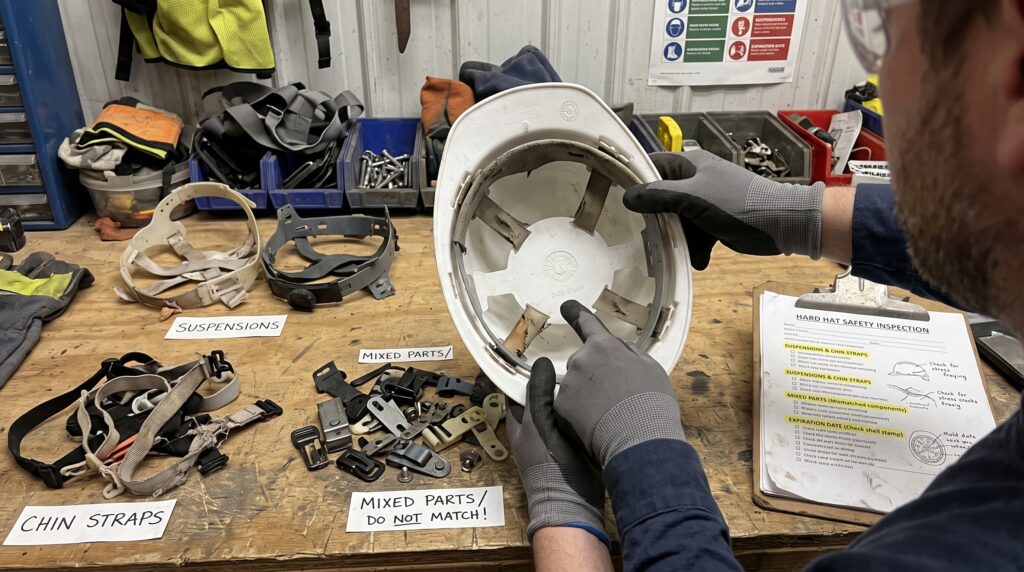
The suspension is the part that spaces your skull from the shell, and it wears faster than the shell. Sweat, oils and daily flexing all take a toll.
Replace it only with the original manufacturer’s part for that exact model and size. A hat is tested and certified as a complete system. A third-party webbing or an incompatible headband can change the clearance between your head and the shell, and that gap is what absorbs the hit.
The same goes for accessories. Face shields, earmuffs, lamps and chin straps should be approved for your specific hat.
Stickers, Paint and Customizing
Workers love personalizing their hats, and I get it. A few things to know first.
- Stickers: stick to non-metallic decals, and keep them away from the edge. Remember that a sticker can also hide a crack during an inspection.
- Paint: many paints and thinners attack the shell. Ask the manufacturer, or have them imprint a logo at purchase.
- Drilling or engraving: never. Ventilation holes and carved names weaken the shell and ruin the certification.
Storing and Receiving Hats
Unused hats age too, and that catches a lot of sites out.
When a box of hard hats arrives, I check the stamp on a few before anything goes on the shelf. A hat that sat in a distributor’s warehouse for two years has already used up part of its life.
Store hats in a cool, dry spot out of direct sun, away from fuel, solvents and heavy loads. Use oldest stock first, the same way you would with anything perishable.
For Employers: Records That Stand Up
OSHA’s PPE rules, including 29 CFR 1926.95 for construction and 1910.132 for general industry, expect protective equipment to be kept in reliable condition. There’s no expiration clause, but a damaged or aged hat can still draw attention in an inspection.
A simple system works well:
- Issue log: name, hat serial or ID, manufacture date and in-service date.
- Color or tag system: a colored sticker or band that shows the replacement year at a glance.
- Inspection record: a quick weekly or monthly sign-off.
- Replacement trigger list: posted where hats are handed out.
What to Do With an Expired Hat
Don’t pass it down as a “visitor hat” or a spare. Once it is retired, it is retired.
Cut the suspension or mark the shell clearly so nobody pulls it from the bin and puts it back into use. Then dispose of it according to your site’s waste practice.
FAQ
Will OSHA fine me for wearing an expired hard hat?
There is no expiration rule to cite. An inspector can still raise an issue if a hat is damaged, degraded or unsuitable for the hazard, so treat age as a risk factor and document your replacement practice.
Can I keep using a 10-year-old hard hat that looks perfect?
No. Even if it was stored well, it’s far past every common manufacturer limit. Surface appearance doesn’t show internal aging.
Do bump caps expire?
Bump caps aren’t a substitute for an ANSI-rated hard hat and don’t follow the same service-life guidance. Follow whatever the maker prints on the cap, and never use one where hard hat protection is required.
How do I find the date if the stamp is faded or missing?
Check the suspension stamp, the original packaging or purchase records, or contact the manufacturer with the model and serial details. If you can’t confirm the age, retire the hat.
Can I replace just the suspension to extend the life of the hat?
Yes, and manufacturers expect you to, on the shorter suspension schedule. Use only the exact original part for that model. The shell still has its own end date.
Does a hard hat last longer if I only wear it occasionally?
Slightly, if it’s stored well. But age and UV exposure on the shelf still count, so the manufacturer’s limit still applies.
What is the safest way to clean a hard hat?
Use lukewarm water and mild soap with a soft cloth. Skip solvents, fuel and abrasive tools, which can weaken the shell. Clean the headband and webbing too, since sweat and oil build up there.
Is hard hat expiration different in the UK and Europe?
Hard hats there are certified to EN 397, which doesn’t set a universal expiry either. Manufacturers state their own service life, often up to 5 years, so read the instructions for your model.