
Every workday carries some level of risk: a dropped wrench, a spark near a fuel line, a slippery floor after a spill. The gap between a near miss and a life-changing injury often comes down to one thing: the right workplace safety equipment, selected for the right hazard, worn correctly, and inspected on schedule.
This guide covers every major category of safety equipment in detail. It explains how each type works, which certification standards to look for, how to select gear for your specific environment, and how to build inspection habits that actually hold up over time. Whether you manage a construction site, run a warehouse, oversee a manufacturing facility, or operate a chemical plant, this guide gives you practical, experience-backed guidance that goes far beyond a generic checklist.
Why Workplace Safety Equipment Matters More Than Most People Realize
Workplace injuries are expensive in every sense. The human cost is obvious. The operational cost is not always tracked as carefully.
The U.S. Bureau of Labor Statistics reports that private industry employers recorded roughly 2.6 million nonfatal workplace injuries and illnesses in a recent year. Falls, slips, and trips account for about 27% of all nonfatal workplace injuries. Exposure to harmful substances or environments contributes tens of thousands of additional cases annually.
Beyond the human toll, the financial impact is real. The National Safety Council estimates the average cost of a medically consulted workplace injury at over $40,000 when accounting for wage losses, medical costs, administrative expenses, and employer uninsured costs. That figure does not include OSHA fines, increased insurance premiums, litigation costs, or the productivity loss from training a replacement worker.
Safety equipment is not a compliance checkbox. It is a direct investment in operational continuity, workforce trust, and long-term cost control.
The other point most safety guides miss: equipment alone does not create safety. A hard hat sitting in a storage room protects no one. The goal is a workplace culture where the right equipment is worn correctly, inspected consistently, and replaced before it fails.
Personal Protective Equipment (PPE): The First Line of Defense
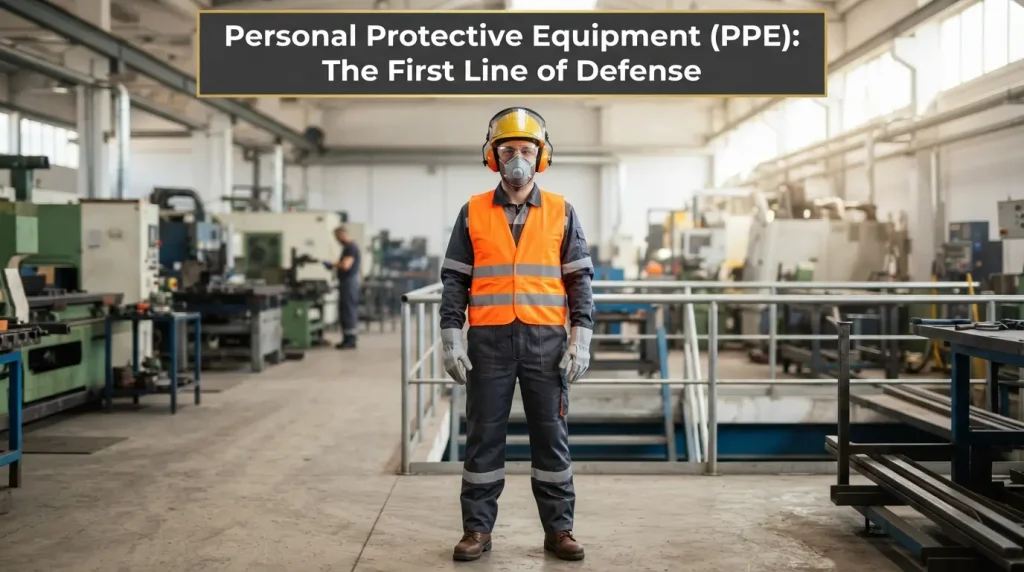
PPE is any equipment worn directly on the body to reduce exposure to a specific hazard. OSHA’s PPE standards (29 CFR 1910.132 for general industry, 29 CFR 1926.95 for construction) require employers to assess workplace hazards and provide appropriate PPE at no cost to employees.
Choosing the right PPE starts with a hazard assessment, not a catalog. Here is what each category covers and what to look for in each.
Head Protection
Hard hats and safety helmets protect against falling objects, fixed low-clearance structures, and electrical contact. The relevant standard in the United States is ANSI/ISEA Z89.1, which defines two types and three classes:
- Type I: Protects the top of the head
- Type II: Protects the top and sides of the head (required on most modern construction sites)
Classes by electrical protection:
- Class E (Electrical): Tested to 20,000 volts
- Class G (General): Tested to 2,200 volts
- Class C (Conductive): No electrical protection
In Europe, look for EN 397 certification. For sites with struck-by risks from the side, such as work near overhead cranes or in tight structural environments, Type II helmets are the correct choice, not Type I, even if Type I is technically compliant for general use.
Most hard hats carry a manufacturer date stamped inside the shell. The shell typically has a five-year service life from the date of manufacture, and the suspension system should be replaced every 12 months. Heat, UV exposure, and chemical contact degrade the materials without visible signs. Do not rely on visual inspection alone.
Eye and Face Protection
Eye injuries send roughly 2,000 U.S. workers to the emergency department every day, according to NIOSH estimates. Most of those injuries are preventable.
The appropriate eye and face protection depends entirely on the hazard type:
| Hazard | Appropriate Protection |
|---|---|
| Flying particles, chips, debris | Safety glasses (ANSI Z87.1) |
| Chemical splashes, vapors | Indirect-vent chemical goggles |
| Welding and cutting arcs | Welding shield with correct shade number |
| Radiation, lasers | Wavelength-specific laser eyewear |
| Combined impact and splash risk | Indirect-vent safety goggles with face shield |
The most common mistake is treating all eye protection as equivalent. Standard safety glasses with side shields stop solid particles but provide no protection against liquid splashes or vapors. Workers handling acids, caustics, or organic solvents need sealed indirect-vent goggles that completely encircle the eye area.
ANSI Z87.1 is the U.S. standard. Look for it marked directly on the lens and frame. In Europe, EN 166 covers general-purpose eye protection.
Hearing Protection
Noise-induced hearing loss is permanent, painless as it develops, and almost entirely preventable. OSHA requires hearing protection when workers are exposed to noise above 85 decibels as an eight-hour time-weighted average (TWA). At 90 dB TWA, exposure limits kick in under the OSHA permissible exposure limit (PEL).
Two primary options are available:
Disposable foam earplugs work best for short-duration, high-intensity noise exposure. NRR (Noise Reduction Rating) values typically range from 25 to 33 dB. They are inexpensive, single-use, and effective when inserted correctly. The most common failure mode is incorrect insertion, which drops actual noise reduction by 50% or more.
Earmuffs suit all-day use in consistently loud environments. They are more consistent in protection level because fit depends less on user technique. Earmuffs with built-in communication systems allow workers to hear verbal warnings and alarms while still receiving attenuation.
A note on over-protection: blocking too much sound in environments where verbal communication matters, such as near moving heavy equipment, creates its own hazard. Match the NRR to the actual measured decibel level, not just the maximum available rating.
Respiratory Protection
Respiratory hazards fall into two categories: particulates and gases or vapors. The wrong respirator for the hazard offers a false sense of safety, which is often more dangerous than no protection at all because it encourages workers to stay in a contaminated environment longer.
Filtering facepiece respirators (dust masks)
- N95: Filters at least 95% of airborne particles; not oil-resistant
- N99 / N100: Higher filtration efficiency; used in higher-concentration environments
- P100: Oil-proof, 99.97% filtration; used in environments with oil aerosols
These are regulated under NIOSH 42 CFR Part 84 in the U.S.
Half-face and full-face respirators with cartridges
Cartridge selection is critical. Different cartridges address different hazards:
- Organic vapor (OV) cartridges for solvents and hydrocarbons
- Acid gas cartridges for hydrochloric acid, chlorine, and sulfur dioxide
- P100 combination cartridges for combined particulate and gas hazards
Supplied-air respirators (SAR) and self-contained breathing apparatus (SCBA)
Required in oxygen-deficient atmospheres (below 19.5% oxygen), immediately dangerous to life or health (IDLH) environments, or anywhere the concentration of a contaminant exceeds the capability of a cartridge-based respirator.
OSHA 29 CFR 1910.134 governs respiratory protection programs, which must include fit testing, medical evaluation, training, and a written program before any tight-fitting respirator is used.
Hand Protection
Hand injuries are among the most frequent workplace injuries. The key is matching glove material and cut resistance to the specific hazard, because a glove designed for one hazard can fail completely against another.
Cut-resistant gloves: Rated under ANSI/ISEA 105 on a scale from A1 (lowest) to A9 (highest cut resistance). High-performance polyethylene (HPPE), steel, and glass fiber materials provide cut resistance without sacrificing dexterity.
Chemical-resistant gloves: Material selection depends on the specific chemical:
- Nitrile: Effective against oils, fuels, and many solvents
- Neoprene: Resists oils, acids, and some solvents
- Butyl rubber: Excellent against ketones, esters, and strong acids
- Natural latex: Adequate for mild chemicals but carries allergy risks
Always consult the chemical compatibility chart provided by the glove manufacturer. No single glove material protects against all chemicals.
Electrical-insulating gloves: Rated under ASTM D120 in voltage classes from 00 (500V AC max) to 4 (40,000V AC max). Must be inspected by inflation test before each use.
Thermal and heat-resistant gloves: Used in foundry, welding, and glass-handling work. Material and construction determine contact heat resistance versus convective and radiant heat.
Foot and Leg Protection
Safety footwear requirements vary significantly by industry. The relevant U.S. standard is ASTM F2412/F2413, which specifies performance requirements for impact resistance, compression resistance, metatarsal protection, and electrical hazard protection.
Key categories:
Steel-toe boots: Protect against crushing and falling objects. Impact resistance is rated at 75 ft-lb.
Composite-toe boots: Match steel-toe protection levels without metallic content. Better for cold-weather environments (metal conducts cold) and security-sensitive sites with metal detectors.
Metatarsal guards: External or internal guards protecting the top of the foot from the ankle to the toes. Required in foundries, steelmaking, and heavy manufacturing where falling objects pose risk to the entire foot, not just the toe.
Slip-resistant soles: Critical in kitchens, wet processing areas, and any surface where oils or fluids are present. Look for outsoles rated under ASTM F1677 (Mark II test) or the European SRC rating.
Electrical hazard (EH) rated footwear: Insulates the foot from electrical ground faults up to 18,000V in dry conditions.
High-Visibility Clothing
High-visibility (hi-vis) apparel is required any time workers are near moving vehicles, equipment, or at risk of being struck because they are not clearly visible to machine operators or drivers.
ANSI/ISEA 107 classifies hi-vis garments by performance class:
- Class 1: Minimum visibility for low-traffic environments with clear separation from hazards
- Class 2: Required for most roadway and warehouse work around moving equipment
- Class 3: Maximum visibility for high-speed traffic and nighttime work; covers torso, arms, and legs
The standard also specifies fluorescent background material colors (yellow-green or orange-red) and retroreflective striping widths for nighttime visibility. Hi-vis shirts without ANSI certification may look similar but do not meet the retroreflectivity requirements that make the difference at night or in low-light conditions.
Body and Skin Protection
Full-body protective clothing becomes necessary when PPE for individual body parts is not sufficient for the hazard level:
Chemical-resistant coveralls: Rated by NFPA 1991 (vapor-tight suits) or NFPA 1992 (liquid splash protection). The protection rating of the suit must match the specific chemical and exposure type. A suit rated for acid splash will not necessarily protect against organic vapor permeation.
Arc flash protective clothing: Rated in calories per square centimeter (cal/cm2). Incident energy analysis or arc flash risk assessment determines the required arc rating for a specific piece of equipment. Wearing a 4 cal/cm2 shirt near equipment with an 8 cal/cm2 arc flash boundary is inadequate.
Welding jackets and aprons: Protect against spatter, UV radiation, and radiant heat during welding, cutting, and grinding operations.
Disposable coveralls: Used in contamination control, asbestos abatement, spray painting, and pharmaceutical environments where reusable clothing would carry contamination risk.
Fall Protection Systems
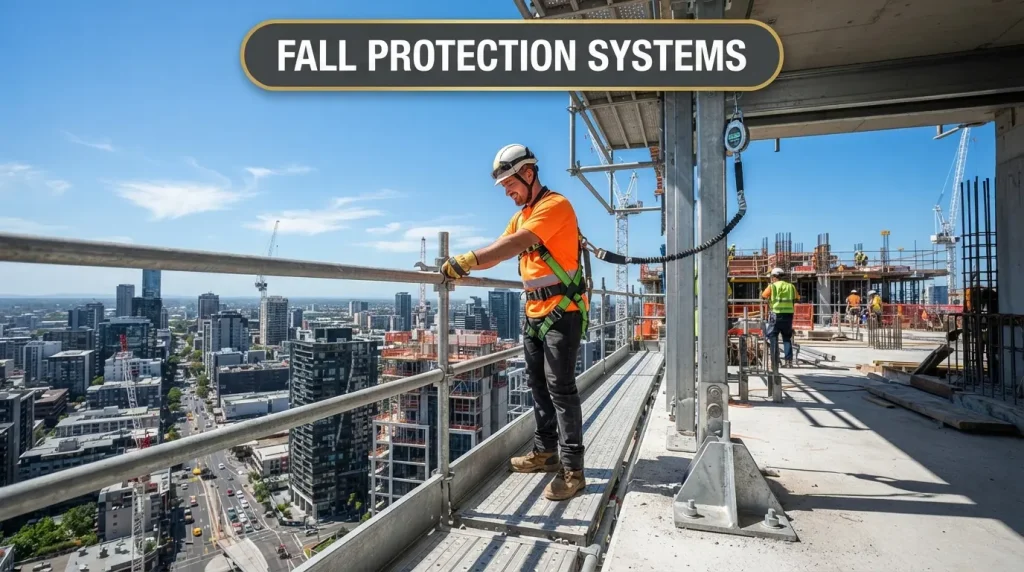
Falls are the leading cause of fatalities in the construction industry and a top cause across all industries. OSHA requires fall protection whenever workers are at or above four feet in general industry (six feet in construction, ten feet in marine terminals).
A complete fall protection system has three interdependent components. All three must be rated, inspected, and compatible with each other:
1. Anchor Points
The anchor point must withstand a minimum of 5,000 pounds per attached worker, or be designed by a qualified person to a safety factor of at least two. Common anchor types include:
- Structural beam clamps
- Concrete anchors
- Roof anchors bolted to structural members
- Horizontal lifeline systems spanning between anchors
A worker with a full-body harness connected to an unrated anchor point has no meaningful fall protection. Anchor capacity is the most frequently overlooked component of fall arrest systems.
2. Full-Body Harnesses
Harnesses distribute arrest forces across the thighs, pelvis, chest, and shoulders, rather than concentrating them at a single attachment point. Rated under ANSI Z359.11.
Key fit checks:
- Leg straps should admit only two fingers between the strap and thigh
- Chest strap should sit mid-chest
- D-ring should sit between the shoulder blades, not at the waist
A loose harness generates higher force on the body during a fall. A harness that cannot pass a fit check should not be used.
3. Connecting Devices
- Shock-absorbing lanyards: Extend to a maximum of six feet; decelerate the worker over a longer distance, reducing peak arrest force below 1,800 pounds per ANSI Z359.13
- Self-retracting lifelines (SRLs): Allow free movement and engage automatically when fall speed exceeds a set threshold. SRLs generate lower arrest forces than lanyards and allow work at shorter clearance heights
- Rope grabs: Slide freely along a vertical lifeline and lock under fall force
Calculate total fall clearance before selecting a connecting device. A six-foot lanyard on a ten-foot platform leaves a worker hitting the ground before the arresting system reaches peak force.
Inspect all three components before every shift. Look for cuts, abrasion, deformation, corrosion of hardware, UV degradation, and chemical contamination. Retire any harness or lanyard that has taken a fall load, even if visible damage is not present. Internal fibers may be damaged beyond safe use.
Fire Safety Equipment
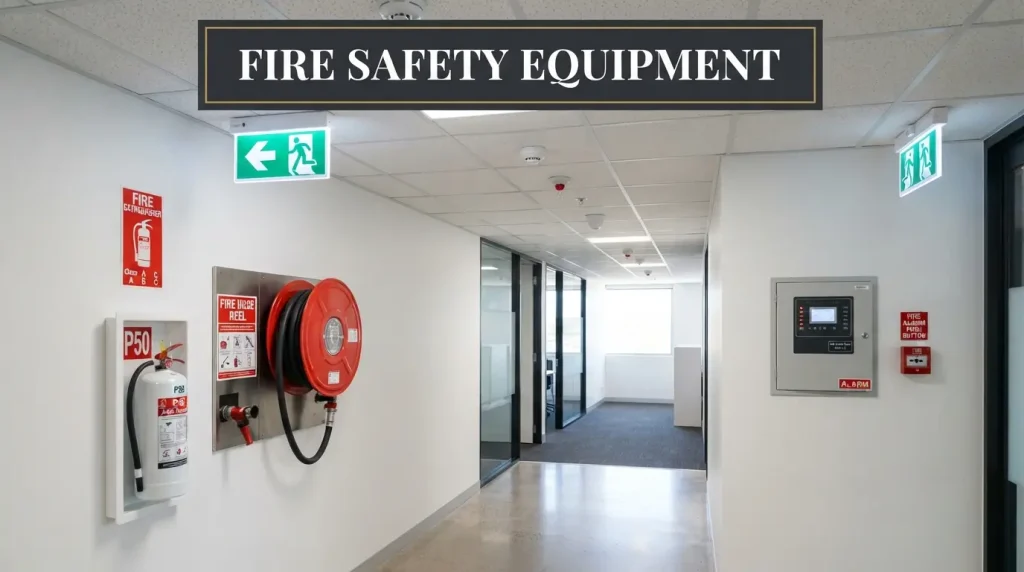
Fire risk exists across virtually every workplace type, from a small office with a kitchen to a petrochemical facility. The specifics of the risk determine the equipment required.
Fire Extinguishers
Fire extinguishers must match the class of fire present in the area. Using the wrong class of extinguisher can spread a fire, cause electrocution, or make the situation worse.
| Fire Class | Fuel Type | Correct Extinguisher Type |
|---|---|---|
| Class A | Wood, paper, fabric, rubber | Water, dry chemical, foam |
| Class B | Flammable liquids, gasoline, oils | CO2, dry chemical, foam |
| Class C | Electrical equipment | CO2, dry chemical (non-conductive) |
| Class D | Combustible metals (magnesium, titanium) | Dry powder (specific to metal) |
| Class K | Cooking oils, fats (commercial kitchens) | Wet chemical |
OSHA 29 CFR 1910.157 requires extinguishers to be inspected monthly, serviced annually, and hydrostatically tested on intervals specified by the manufacturer (typically every five to twelve years depending on type).
Fire Blankets
Fire blankets smother small fires by cutting off oxygen. They are particularly useful in laboratories, kitchens, and workplaces where a person’s clothing may ignite. A fire blanket rated to EN 1869 provides at least thirty minutes of thermal protection when used correctly.
Smoke, Heat, and Gas Detectors
Early warning systems give workers evacuation time. In industrial settings, multi-sensor detectors that trigger on both smoke and heat reduce false alarms from dust or steam while still catching genuine fires quickly. In environments with flammable gas storage, combustible gas detectors (LEL detectors) provide the first alert before a concentration reaches ignition threshold.
Emergency Evacuation Equipment
Clearly marked, unobstructed evacuation routes are a legal requirement, not a suggestion. Additional evacuation aids in specific environments include:
- Emergency stairway chairs for multi-story buildings where elevator use is prohibited during fire
- Evacuation route maps posted at each exit
- Emergency lighting systems that activate on power failure
Electrical Safety Equipment
Electrical hazards cause roughly 1,000 deaths annually in U.S. workplaces, according to OSHA estimates. The equipment and procedures required depend entirely on the voltage level and the task being performed.
Lockout/Tagout (LOTO) Devices
OSHA 29 CFR 1910.147 requires lockout/tagout procedures any time workers perform maintenance or service on equipment where unexpected energization could cause injury. LOTO equipment includes:
- Padlocks (one per authorized worker, keyed individually)
- Hasp devices that allow multiple padlocks on a single isolation point
- Valve lockouts for pneumatic and hydraulic isolation
- Electrical plug lockouts
- Circuit breaker lockout clips
- Tags that communicate the status and identity of the person who applied the lock
LOTO is a procedure, not just a device. Equipment must be shut down, all energy sources isolated (including stored pneumatic, hydraulic, and spring energy), isolation verified, and then locked. A tag without a lock provides no physical protection.
Insulated Tools and Gloves
For live electrical work that cannot be de-energized, insulated tools rated under IEC 60900 (1,000V AC / 1,500V DC) provide protection against accidental contact. Electrical insulating gloves must be rated to the voltage class of the equipment being worked and tested by dielectric testing on a schedule defined by ASTM F496 (every six months).
Arc Flash Protective Clothing
An arc flash incident releases enormous amounts of thermal energy in a fraction of a second. Arc flash clothing is rated in cal/cm2, and the required rating comes from an arc flash risk assessment performed per NFPA 70E or IEEE 1584.
Arc-rated clothing does not prevent injury, but it prevents ignition. A garment that melts or catches fire adds burning material to the heat source. Arc-rated fabrics self-extinguish when the arc event ends.
Never substitute flame-resistant (FR) clothing for arc-rated (AR) clothing. All AR clothing is FR-rated, but not all FR clothing has a published arc rating.
Hazardous Material Handling Equipment

Workplaces that handle chemicals, biological agents, or radioactive materials need containment and decontamination equipment in addition to PPE.
Spill Containment and Response Kits
Spill kits must be matched to the chemicals in use:
- Universal kits: Handle water-based and oil-based spills
- Hazmat kits: Include chemically resistant gloves, goggles, and absorbents for aggressive chemicals
- Oil-only kits: Repel water and absorb only hydrocarbons (used near waterways)
Spill kit contents degrade over time. Absorbent materials can compact and lose capacity. Inspect and restock kits quarterly, not just after use.
Safety Data Sheets (SDS) and Chemical Identification
OSHA’s Hazard Communication Standard (HazCom, 29 CFR 1910.1200) requires SDS for all hazardous chemicals. The SDS specifies the correct PPE for each substance, first aid procedures, spill response steps, and incompatible materials. This document should be immediately accessible, not archived in a filing cabinet.
Eyewash Stations and Emergency Showers
ANSI Z358.1 requires emergency eyewash stations within 10 seconds of travel (roughly 55 feet) from the hazard for any chemical that can cause eye or skin injury. Requirements include:
- Tepid water (60 to 100 degrees Fahrenheit) to encourage prolonged flushing
- Minimum 0.4 GPM flow for eyewash, 20 GPM for drench showers
- 15-minute continuous flow capability
- Activation within one second without the use of hands
Monthly activation and flushing is required to prevent microbial growth in the supply line and verify function. Document each test.
Chemical Storage and Containment
Secondary containment systems (berms, drip trays, and containment pallets) prevent spills from reaching drains or spreading to adjacent areas. The containment volume should equal at least 110% of the largest single container volume in the storage area, per EPA and OSHA guidance.
Confined Space Entry Equipment
Confined space entry is among the most hazardous activities in any industry. Permit-required confined spaces (those with potential for atmospheric hazard, engulfment, or configuration hazards) require a specific set of equipment and procedures under OSHA 29 CFR 1910.146.
Key equipment for confined space entry:
Multi-gas detectors: Continuously monitor oxygen level, combustible gas (% LEL), carbon monoxide, and hydrogen sulfide before and during entry. Calibrate before each use; bump test daily at minimum.
Supplied-air respirators or SCBA: Required when atmospheric testing shows an oxygen-deficient, oxygen-enriched, or immediately dangerous to life or health (IDLH) atmosphere.
Retrieval systems: A tripod and winch system positioned over the entry point allows non-entry rescue without requiring a second entrant to enter the space. This protects rescuers, who account for more than half of all confined space fatalities.
Communication equipment: Continuous two-way communication between the entrant and the attendant stationed outside.
First Aid Equipment
First aid equipment provides the immediate response capability that limits the severity of an injury before medical services arrive.
OSHA 29 CFR 1910.151 requires employers to ensure the ready availability of medical personnel when the workplace is not near an infirmary, clinic, or hospital. In the absence of nearby emergency medical care, a person trained in first aid and a first aid kit must be available.
A well-stocked workplace first aid kit typically includes:
- Adhesive bandages in multiple sizes
- Sterile gauze pads and rolls
- Elastic bandages for sprains
- Antiseptic wipes and solution
- Disposable gloves (non-latex available)
- CPR face shield or resuscitation mask
- Scissors and tweezers
- Instant cold packs
- Emergency blanket
- First aid instruction guide
For workplaces with chemical exposure risk, eyewash bottles supplement fixed eyewash stations at satellite work areas. For worksites more than four minutes from definitive medical care, defibrillators (AEDs) may be warranted given that the survival rate for witnessed cardiac arrest drops roughly 10% for every minute without defibrillation.
Safety Signage and Barriers
Signs and physical barriers are passive protection measures that work even when workers are distracted or unfamiliar with the area.
Safety Signs
ANSI Z535 establishes the U.S. standard for safety signs, with five signal word categories:
- DANGER: Indicates an imminently hazardous situation that will result in death or serious injury
- WARNING: Indicates a potentially hazardous situation that could result in death or serious injury
- CAUTION: Indicates a potentially hazardous situation that may result in minor or moderate injury
- NOTICE: Indicates information not related to personal injury
- SAFETY INSTRUCTION: Indicates general safety information
Color coding under ANSI Z535 is standardized. Red for danger. Orange for warning. Yellow for caution. Blue for notice. Green for safety instruction. Using the correct color with the correct signal word prevents sign inflation, where workers stop reading signs because too many use “DANGER” for minor hazards.
Physical Barriers
- Safety cones and delineators for temporary hazard zones and traffic control
- Expandable barriers for isolating active maintenance areas
- Machine guarding fixed barriers and interlocked guards
- Safety netting under elevated work platforms
Ergonomic Safety Equipment
Musculoskeletal disorders (MSDs) account for roughly 30% of all nonfatal workplace injuries and illnesses requiring days away from work, per BLS data. Ergonomic equipment reduces the physical load that leads to cumulative strain injuries.
Anti-fatigue matting: Reduces lower limb fatigue for workers standing on hard floors for extended periods. Particularly effective in assembly lines, machine operation, and retail settings.
Mechanical lifting aids: Floor-level dollies, vacuum lifters, and ergonomic lift tables reduce manual handling load. NIOSH recommends the revised lifting equation to assess manual lifting tasks and set weight limits based on task variables.
Vibration-dampening gloves: Reduce hand-arm vibration syndrome (HAVS) risk from powered hand tools. Most effective when combined with power tools designed to lower vibration output at the source.
Sit-stand workstation equipment: Adjustable monitor arms, keyboard trays, and anti-fatigue mats allow posture variation throughout the shift rather than static loading in one position.
How to Select the Right Safety Equipment: A Practical Framework
Equipment selection based on habit, price, or what the last safety manager ordered often results in gear that does not match the actual hazard. Use this process instead:
Step 1: Conduct a written hazard assessment. OSHA requires a documented hazard assessment for PPE selection. Walk the job, identify specific hazards by task, and record the findings. Review it whenever tasks, materials, or equipment change.
Step 2: Identify applicable standards. For each hazard, identify the OSHA requirement (the regulatory floor), the applicable ANSI/ASTM/NIOSH standard (the performance benchmark), and any industry-specific standards (such as NFPA 70E for electrical).
Step 3: Match equipment to exposure level and duration. A worker exposed to 90 dB for thirty minutes needs different protection from one exposed to the same level for eight hours. Protection level must address the actual exposure, not a worst-case assumption that results in uncomfortable, rarely worn gear.
Step 4: Verify fit before purchase or issue. Particularly for respirators and harnesses, fit determines function. Respirator fit testing per OSHA 1910.134 must be conducted annually. Harnesses must be adjusted per manufacturer instructions and verified for fit before each use.
Step 5: Establish inspection, maintenance, and replacement schedules in writing. Most PPE has a documented service life and inspection interval in the manufacturer’s product manual. Post that schedule where equipment is stored and assign responsibility by name, not just by role.
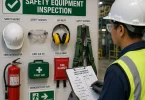
Safety Equipment Inspection and Replacement Schedule
The following table covers typical inspection intervals and replacement triggers. Always defer to manufacturer documentation for product-specific guidance, as it takes precedence.
| Equipment | Pre-Use Check | Periodic Inspection | Replacement Trigger |
|---|---|---|---|
| Hard hat / helmet | Yes, visual | Monthly | After impact, 5 years from manufacture date, visible cracks or deformation |
| Safety glasses | Yes, visual | As inspected | Lens scratches affecting vision, frame damage |
| Earplugs | Yes | Replace regularly | Single-use: after each use; reusable: per manufacturer |
| Respirator | Yes, seal check | Monthly | Cartridge end-of-service life; any damage to facepiece or straps |
| Cut-resistant gloves | Yes, visual | Monthly | Cuts, punctures, or worn areas through the outer layer |
| Chemical gloves | Yes, inflate | Before each use | Any permeation, discoloration, or physical damage |
| Safety footwear | Yes, visual | Monthly | Sole separation, toe cap exposure, significant sole wear |
| Full-body harness | Yes, visual | Before each use | Any fall arrest event; cuts, abrasion, corrosion of hardware |
| Lanyards / SRLs | Yes, visual | Before each use | Any fall arrest event; cuts, kinks, corrosion |
| Arc flash clothing | Yes, visual | Inspect after each wash cycle | Holes, tears, or contamination with flammable materials |
| Fire extinguisher | Monthly visual | Annual service | Pressure drop, damaged nozzle, expired hydrostatic test |
| Gas detector | Yes, bump test | Calibrate per manufacturer | Sensor failure or out-of-range calibration |
| Eyewash station | Monthly test | Quarterly full inspection | Non-functioning nozzle, inadequate flow rate |
Training: The Component That Makes Equipment Work
Equipment without training is a liability. A worker who does not know how to don and doff a respirator, fit a harness, or read a gas detector alarm is not protected by that equipment. OSHA requires training for virtually every category of PPE and safety system.
Effective safety training covers three areas:
- Why the equipment matters: Understanding the consequence of the hazard makes workers more likely to use protection consistently, even when no supervisor is present.
- How to use it correctly: Demonstration and return demonstration, where the worker shows the trainer they can perform the task, are more effective than lecture or video alone.
- How to inspect and report damaged equipment: Workers who use equipment daily are the first to notice wear, fit problems, and damage. Building a clear reporting path, without blame or penalty for raising concerns, keeps equipment status accurate.
Retrain whenever equipment changes, a worker is assigned to a new task with different hazards, or following any incident involving the equipment. Retrain periodically even without changes, because habits degrade.
Common Questions About Workplace Safety Equipment
What is the most important piece of workplace safety equipment?
There is no single answer. The most critical equipment is determined by the specific hazard present. In an environment with overhead work, head protection may be the priority. In a chemical facility, respiratory and skin protection may be. Always start with the hazard assessment, not a predetermined list.
Are employers required to provide safety equipment at no cost?
In the United States, OSHA requires employers to provide most PPE at no cost to employees when it is required for compliance with OSHA standards. Some exceptions exist for non-specialty safety-toe footwear and non-specialty prescription safety eyewear. Workers should never be charged for equipment mandated by law.
Can employees use their own personal safety equipment?
OSHA permits employees to use personal PPE when the employer verifies it meets the applicable standard and provides adequate protection. The employer is responsible for verifying compliance, not assuming it. Equipment that meets the standard but fits poorly still represents a compliance and protection failure.
How do I verify that safety equipment meets the correct standard?
Look for the certification mark stamped or labeled on the product itself. ANSI, NIOSH, ASTM, and EN marks should be visible on the product, not just stated in marketing materials. Cross-reference the model number against the certifying body’s published database when procurement involves high-volume or high-stakes purchasing.
Does safety equipment expire if it has never been used?
Yes, in many cases. Respirator cartridges degrade when exposed to ambient air, even unopened. Chemical-resistant gloves made from natural or synthetic rubber lose elasticity over time. Spill absorbents can compact or lose absorption capacity. UV-exposed hard hat shells lose impact resistance. Always check manufacturer-stated shelf life rather than assuming unused means undegraded.
How often should I retrain workers on safety equipment?
At minimum, retrain at initial assignment, after any change in equipment or task, and following any incident. Beyond those triggers, annual refresher training maintains retention. Studies on safety training retention consistently show significant knowledge decay within twelve months without reinforcement.
What should I do if safety equipment is damaged mid-shift?
Remove it from service immediately. Do not use damaged PPE for the remainder of the shift pending replacement. Establish a clear process for workers to report and exchange damaged equipment without fear of discipline or production pressure. A worker who hides a cracked harness rather than report it is a predictable outcome of a culture that penalizes downtime.
Building a Safety Equipment Program That Holds Up Over Time
A safety equipment program that exists only as a policy document on an intranet does not protect anyone. The programs that reduce injury rates over time share a few characteristics:
Written hazard assessments: Updated whenever tasks, materials, or equipment change. Not filed away after initial creation.
Equipment accountability: Workers sign for issued equipment. Replacement is straightforward and blame-free. Inventory is tracked so gaps are visible before a shift starts with missing gear.
Inspection records: Pre-use checks documented for high-stakes equipment like harnesses and gas detectors. Periodic inspection results logged by date and inspector name.
Clear reporting paths: Workers can flag damaged equipment, near misses, and inadequate gear without consequences. Management responds visibly and promptly.
Procurement standards: Every purchasing decision specifies the required certification standard, not just the lowest price. Vendors must document compliance before orders are approved.
Workplace safety equipment works only as part of a larger system: the right gear, matched to the right hazard, worn correctly by trained workers, inspected on schedule, and replaced before it fails. Building that system consistently protects your workforce more effectively than any single piece of equipment can on its own. Start with the hazard, not the catalog, and build from there.