
Every ten minutes, a construction worker dies somewhere in the world. Not because safety knowledge does not exist, but because it is not applied consistently, completely, or at the right time.
Construction is the most hazardous industry on the planet for a reason. Sites are temporary by design, crews change regularly, tasks shift daily, and conditions evolve by the hour. An open trench that did not exist at 7 a.m. can appear before lunch. A power line that was safely out of reach on Monday can be directly above a new scaffold by Wednesday. Hazards are not static, and neither is the work that creates them.
In the United States, nearly one in five workplace fatalities happens on a construction site, even though the industry employs only about 6 percent of the workforce. The European Union reports similar proportions. The International Labour Organization estimates that construction accounts for a disproportionate share of the world’s 2.3 million annual work-related deaths. These are not statistics. They are people.
The good news is unambiguous: the overwhelming majority of construction accidents are preventable. The hazards are well-documented. The control measures are established. The regulations exist. What separates safe sites from dangerous ones is not access to information but the discipline to apply it every day.
This guide covers every major area of construction safety in the depth that actual prevention requires. Whether you are a worker stepping onto your first site, a foreman managing a crew, a safety officer building a program, or a site owner who wants to understand what comprehensive protection actually looks like, this is the resource you need.
1. What Is Construction Safety?

You May Also Like It:
Temporary Construction Safety Railing: The Complete Guide for Job Site Safety
Construction Safety Solutions: A Complete Guide for Modern Construction Sites
Construction Safety Products: A Complete Guide to Protecting Your Crew
What Does Construction Safety Meaning?
Construction safety is the complete set of practices, procedures, regulations, equipment, and cultural norms used to protect every person on or near a construction site from injury, illness, or death. It applies to the building of new structures, the renovation and repair of existing ones, the demolition of structures, and all civil engineering work, including roads, bridges, tunnels, and utilities.
The scope of construction safety is broader than most people assume. It includes:
- Physical hazard control: preventing falls, struck-by incidents, electrocution, and crush injuries
- Health hazard management: controlling exposure to silica dust, asbestos, lead, chemical vapors, and extreme temperatures
- Psychological safety: addressing fatigue, mental health, and substance abuse
- System-level protection: building safety plans, permit systems, and emergency response procedures
- Legal compliance: meeting OSHA, HSE, EU Directive, and ISO requirements
1.1 Safety Is a Shared Responsibility
A common misconception is that construction safety belongs to one person, typically the safety officer or the site supervisor. In reality, safety is distributed across every level of the project:
- Owners and clients set the contract terms that determine how much time and budget are allocated to safety
- Architects and engineers can design out hazards before anyone picks up a tool, a practice called prevention through design
- Contractors and subcontractors establish site-level safety programs, provide training, and enforce rules
- Supervisors and foremen translate policies into daily habits and hold crews accountable
- Individual workers are the last line of defense and the first to spot hazards on the ground
When any level fails to carry its share, risk increases for everyone else on site.
1.2 The Hierarchy of Controls
Before diving into specific hazards, understand the hierarchy of controls. This is the framework that every safety decision should follow. It ranks control measures from most to least effective:
- Elimination: Remove the hazard entirely. Design a process that does not require working at height, for example.
- Substitution: Replace a dangerous material or method with a safer one. Use water-based paint instead of solvent-based.
- Engineering controls: Physically separate workers from the hazard. Install guardrails, use local exhaust ventilation, enclose noisy machinery.
- Administrative controls: Change the way work is done. Schedule noisy work when fewer people are present. Rotate workers to limit silica exposure duration.
- Personal protective equipment: Use as a last line of defense, not a first response. PPE does not eliminate the hazard; it reduces exposure when other controls are not enough.
Most construction safety plans work backward through this list, starting with PPE because it is the most visible. The most effective programs start at the top and work down.
2. The True Cost of Construction Accidents

2.1 The Human Cost
Every construction fatality leaves behind a family. Every serious injury can end a career, change a person’s capacity to care for themselves, and ripple through a household for years. Permanent disability from a construction accident, a spinal injury from a fall, hearing loss from years of unprotected noise exposure, mesothelioma from asbestos, is not just a medical outcome. It changes who a person is and what they can do.
Non-fatal injuries are vastly underreported across the industry. Workers in precarious employment situations, day laborers, undocumented workers, and those on informal contracts, often do not report injuries for fear of losing work. The official statistics understate the real scale of harm.
2.2 The Financial Cost
The direct and indirect costs of a single construction accident are substantial:
- Direct costs: medical treatment, workers compensation claims, equipment damage, site cleanup
- Indirect costs: lost productivity, investigation time, retraining, increased insurance premiums, legal defense
- Project costs: work stoppages, schedule delays, potential contract penalties
- Regulatory costs: OSHA fines, which can reach up to USD 156,259 per willful or repeated violation as of 2024
The International Labour Organization estimates global construction accident costs exceed USD 1 trillion annually. For individual companies, the U.S. Liberty Mutual Workplace Safety Index consistently shows that for every dollar spent on prevention, companies save four to six dollars in avoided costs.
2.3 The Reputational and Legal Cost
A serious accident damages a contractor’s reputation in ways that outlast the project. Public tenders increasingly require safety records and incident rate disclosures. A high Experience Modification Rate (EMR), the insurance metric that reflects a company’s claim history, directly increases bid costs and can disqualify a firm from certain contracts entirely.
Criminal liability is an escalating concern in multiple jurisdictions. In the UK, the Corporate Manslaughter and Corporate Homicide Act 2007 allows prosecution of organizations when a management failure causes a worker’s death. Several EU countries have similarly toughened corporate liability laws. In the United States, OSHA’s Severe Violator Enforcement Program subjects companies with repeated willful violations to enhanced inspections and follow-up scrutiny.
3. The Fatal Four: Leading Causes of Construction Deaths
OSHA and equivalent agencies worldwide track construction fatalities by cause. Year after year, four categories dominate. In the United States alone, the Fatal Four account for more than 60 percent of all construction worker deaths.
3.1 Falls from Height
Falls are the single biggest killer on construction sites worldwide. They occur from roofs, scaffolding, ladders, unguarded floor openings, leading edges, and elevated platforms. A worker can fall from a six-foot ladder just as easily as from a six-story scaffold, and the consequences of either can be fatal.
Fall Protection Triggers
In the United States, OSHA requires fall protection for any work performed six feet or more above a lower level (29 CFR 1926.502). In the European Union, the threshold is generally two meters. Regardless of regulation, best practice is to treat any elevated work as a fall risk and plan protection accordingly.
Accepted Fall Protection Methods
- Guardrail systems: Top rail at 42 inches (plus or minus 3 inches), mid-rail at 21 inches, capable of withstanding 200 pounds of force in any outward or downward direction
- Safety net systems: Installed as close as possible below the work area, capable of absorbing the energy of a falling worker
- Personal fall arrest systems (PFAS): Full-body harness connected to an anchor point via a lanyard or self-retracting lifeline. The anchor must support 5,000 pounds per worker attached.
- Covers: For floor holes, properly secured, capable of supporting twice the expected load, and marked with ‘HOLE’ or ‘COVER’
Ladder Safety
More workers die from ladder falls than from any other elevated surface. Correct ladder use requires:
- Securing the top and bottom of every straight or extension ladder before climbing
- Maintaining three points of contact at all times when ascending or descending
- Never standing on the top three rungs of a straight ladder or the top two rungs of a stepladder
- Facing the ladder when climbing and descending, not turning sideways
- Keeping the body centered between the rails, not leaning out to reach
- Using the right ladder for the job: extension ladders for access, stepladders for self-supported work
- Inspecting every ladder before use for cracks, bent rails, missing rungs, and damaged feet
Roof Work
Roofing is statistically one of the most dangerous tasks in construction. Residential roofing workers face a fatality rate many times higher than the construction average. Every roof work plan must address:
- Whether a controlled access zone, warning line system, or PFAS will be used
- Skylight protection: Skylights that appear solid can give way under a worker’s weight. Each must be covered or guarded.
- Steep slope versus low slope distinctions: Different OSHA requirements apply
- Weather conditions: Do not perform roof work in rain, snow, ice, or high winds
3.2 Struck-By Incidents
Struck-by incidents cover any situation where a worker is hit by a moving object. This includes vehicles, crane loads, falling tools, flying debris from cutting or grinding, and projectiles from powder-actuated tools.
Vehicle and Equipment Hazards
Heavy construction equipment has large blind spots. Operators of excavators, dump trucks, and skid steers often cannot see workers directly behind or beside them. Control measures include:
- Establish clearly marked pedestrian walkways separated from vehicle routes
- Require spotters for any reversing vehicle operating near workers on foot
- Install backup alarms on all construction vehicles
- Use hard barricades, not just cones, around active crane swing radiuses
- Conduct daily planning meetings that map out vehicle movement routes
Falling Objects
Tools and materials dropped from height gain enough momentum to be lethal. Controls include:
- Toeboards on scaffolds and elevated work platforms to prevent objects from rolling off
- Tool lanyards to prevent dropped hand tools from workers working at height
- Debris nets below elevated work areas
- Controlled access zones below overhead work, keeping people out of the drop zone
- Hard hats for all workers in areas where overhead work is occurring
3.3 Electrocutions
Construction workers contact energized electrical sources more often than workers in almost any other industry. Electrocution can result from contact with overhead power lines, faulty or ungrounded tools, temporary wiring failures, and exposed energized components in renovation and demolition work.
Overhead Power Line Safety
Power lines are responsible for a significant share of construction electrocutions. Most incidents occur because workers and equipment operators underestimate how close they are to energized lines. Key requirements:
- Maintain at least 10 feet of clearance from power lines up to 50 kV. Clearance increases for higher voltage lines.
- Before any work begins near power lines, contact the utility company to confirm voltage and request de-energization or insulation if feasible
- Use non-conductive measuring tools, wood or fiberglass ladders, and non-conductive scaffolding components near energized lines
- Designate a spotter whose sole responsibility is monitoring equipment clearance near overhead lines
Ground Fault Circuit Interrupter (GFCI) Protection
GFCI devices detect leakage current and cut power within milliseconds before it can cause cardiac arrest. OSHA requires GFCI protection for all 120-volt, single-phase, 15- and 20-ampere receptacles on construction sites. GFCIs must be tested before each use.
Lockout/Tagout (LOTO) Procedures
LOTO procedures prevent the accidental energization of equipment during maintenance or repair. A full LOTO procedure involves:
- Notify all affected workers before de-energizing equipment
- Identify all energy sources: electrical, pneumatic, hydraulic, gravitational, thermal
- Shut down the equipment using the normal stopping procedure
- Isolate every energy source using a lockout device
- Apply a personal padlock and tag to each isolation point
- Release or restrain stored energy: bleed pressure, block elevated components, discharge capacitors
- Verify the equipment is de-energized before beginning work
- Perform work
- Restore energy only after all workers have removed their personal locks
Group LOTO applies when multiple workers are servicing the same equipment. Each worker applies their own personal lock to a group lockout hasp, and no one can re-energize the equipment until every personal lock has been removed.
3.4 Caught-In or Caught-Between Incidents
This category includes trench collapses, workers pinned between a vehicle and a fixed structure, and workers pulled into unguarded rotating machinery. Trench collapses deserve particular focus because they are catastrophically fast and almost entirely preventable.
Trench and Excavation Safety
A cubic yard of soil can weigh between 1,600 and 3,000 pounds depending on soil type and moisture content. When a trench wall collapses, there is no warning and no time to react. Burial compresses the chest, preventing breathing, and death can occur within minutes.
OSHA requires a protective system for any excavation five feet or deeper, and for shallower excavations where soil conditions dictate risk (29 CFR 1926 Subpart P). Acceptable systems include:
- Sloping: Cutting back the trench walls at an angle that matches the soil type (Type A soil: 0.75H:1V; Type B soil: 1H:1V; Type C soil: 1.5H:1V)
- Shoring: Hydraulic, mechanical, or timber structures that brace the trench walls
- Trench boxes (shields): Pre-engineered steel boxes that workers operate inside of
Additional excavation requirements:
- A competent person must inspect the excavation daily and after any rain or event that could change conditions
- Means of egress (a ladder, stairway, or ramp) must be within 25 lateral feet of any worker in a trench
- Spoil piles must be kept at least two feet from the edge of the excavation
- Standing water indicates saturated soil and elevated collapse risk: pump before entering
Machinery Guarding
Rotating parts such as gears, belts, pulleys, and drill bits can catch loose clothing, gloves, or body parts and draw them in faster than a worker can react. OSHA’s machine guarding standard (29 CFR 1910.212) requires guards on all points of operation where workers could contact moving parts. On construction sites, this applies to table saws, grinders, drill presses, and concrete mixers.
4. Personal Protective Equipment

PPE is the last layer of protection after engineering controls and administrative measures have been applied. It does not eliminate hazards. It reduces the severity of harm when other controls are not enough. Selecting, using, and maintaining PPE correctly is a skill, not a formality.
4.1 Core PPE for Construction Sites
Head Protection: Hard hats protect against falling objects and lateral impact. Class E hard hats also protect against high-voltage electrical contact up to 20,000 volts. Replace any hard hat after a direct impact, even if no visible damage exists. UV radiation degrades the plastic over time: most manufacturers recommend replacement every five years regardless of condition.
Eye and Face Protection: Safety glasses protect against flying particles and light-duty splash hazards. Goggles provide a sealed barrier for chemical splash or fine dust. Face shields protect the full face during grinding, chipping, or chemical handling, and must be worn over safety glasses, not instead of them.
Hearing Protection: Sustained noise above 85 decibels damages hearing over time. Most power tools, compressors, and heavy equipment exceed this level. OSHA requires a hearing conservation program when workers are exposed to 85 dB or more averaged over an 8-hour shift. Foam earplugs provide 25-33 dB of noise reduction when inserted correctly. Earmuffs are faster to put on but may not seal properly over safety glasses.
Respiratory Protection: The type of respirator required depends on the specific airborne hazard. A nuisance dust mask (not NIOSH-approved) offers no protection against silica, asbestos, or chemical vapors. N95 respirators filter at least 95 percent of airborne particles but do not protect against gases or vapors. Half-face or full-face respirators with combination cartridges protect against both particles and specific gases. Before wearing any tight-fitting respirator, workers must pass a medical evaluation and a fit test.
Hand Protection: Different gloves protect against different hazards. Cut-resistant gloves for handling sheet metal or glass. Chemical-resistant gloves (neoprene, nitrile, or butyl) for solvents and acids. Insulated gloves rated to the working voltage for electrical work. Anti-vibration gloves for extended tool use. Check the glove rating before assuming it protects against the hazard at hand.
Foot Protection: Steel-toe or composite-toe boots protect against crush and puncture injuries. Composite-toe boots are preferred for electrical work because they do not conduct electricity. Puncture-resistant midsoles prevent nail penetrations. Slip-resistant outsoles matter on wet concrete, oily surfaces, and elevated platforms.
High-Visibility Clothing: Class 2 vests are required for workers near roadway traffic moving up to 45 mph. Class 3 vests or garments are required for higher-speed traffic zones. Retroreflective striping must be visible at night from at least 1,000 feet.
4.2 PPE Inspection, Maintenance, and Replacement
PPE that looks intact can fail under load if it has been previously stressed. Harness webbing degrades with UV exposure and repeated shock loads. Hard hat shells can develop micro-cracks from impact. Respirator cartridges reach their service life based on concentration and time, not just appearance.
- Hard hats: Inspect shell and suspension system before each use. Replace after any impact. Replace unconditionally every five years or per manufacturer guidance.
- Fall arrest harnesses: Inspect before each use. Retire any harness that has arrested a fall, shows fraying, has deformed hardware, or is over ten years old.
- Respirator cartridges: Replace on a written schedule based on the contaminant concentration and work duration. For organic vapor cartridges, replace at the end of each shift at minimum.
- Safety glasses and goggles: Replace when scratched, as scratched lenses impair vision and reduce impact resistance.
- Hearing protection: Foam earplugs are typically single-use. Earmuff cushions should be replaced when they harden, crack, or lose their seal.
5. Scaffold Safety
Scaffolding is involved in a disproportionate share of construction fatalities and serious injuries. The three primary causes of scaffold-related incidents are planking or support failure, the worker slipping, and objects falling from the scaffold onto workers below.
5.1 Types of Scaffolding
- Supported scaffolding: The most common type. Platforms are supported from below by poles, legs, frames, or outriggers. Includes tube-and-coupler systems, system scaffolding (e.g., Ringlock, Kwikstage), and pump jack scaffolds.
- Suspended scaffolding: Platforms hung from above by ropes or other non-rigid means. Two-point adjustable suspended scaffolds (swing stages) are common on high-rise facade work.
- Rolling scaffolds: Mobile supported scaffolds on castors. Used for interior work but require locking castors when occupied and must not be moved while workers are on them.
5.2 Scaffold Erection and Dismantling
In the United States, scaffold erection, moving, dismantling, and alteration must be directed by a competent person. Many jurisdictions require that scaffold erectors receive specific training beyond general construction safety orientation.
- Follow the manufacturer’s erection sequence and specifications. Do not improvise connections.
- Erect on solid, level footings with base plates and mudsills as required
- Install guardrails on all open sides and ends of scaffolds 10 feet or more above the ground
- Plank the full working area: plank gaps must not exceed one inch
- Secure planks from movement: hook plank cleats, overlap ends by at least six inches, or use safety hooks
- Inspect the scaffold at the start of every work shift and after any event that could affect its integrity
5.3 Scaffold Load Capacity
Each scaffold must be capable of supporting at least four times its maximum intended load. Do not store materials on a scaffold beyond what is needed for the immediate task. Overloading a scaffold can cause progressive collapse with little warning. Display the scaffold’s rated capacity visibly so workers and supervisors can monitor loading.
6. Electrical Safety on Construction Sites

Construction sites have some of the most complex and changeable electrical environments in any industry. Temporary power systems are installed and extended as the project grows, multiple contractors tie into the same circuits, and the exposure to water, soil, and physical damage is constant.
6.1 Temporary Wiring Standards
- All temporary wiring must comply with OSHA 29 CFR 1926.402 through 1926.408 and the National Electrical Code (NEC) Article 590 in the U.S.
- Temporary extension cords must be rated for outdoor use, listed for the amperage they carry, and free of splices, cuts, or insulation damage
- Do not run cords through doorways or windows where they can be pinched. Use cord covers where cords cross walkways.
- Protect cords from physical damage: do not run them under heavy equipment or materials
- Temporary lighting strings must be maintained in good condition and protected from physical damage
6.2 Arc Flash Hazards
Arc flash is an electrical explosion that releases tremendous energy as heat, light, and pressure. Arc flash incidents cause severe burns, blindness, and death. The risk is present whenever energized electrical work is performed. Before any energized work begins, an arc flash hazard analysis must establish the required PPE including arc-rated face shields, arc flash suits, and insulating gloves rated to the working voltage.
6.3 Safe Work Near Overhead Power Lines
Overhead power line contacts kill construction workers every year, usually involving cranes, aerial lifts, scaffolding, or hand tools like aluminum ladders and conduit. The electricity does not require direct contact: it can arc across a gap.
- Call 811 (in the U.S.) or the equivalent utility notification service before digging to locate underground utilities
- Contact the utility company before starting work that will bring equipment or workers within the safe clearance distance of overhead lines
- Use non-conductive ladders and tools whenever working near overhead electrical hazards
- Post spotter whenever equipment like cranes or aerial lifts operates near overhead power lines
7. Excavation and Trenching Safety
Trench collapses kill workers in seconds and provide no warning. A collapse burying a worker to chest level exerts thousands of pounds of pressure, preventing breathing and cutting off circulation. Survival after more than a few minutes of full burial is unlikely. Yet many workers and supervisors underestimate the risk of trenches that appear stable.
7.1 Soil Classification
Not all soil is equally stable. OSHA classifies soil into three types for trenching purposes:
- Type A: Stiff clay, hardpan, cemented soils. Most stable. Maximum allowable slope is 0.75H:1V (53 degrees from horizontal).
- Type B: Granular cohesionless soils, angular gravel, previously disturbed soils, dry unstable rock. Moderate stability. Maximum slope is 1H:1V (45 degrees).
- Type C: Gravel, sand, loamy sand, submerged soil, unstable rock, soil from which water is seeping. Least stable. Maximum slope is 1.5H:1V (34 degrees).
A competent person must classify soil before workers enter any excavation. Classification involves visual inspection and manual tests: ribbon test for clay content, thumb penetrometer test for unconfined compressive strength, and observation of fissures or layering.
7.2 Additional Excavation Requirements
- Locate all underground utilities before beginning any excavation using the local utility notification system
- Keep excavations free of standing water: pump water out before entry and monitor for water inflow
- Do not allow workers to work beneath loads being moved by excavating equipment
- If excavation is adjacent to a building or roadway, evaluate the effect on structural stability
- A competent person must inspect the excavation daily, after rain, and whenever conditions change
8. Crane, Rigging, and Lifting Safety
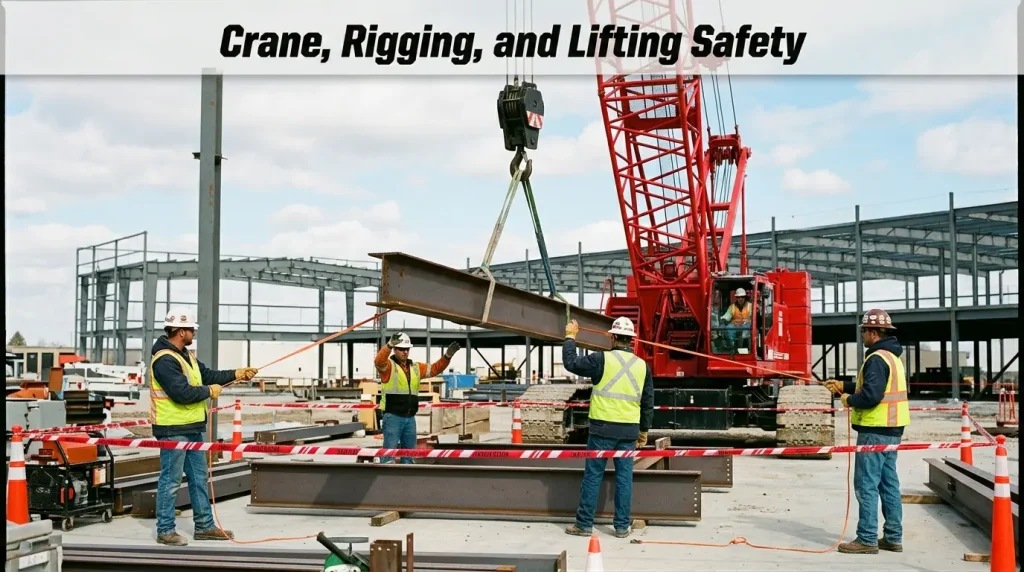
Cranes are involved in a significant number of fatal construction incidents. Crane collapses, contact with power lines, dropped loads, and crane tip-overs all cause deaths and serious injuries. The combination of high loads, complex mechanical systems, and the interaction of multiple workers makes lifting operations one of the highest-risk activities on any site.
8.1 Pre-Lift Planning
Every critical lift, and in many jurisdictions every crane lift, requires a documented lift plan. A critical lift typically involves loads exceeding 75 percent of a crane’s rated capacity, multiple cranes, or unusual conditions. The lift plan must address:
- Load weight including rigging and hardware
- Crane capacity at the required radius and boom angle (from the load chart)
- Ground bearing conditions and outrigger pad sizing
- Overhead clearances including power lines
- Swing radius exclusion zone
- Rigging selection: sling type, capacity, angle, and hitch method
- Communication plan: hand signals or radio channels
8.2 Rigging Fundamentals
- Never exceed the working load limit (WLL) of any rigging component
- Sling angle affects capacity: at 30 degrees from horizontal, a two-leg bridle sling carries only 50 percent of its vertical rated capacity
- Inspect all rigging before each use: reject slings with broken wires, kinks, hooks with more than 15 percent throat opening, or missing safety latches
- Protect slings from sharp edges using edge protectors or softeners
- The load must be rigged to prevent uncontrolled movement. Use tag lines to guide loads, not hands.
- Never stand under a suspended load. Never ride a crane hook or load.
8.3 Operator Qualification
In the United States, OSHA’s crane standard (29 CFR 1926.1427) requires that crane operators be certified by an accredited crane operator testing organization or qualified by an audited employer program. The certification must match the equipment type and lifting capacity. Certification and qualification are not interchangeable.
9. Confined Space Entry
Confined spaces claim the lives of workers and would-be rescuers every year. The rescuers who die attempting to save a fallen colleague are a particular tragedy because their deaths are entirely avoidable with proper emergency planning.
9.1 What Is a Permit-Required Confined Space?
A confined space has three defining characteristics: large enough for a worker to enter and perform work, limited means of entry or exit, and not designed for continuous worker occupancy. A permit-required confined space adds one or more serious hazards:
- Contains or has the potential to contain a hazardous atmosphere
- Contains material that could engulf an entrant
- Has an internal configuration that could trap or asphyxiate a worker
- Contains any other recognized serious safety or health hazard
Common construction permit-required confined spaces include manholes, underground vaults, tanks, silos, storage bins, hoppers, pipe sections, and excavations with limited egress.
9.2 Atmospheric Hazards
The atmosphere inside a confined space can be immediately dangerous to life or health (IDLH) due to:
- Oxygen deficiency: below 19.5 percent oxygen. Normal air is 20.9 percent. Oxygen-deficient atmospheres cause rapid incapacitation without warning smell.
- Oxygen enrichment: above 23.5 percent oxygen. Dramatically increases fire and explosion risk.
- Flammable gases or vapors: above 10 percent of the lower explosive limit (LEL)
- Toxic gases: carbon monoxide, hydrogen sulfide, nitrogen dioxide from diesel engines, or welding fumes
Testing must be performed before entry and continuously during occupation using a calibrated multi-gas monitor. Test for oxygen content, flammable gases, and the specific toxic gases likely to be present based on the space’s history and contents.
9.3 Entry Permit System
Every entry into a permit-required confined space requires an authorized entry permit that documents:
- The space to be entered and the date and duration of the entry
- The work to be performed
- Hazards identified and controls in place
- Acceptable entry conditions based on monitoring results
- Names of entrants, attendants, and entry supervisors
- Communication procedures
- Rescue and emergency services available
- Equipment required including atmospheric monitoring, PPE, and rescue equipment
The attendant (standby person) must remain outside the space at all times. The attendant monitors the entrants, tracks who is inside, communicates with entrants, and initiates rescue if needed. The attendant must never enter the space to perform rescue.
10. Hazardous Materials in Construction
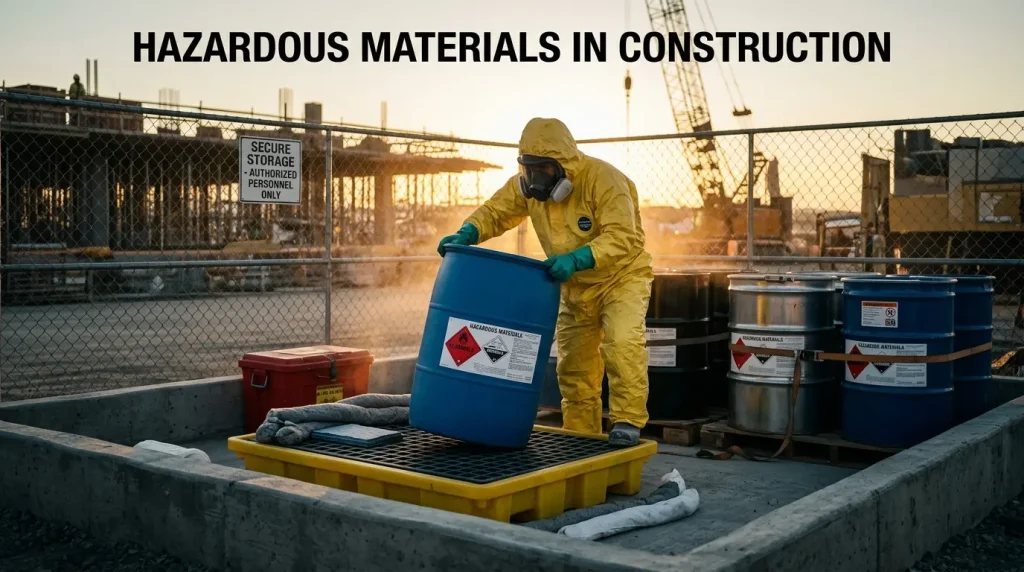
Construction workers face exposure to hazardous materials that may cause cancer, organ damage, and chronic disease years or decades after exposure. These health hazards are invisible, odorless, and tasteless, which makes them particularly dangerous because workers often underestimate or are unaware of the risk.
10.1 Silica Dust
Respirable crystalline silica is one of the most significant occupational health hazards in construction. It is generated when workers cut, grind, drill, or crush materials that contain silica: concrete, masonry, tile, and sandstone. Inhaled silica particles cause silicosis, an irreversible and progressive lung disease that can also lead to lung cancer.
OSHA’s silica standard (29 CFR 1926.1153) requires employers to limit worker exposure to 50 micrograms of respirable silica per cubic meter of air averaged over 8 hours. Compliance options include:
- Table 1 compliance: Follow OSHA’s specified engineering controls and work practices for listed tasks (for example, using wet methods or local exhaust ventilation when grinding concrete)
- Alternative compliance: Measure actual silica exposure and implement controls to meet the permissible exposure limit
Table 1 tasks and required controls include: using a vacuum with HEPA filter when jackhammering, wet cutting masonry with angle grinders, and wet drilling in rock or concrete. Respiratory protection is also required for many Table 1 tasks.
10.2 Asbestos
Asbestos was used extensively in construction materials until the late 1970s and into the 1980s. Buildings constructed before 1990 may contain asbestos in insulation, floor tiles, ceiling tiles, roofing materials, pipe insulation, and spray-applied fireproofing. Disturbing asbestos-containing materials releases fibers that cause mesothelioma, asbestosis, and lung cancer.
Before any demolition, renovation, or repair work on pre-1990 buildings, a licensed asbestos inspector must assess the site. If asbestos-containing materials are found, a licensed abatement contractor must remove them before construction work begins. Workers who may encounter asbestos must receive awareness training at minimum, and those involved in abatement require full Class I, II, or III asbestos worker certification depending on the scope of work.
10.3 Lead
Lead paint is common in structures built before 1978 in the United States and before similar cutoff dates in other countries. Lead exposure causes neurological damage, kidney disease, and developmental harm. Activities that generate lead dust include sanding, scraping, torching, demolishing, or disturbing lead paint surfaces.
OSHA’s lead standard for construction (29 CFR 1926.62) sets the permissible exposure limit at 50 micrograms per cubic meter and the action level at 30 micrograms per cubic meter. Engineering controls, respirators with appropriate cartridges, and decontamination procedures are required for lead work.
10.4 Chemical Safety and Hazard Communication
The OSHA Hazard Communication Standard (29 CFR 1910.1200, applicable to construction) requires:
- Safety Data Sheets (SDS) for all hazardous chemicals on site, accessible to workers at all times
- Proper labeling of chemical containers with the GHS (Globally Harmonized System) pictograms, signal word, hazard statements, and precautionary statements
- Training for workers on the chemicals they may encounter, how to read SDS sheets, and how to protect themselves
Common hazardous chemicals on construction sites include solvents, adhesives, epoxy resins, concrete curing compounds, spray paints, and compressed gases. Store incompatible chemicals separately, ventilate storage areas, and maintain a current SDS for every chemical on site.
11. Hand and Power Tool Safety
Hand and power tools are involved in a large number of non-fatal construction injuries: lacerations, crush injuries, punctures, and eye injuries. The familiarity that comes with daily tool use breeds complacency, which is when most tool-related injuries happen.
11.1 General Tool Safety Principles
- Inspect every tool before use. Do not use a tool with a cracked handle, missing guard, or damaged cord.
- Use the right tool for the job. Using a tool for an unintended purpose increases injury risk.
- Keep tools sharp. Dull blades require more force and are more likely to slip.
- Disconnect power before changing blades, bits, or accessories
- Never carry a power tool by its cord
- Store tools properly when not in use to prevent damage and unauthorized use
11.2 Abrasive Wheels and Grinders
Angle grinders are one of the most dangerous tools on construction sites. Disc failures at operating speed can project fragments at ballistic velocity. Key requirements:
- Inspect the wheel before mounting. Ring test: a properly cured wheel produces a clear ring when tapped. A cracked wheel produces a dull thud.
- Never exceed the maximum RPM marked on the wheel
- Always mount the correct guard and do not remove it
- Use the correct wheel for the material: cutting wheels for cutting, grinding wheels for grinding
- Wear a face shield over safety glasses when grinding
- Keep bystanders clear of the grinding zone
11.3 Powder-Actuated Tools
Powder-actuated tools fire a fastener into concrete or steel using a powder charge. The velocity is comparable to a firearm. Only trained and authorized operators may use them. Key safety requirements:
- Never point a powder-actuated tool at another person
- Inspect the tool before use according to the manufacturer’s instructions
- Do not use in explosive atmospheres
- If the tool misfires, wait 30 seconds before attempting to remove the cartridge
- Wear hearing protection and eye protection
12. Welding, Cutting, and Hot Work Safety

Welding and cutting operations create multiple simultaneous hazards: fire, toxic fumes, intense UV radiation causing arc eye and skin burns, electrical shock, and explosion from compressed gases. Hot work is responsible for a significant share of construction site fires.
12.1 Hot Work Permits
A hot work permit is a written authorization that confirms appropriate fire precautions are in place before welding, cutting, brazing, or any other spark-producing work begins. The permit process involves:
- Identifying and removing all combustible materials within 35 feet of the hot work area
- Wetting down combustible surfaces that cannot be removed
- Covering openings and cracks with fireproof blankets to prevent sparks from dropping to lower levels
- Confirming fire extinguishers are immediately available at the work site
- Designating a fire watch who remains in the area for at least 30 minutes after hot work is complete
12.2 Welding Fumes
Welding fumes contain metallic oxides, fluorides, and silicates that cause respiratory disease. Stainless steel welding generates hexavalent chromium, a confirmed human carcinogen. Galvanized metal welding releases zinc oxide, which causes metal fume fever.
- Use local exhaust ventilation positioned to capture fumes at the source
- Never weld in a confined space without forced air ventilation and continuous atmospheric monitoring
- Use respiratory protection appropriate for the materials being welded
- Keep your head out of the fume plume
12.3 Compressed Gas Cylinder Safety
- Store cylinders upright and secured to prevent tipping
- Keep oxygen and fuel gas cylinders separated by at least 20 feet or a fire-rated wall
- Cap all cylinders when not in use
- Transport cylinders using a proper cart: do not roll them on their bottom edge or carry them horizontally
- Never use oil or grease on oxygen equipment: oil ignites spontaneously in high-oxygen environments
- Never store cylinders near heat sources or open flames
13. Demolition Safety
Demolition is statistically more dangerous than most types of new construction. The hazards include structural instability, unexpected hazardous materials, compromised utilities, and the unpredictability inherent in breaking down an existing structure whose full condition may not be known.
13.1 Pre-Demolition Engineering Survey
Before any demolition begins, a competent person must conduct an engineering survey of the structure to determine its condition, methods of construction, and the possibility of unplanned collapse. The survey must consider:
- The structural system and how it will be affected as elements are removed
- The location of load-bearing walls, columns, and beams
- Underground structures including basements, vaults, and tanks
- Utility locations: gas, electric, water, sewer, and communications
- The presence of hazardous materials: asbestos, lead, PCBs, and mercury-containing equipment
13.2 Hazardous Material Remediation Before Demolition
All identified asbestos, lead paint, and other hazardous materials must be removed or rendered safe before demolition equipment is brought in. Demolition disrupts materials far more aggressively than normal renovation work and can release dangerous quantities of hazardous fibers and dust that no air filtration system can fully control at demolition scale.
13.3 Structural Controls During Demolition
- Demolish walls and floors in reverse order of construction where possible
- Do not demolish floor or roof sections that support other floors above
- Shore or brace structural elements that will be temporarily unsupported during progressive demolition
- Establish and enforce exclusion zones around demolition work: no person within the potential collapse zone
- Wet down masonry and concrete before demolition to control dust
14. Fire Safety on Construction Sites

Construction sites are fire environments: flammable materials are abundant, temporary electrical systems are imperfect, and hot work creates ignition sources. A fire on a construction site can spread rapidly because fire suppression systems have not yet been installed and the building shell may be open.
14.1 Fire Prevention
- Store flammable and combustible liquids in approved safety cans with flame-arrestor screens
- Keep quantity of flammable liquids at the point of use to the minimum needed for one shift
- Maintain a minimum 35-foot separation between flammable storage areas and hot work
- Dispose of oily rags and combustible waste in metal containers with self-closing lids
- Ensure that temporary heaters are kept away from combustible materials and are turned off when the area is unoccupied
- Perform a fire hazard inspection at the end of each shift
14.2 Fire Extinguisher Requirements
OSHA requires portable fire extinguishers on construction sites. NFPA 10 provides the placement standard: a fire extinguisher must be within 75 feet of any point in the area where combustible or flammable materials are present. All workers must know the location of extinguishers and how to operate them.
The PASS method for operating a fire extinguisher:
- P: Pull the safety pin
- A: Aim the nozzle at the base of the fire
- S: Squeeze the handle slowly
- S: Sweep from side to side until the fire is extinguished
Know when not to fight a fire. If the fire is larger than a waste basket, if you do not have the right extinguisher type, or if you are not sure how to use it, evacuate and call emergency services.
14.3 Emergency Evacuation Planning
Every construction site must have a written emergency action plan (OSHA 29 CFR 1926.35) that addresses:
- Emergency escape procedures and route assignments
- Procedures for workers who must remain to shut down critical systems before evacuation
- How to account for all workers after evacuation
- Designated rescue and medical duties for workers assigned those functions
- Preferred means of reporting fires and emergencies
- Names, titles, and contact information for persons who can be contacted for further information
15. Traffic Control and Work Zone Safety
Work zones where construction meets moving vehicle traffic are among the most dangerous environments in construction. Flagger fatalities, worker struck-by incidents from vehicles, and multi-vehicle accidents in work zones occur regularly.
15.1 Temporary Traffic Control Plans
A temporary traffic control (TTC) plan, sometimes called a traffic management plan, must be developed for any construction work affecting public roadways. The plan must comply with the Manual on Uniform Traffic Control Devices (MUTCD) in the United States or equivalent national standards elsewhere. It specifies:
- Warning sign placement and spacing based on posted speed limit
- Channelizing device type, placement, and spacing
- Lane closure procedures
- Speed reduction measures
- Flagger positioning and communication
15.2 Flagger Safety
Flaggers directing traffic are exposed to both vehicle traffic and construction site hazards simultaneously. Requirements include:
- Class 3 high-visibility safety garments at all times
- OSHA-approved flagger paddle or stop/slow sign. Using only hand signals is not acceptable.
- Positioning in a location that allows the flagger to be seen by traffic and to escape if a vehicle does not comply
- Training in proper flagging procedures before assignment
16. Construction Safety Training
Training is where knowledge becomes behavior. A well-designed training program does not just transfer information. It changes what workers do when they are standing at the edge of a trench, operating near overhead wires, or deciding whether to report a near-miss.
16.1 New Worker Orientation
Workers in their first year on a construction site are injured at a significantly higher rate than experienced workers. New worker orientation must cover:
- Site-specific hazards and emergency procedures
- PPE requirements and how to obtain, inspect, and use them
- Reporting procedures for injuries, near-misses, and hazards
- Who to contact with safety questions or concerns
- The company’s stop-work authority policy
Pair every new hire with an experienced worker for at least the first two weeks. Mentoring reduces new-worker injury rates more effectively than additional classroom training alone.
16.2 Toolbox Talks
Toolbox talks are short (5-15 minute) safety briefings held before a shift or before beginning a specific task. They are the most effective training format for behavioral change because they are frequent, task-specific, and conversational. Effective toolbox talks:
- Address a specific hazard relevant to that day’s work
- Invite workers to share their own experiences and observations
- Are documented with date, topic, attendees, and any actions taken
- Are delivered by a supervisor who is present on site, not a video played in a break room
16.3 Competent Person Requirements
OSHA requires a competent person to be responsible for specific high-risk activities. A competent person is defined as one who is capable of identifying existing and predictable hazards in the surroundings or working conditions which are unsanitary, hazardous, or dangerous to employees and who has authorization to take prompt corrective measures to eliminate them.
OSHA specifically requires a competent person for: excavation and trenching, scaffold erection and inspection, fall protection, steel erection, and cranes and derricks, among others.
16.4 OSHA 10-Hour and 30-Hour Training
OSHA Outreach Training provides workers and supervisors with general industry and construction safety knowledge:
- OSHA 10: A 10-hour course covering construction hazard identification and avoidance. Commonly required by contract on public projects.
- OSHA 30: A 30-hour course for supervisors and safety personnel. Covers the same topics in greater depth plus program management, safety culture, and regulatory navigation.
OSHA Outreach Training completion is not a substitute for task-specific training required by specific OSHA standards, such as confined space entry training, crane operator certification, or fall protection training.
17. Job Hazard Analysis
A Job Hazard Analysis (JHA), also called a Job Safety Analysis (JSA) or Activity Hazard Analysis (AHA), is a formal process for identifying the hazards associated with each step of a specific task before the task begins and determining appropriate control measures for each hazard.
17.1 Steps in a JHA
- Step 1: Select the job to analyze. Prioritize new tasks, tasks with injury history, and tasks with significant consequences of failure.
- Step 2: Break the task into sequential steps. List each discrete action, not the entire task as one item.
- Step 3: Identify hazards for each step. Ask: what could go wrong? What has gone wrong in the past?
- Step 4: Identify control measures. Work through the hierarchy of controls for each hazard.
- Step 5: Document and communicate. Review the JHA with the crew performing the task before it begins.
- Step 6: Revise when conditions change. A JHA is not a permanent document. Update it whenever the task, equipment, or work environment changes.
17.2 Pre-Task Planning
Pre-task planning is a brief, informal version of JHA conducted by the crew at the start of each work activity. The foreman and workers take five minutes to walk through the task, identify the top hazards for that specific day and that specific site condition, and confirm that controls are in place. Pre-task planning catches hazards that the formal JHA, written days or weeks earlier, may not have anticipated.
18. Permit-to-Work Systems
A permit-to-work (PTW) system is a formal documented safety control system used for non-routine high-hazard work. It ensures that the responsible person has assessed the work, identified all hazards, put controls in place, and authorized the work to proceed.
18.1 Types of Work Permits
- Hot work permit: Required for welding, cutting, grinding, or any other spark-producing work in areas with fire or explosion risk
- Confined space entry permit: Required before any worker enters a permit-required confined space
- Electrical isolation permit: Documents LOTO procedures and confirms energy isolation before electrical work begins
- Excavation permit: Used on sites where underground utilities are present or soil conditions are complex
- Working at height permit: Used on some sites for work above a specified height threshold where standard guardrails cannot be used
18.2 The Permit Cycle
Every permit follows a defined cycle: issue, use, and close. The issuing authority (typically the site supervisor or safety officer) prepares and signs the permit. The performing authority (the crew doing the work) accepts the permit and works within its conditions. When the work is complete, the permit is formally closed and the site is restored to a safe condition. Open permits must not be used as authorization for work after the stated period.
19. Regulatory Framework
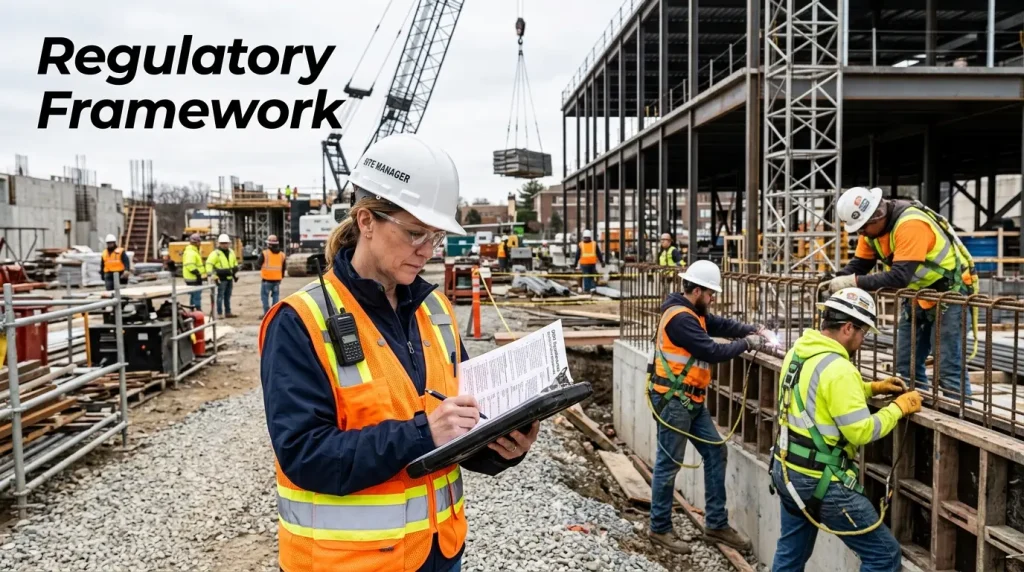
Construction safety is regulated at national and international levels. Understanding the regulatory landscape helps employers maintain compliance and workers understand their rights.
19.1 United States: OSHA
The Occupational Safety and Health Administration (OSHA) enforces federal construction safety standards under Title 29 of the Code of Federal Regulations, Part 1926. Key subparts include:
- Subpart C: General Safety and Health Provisions including competent person requirements
- Subpart D: Occupational Health and Environmental Controls including hazard communication and noise
- Subpart E: Personal Protective and Life Saving Equipment
- Subpart F: Fire Protection and Prevention
- Subpart K: Electrical
- Subpart L: Scaffolding
- Subpart M: Fall Protection
- Subpart N: Cranes, Derricks, Hoists, Elevators, and Conveyors
- Subpart P: Excavations
- Subpart Q: Concrete and Masonry Construction
- Subpart R: Steel Erection
- Subpart S: Underground Construction, Caissons, Cofferdams, and Compressed Air
- Subpart T: Demolition
- Subpart V: Power Transmission and Distribution
- Subpart X: Stairways and Ladders
- Subpart Z: Toxic and Hazardous Substances
OSHA Penalties (2024)
- Serious violation: up to USD 16,131 per violation
- Willful or repeated violation: up to USD 161,323 per violation
- Failure to correct: up to USD 16,131 per day beyond the abatement date
19.2 United Kingdom: HSE
The Health and Safety Executive (HSE) enforces the Health and Safety at Work etc. Act 1974 and associated regulations including the Construction (Design and Management) Regulations 2015 (CDM 2015). CDM 2015 requires a Principal Designer to plan, manage, monitor, and coordinate health and safety during the pre-construction phase, and a Principal Contractor to do the same during construction. Projects must have a Construction Phase Plan and, for projects meeting certain thresholds, an F10 notification to the HSE.
19.3 European Union: Construction Sites Directive
EU Directive 92/57/EEC (Construction Sites Directive) establishes minimum safety requirements for construction sites across EU member states. It requires a safety and health plan for projects above a size threshold and mandates a safety coordinator when multiple contractors work on the same site simultaneously. National legislation in each EU country implements the directive.
19.4 ILO International Standards
The International Labour Organization’s Code of Practice on Safety and Health in Construction, revised in 2022, provides a global framework that many countries use as a baseline. Its key principles include:
- Prevention through design: Safety must be considered during the design phase, not added on during construction
- Risk assessment before work begins
- Worker participation in safety planning
- Contractor coordination on multi-employer sites
19.5 ISO 45001: Occupational Health and Safety Management Systems
ISO 45001 is the international standard for occupational health and safety (OHS) management systems. It replaced OHSAS 18001 in 2018 and uses the same high-level structure as ISO 9001 (quality) and ISO 14001 (environment). Certification to ISO 45001 demonstrates to clients, insurers, and regulators that a company has a structured, auditable approach to managing OHS risk.
The standard is built on the Plan-Do-Check-Act (PDCA) cycle:
- Plan: Identify hazards, assess risks, set objectives, and plan controls
- Do: Implement controls, conduct training, and communicate
- Check: Monitor performance, audit the system, and investigate incidents
- Act: Take corrective action, continually improve the system
20. Building a Construction Safety Plan
A site-specific safety plan is not a generic template downloaded from the internet. It is a living document built around the specific hazards, crew, location, and scope of a particular project. Every major construction project should have one.
20.1 What a Safety Plan Must Include
- Project description and site information
- Safety roles and responsibilities: who is responsible for what
- Site-specific hazard identification and risk assessment
- Required permits and their processes
- Emergency response procedures: who to call, evacuation routes, muster points, nearest hospital
- Incident and near-miss reporting procedures
- PPE requirements by task
- Training requirements and documentation
- Subcontractor safety management procedures
- Safety inspection schedule
- Disciplinary procedures for safety violations
20.2 Emergency Response Planning
The emergency response section must be specific, not generic. It must include:
- The address of the site and GPS coordinates for emergency services
- The location of the nearest hospital with trauma capability and the route to get there
- Names and phone numbers of the site safety officer and project manager
- Assembly points and how to account for all workers after an evacuation
- Procedures specific to the site’s likely emergency scenarios: fire, medical emergency, trench collapse, structural failure, hazardous material release
21. Incident Reporting and Investigation

The goal of incident investigation is not to assign blame. It is to understand exactly what happened and why, so the same event cannot happen again. Companies that treat incident investigation as a blame exercise train workers to hide incidents, which guarantees they will recur.
21.1 What Must Be Reported to OSHA
Employers must notify OSHA:
- Within 8 hours: any work-related fatality
- Within 24 hours: any work-related inpatient hospitalization, amputation, or loss of an eye
Recordable injuries, which appear on the OSHA 300 log, include work-related injuries or illnesses that result in days away from work, restricted work or transfer, medical treatment beyond first aid, loss of consciousness, or diagnosis of a significant injury by a health care professional.
21.2 Near-Miss Reporting
A near-miss is any event that could have caused injury or property damage but did not, by chance or because someone intervened. Near-misses are the most valuable safety data a site generates because they reveal the exact conditions that lead to incidents before anyone is hurt. Sites that have a high near-miss reporting rate are not more dangerous. They are better at identifying and correcting hazards before they cause harm.
Encourage near-miss reporting by making the process easy (a simple form or app), responding to every report visibly, and never using near-miss reports as the basis for discipline.
21.3 Root Cause Analysis
Surface-level incident investigation asks what happened. Root cause analysis asks why it happened and what conditions allowed it to happen. Effective root cause analysis tools include:
- 5 Whys: Ask why repeatedly until you reach the underlying system failure, not just the proximate cause
- Fishbone (Ishikawa) diagram: Organize potential causes by category: people, methods, machines, materials, environment, measurement
- Fault tree analysis: A formal top-down approach to mapping the logic of how an event occurred
Corrective actions that only address worker behavior, ‘worker failed to wear PPE,’ without addressing the conditions that made that behavior likely, will not prevent recurrence.
22. Subcontractor Safety Management
Most construction projects involve multiple subcontractors working on the same site simultaneously. Managing safety across multiple employers requires clear agreements, coordination, and consistent enforcement.
22.1 Pre-Qualification
Before awarding a subcontract, evaluate the subcontractor’s safety performance:
- Experience Modification Rate (EMR): An EMR above 1.0 indicates worse-than-average claims history. Many general contractors will not award contracts to subs with EMRs above 1.2.
- OSHA 300 log and incident rates for the past three years
- Their written safety program and whether it addresses the hazards specific to their scope of work
- Evidence of required certifications and training for their workers
22.2 Coordination During the Project
- Include subcontractors in site safety orientation before their crew begins work
- Hold regular coordination meetings where subcontractor safety representatives participate
- Ensure subcontractors understand the site’s permit-to-work system, emergency procedures, and housekeeping standards
- Conduct joint inspections with subcontractor safety representatives
- Address safety violations by subcontractor crews promptly. Allowing different standards for subcontractors versus direct employees creates a two-tier safety culture.
23. Heat, Cold, and Weather Safety
Outdoor construction workers are directly exposed to weather conditions that can kill or incapacitate faster than most recognized construction hazards. Heat illness, cold stress, lightning, and high wind all present serious risks that require active management.
23.1 Heat Illness Prevention
Heat is one of the most underreported causes of construction worker deaths. Heat stroke can kill within minutes if not treated immediately. The risk is highest for new workers in their first days on a hot site: the body needs 7-14 days of gradual exposure to acclimatize to heat.
Heat Illness Progression
- Heat cramps: Painful muscle spasms due to salt and fluid loss. Move to cool area, drink electrolyte fluids.
- Heat exhaustion: Heavy sweating, cool pale skin, fast weak pulse, nausea, dizziness, headache. Move to cool area, loosen clothing, apply cool wet cloths, give fluids if conscious. Call emergency services if no improvement within 15 minutes.
- Heat stroke: High body temperature above 103 degrees F (39.4 C), hot red dry or moist skin, rapid strong pulse, confusion, loss of consciousness. This is a medical emergency. Call 911 immediately. Cool the person rapidly with whatever means are available: cool water, ice packs to armpits and groin, cool mist with fan.
Heat Illness Prevention Program
California’s Heat Illness Prevention Standard (Title 8, Section 3395), now widely adopted as a model, requires:
- Drinking water: at least one quart (one liter) per worker per hour in the heat
- Shade: enough to accommodate all workers resting at any given time, maintained at less than 80 degrees F when possible
- Cool-down rest periods: when a worker feels the need to protect themselves from overheating
- High heat procedures when temperatures reach 95 degrees F or above
- Acclimatization: a structured plan for gradually increasing heat exposure for new workers and returning workers
- Emergency response planning specific to heat-related illness
23.2 Cold Stress
Cold weather reduces manual dexterity, impairs judgment, and causes frostbite and hypothermia. Construction workers are particularly vulnerable when exposed to cold temperatures combined with wind, rain, or physical exertion that results in wet clothing.
- Dress in layers: moisture-wicking base layer, insulating mid-layer, wind and waterproof outer layer
- Schedule warm-up breaks in heated areas
- Keep workers dry: wet clothing loses most of its insulating value
- Recognize early signs of frostbite: numbness, white or grayish-yellow skin, hard or waxy texture
- Recognize hypothermia: shivering, exhaustion, confusion, slurred speech, slow or clumsy movement
23.3 Lightning Safety
Lightning is a serious but often ignored construction hazard. Workers on cranes, structural steel, scaffolding, and rooftops are particularly exposed.
- Suspend outdoor work when lightning is within 10 miles (when thunder can be heard)
- Resume work only after 30 minutes has passed since the last thunder
- Avoid contact with metal structures, equipment, and standing water during a storm
- Do not shelter under trees or in open-sided sheds: seek enclosed buildings or hard-topped vehicles
24. Mental Health and Fatigue in Construction
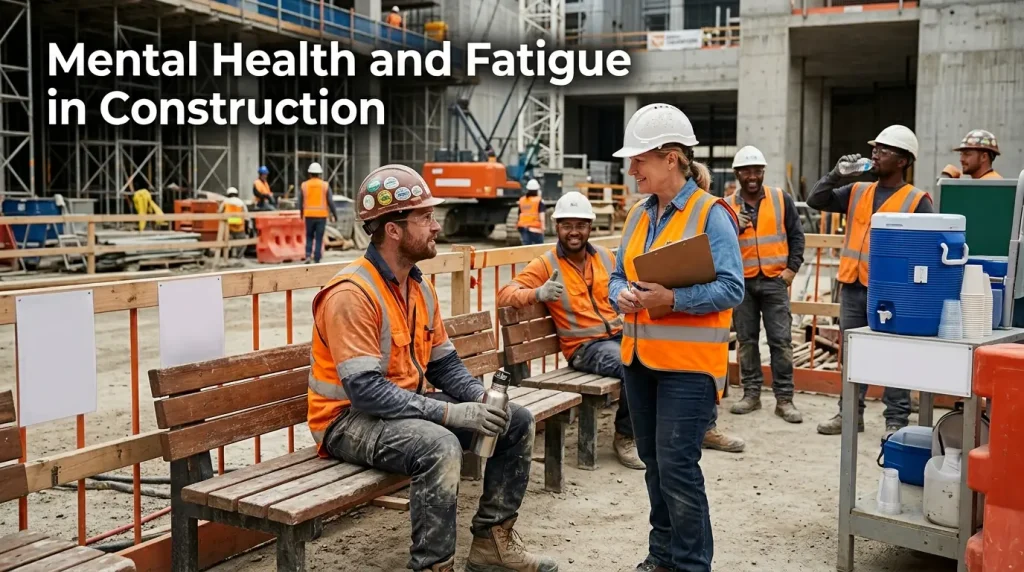
The construction industry has one of the highest suicide rates of any occupation. Male construction workers in the United States die by suicide at a rate more than three times the national average. Mental health is a construction safety issue. Ignoring it costs lives.
24.1 Risk Factors in Construction
- Physically demanding and often painful work that takes a cumulative toll on the body
- Irregular employment, including layoffs and seasonal work, that creates financial insecurity
- Work culture that stigmatizes vulnerability and discourages help-seeking
- Exposure to traumatic events including fatal accidents and serious injuries
- Physical separation from family during long-haul and infrastructure projects
- High rates of musculoskeletal pain that may lead to opioid prescriptions and dependence
24.2 Fatigue
Fatigued workers make more errors, react more slowly, and are more likely to take shortcuts. Long shifts, night work, physical exertion, and irregular sleep schedules combine to create significant fatigue risk in construction. Studies show that 17 hours of continuous wakefulness produces impairment equivalent to a blood alcohol level of 0.05 percent.
- Limit consecutive working hours and ensure adequate rest between shifts
- Recognize fatigue as a site hazard, not a personal weakness
- Never operate cranes, aerial lifts, or other complex equipment when fatigued
- Rotate physically demanding tasks to reduce both physical and mental strain
24.3 Substance Abuse
Construction has elevated rates of alcohol and illicit drug use compared to most other industries. Substance use impairs judgment, coordination, and reaction time, directly increasing injury risk for the user and coworkers.
- Establish a written substance abuse policy that workers understand before they are hired
- Provide access to Employee Assistance Programs (EAPs) that offer confidential counseling and referral
- Train supervisors to recognize impairment and respond appropriately
- Approach substance abuse as a health issue rather than primarily a disciplinary one
25. Building a Real Safety Culture

Rules without culture produce compliance without commitment. A real safety culture is one where workers follow safety procedures because they genuinely believe they matter, not because they are afraid of being caught skipping them. The difference in outcomes between these two states is enormous.
25.1 Leadership Behavior
Nothing communicates organizational priorities more clearly than what leaders do, not what they say. When a superintendent walks past a worker without a hard hat and says nothing, every other worker on site notices. When that same superintendent stops, has a respectful conversation, and ensures the worker has the proper PPE, every worker also notices.
- Leaders must follow every safety rule they enforce, without exception
- Senior management must be visibly present on sites and actively engaged in safety discussions
- Safety performance must factor into supervisory performance evaluations and compensation
25.2 Worker Empowerment and Stop-Work Authority
Stop-work authority is the right and responsibility of any worker to stop a job when they believe it presents an imminent danger. This right is meaningless unless workers trust they will not face retaliation for using it. Companies that discipline workers for stopping unsafe work destroy this trust permanently.
- Communicate stop-work authority clearly to all workers during orientation
- Recognize and thank workers who use stop-work authority, regardless of whether the concern turns out to be serious
- Never suggest that stopping work for safety reasons is causing problems or delaying the project
25.3 Near-Miss Culture
The ratio of near-misses to serious incidents is estimated at 300:1 by Heinrich’s Triangle and similar frameworks. Every serious accident is preceded by hundreds of near-misses that were never reported or investigated. A site that investigates near-misses like real incidents is mining its most valuable safety data.
25.4 Safety Recognition
Recognize safe behavior, not just the absence of incidents. Rewarding crews for zero incidents can incentivize underreporting rather than actual safety improvement. Instead, recognize the behaviors that prevent incidents: completing JHAs, reporting near-misses, using stop-work authority, conducting thorough equipment inspections.
26. Technology in Construction Safety
Construction safety technology has advanced significantly in the past decade. While technology does not replace fundamental practices, it adds meaningful layers of protection on sites that use it well.
26.1 Wearable Safety Technology
- Fall detection wearables: Sensors that detect sudden deceleration consistent with a fall and send an immediate alert to supervisors, especially valuable for workers in isolated areas
- Heat stress monitors: Wristband devices that track skin temperature and heart rate to identify heat illness risk before symptoms appear
- Location tracking: Ultra-wideband or GPS-based systems that track worker location in real time, enable evacuation accounting, and alert supervisors when workers enter exclusion zones
- Fatigue monitoring: Smart helmets with sensors that detect microsleep episodes or head drooping associated with extreme fatigue
26.2 Drones
Drones allow inspection of roofs, scaffolding, structural elements, and elevated areas without putting a worker at height for a routine check. They are particularly valuable for post-storm inspections, progress monitoring, and thermal imaging of building envelopes.
26.3 AI-Powered Safety Monitoring
Computer vision systems installed on site cameras can automatically detect workers who are not wearing hard hats or high-visibility vests, workers who have entered an exclusion zone, and equipment operating dangerously close to pedestrians. These systems provide real-time alerts and generate compliance data that manual walkthroughs cannot match at scale.
26.4 Digital Safety Management Platforms
Digital platforms replace paper-based safety management with systems that:
- Digitize toolbox talks with electronic sign-in and topic tracking
- Manage training records and certifications with expiration alerts
- Facilitate mobile incident and near-miss reporting from the field
- Track corrective actions from incident investigation to closure
- Generate inspection reports and compliance dashboards
26.5 Building Information Modeling for Safety
BIM allows construction projects to be simulated digitally before physical work begins. Safety professionals can use BIM to identify high-risk work sequences, plan fall protection for specific locations, coordinate crane lift paths with other site activities, and review site logistics to separate pedestrian and vehicle traffic.
27. Trade-Specific Safety Considerations
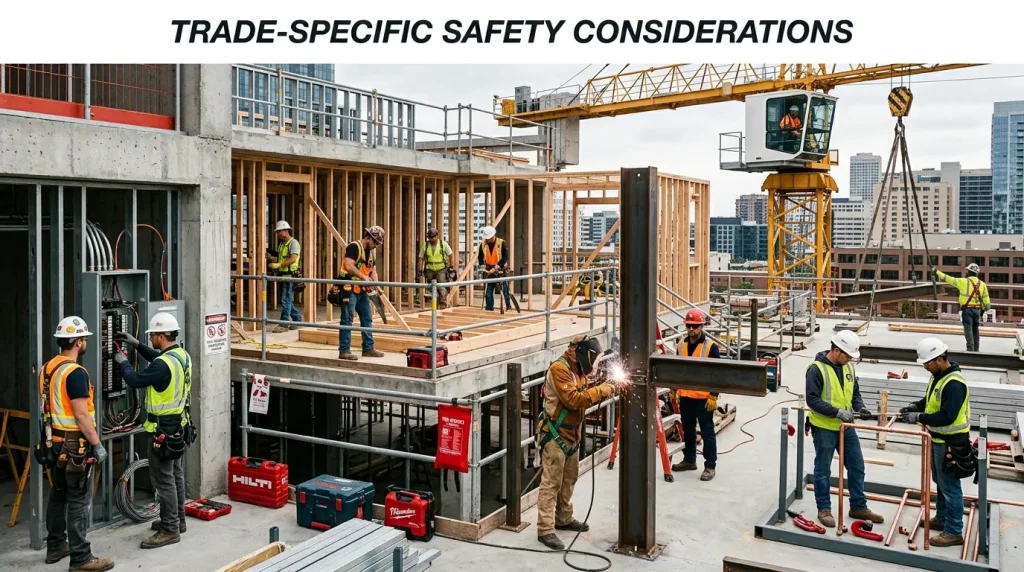
Different construction trades face distinct risk profiles. A safety program that addresses only generic hazards misses the specific risks that kill workers in particular trades.
27.1 Roofers
Roofers face the highest fatality rate of any construction trade. The primary cause is falls, but heat illness, inadequate fall protection on steep slopes, and fragile skylights are major contributing factors.
- Every roofing job requires a written fall protection plan before work begins
- Leading edge work on slopes greater than 4:12 requires PFAS unless the use of a safety net or guardrail system is feasible
- Never allow workers to walk on skylights or fragile roofing materials without covers rated for human weight
- Schedule heat-sensitive roofing work for early morning hours in summer
27.2 Electricians
Electricians face elevated risk from electrocution, arc flash, and falls from ladders. Electricians also work in partially completed buildings where they may encounter structural openings not yet guarded by other trades.
- All electricians working on energized systems must be qualified electrical workers with documented training
- Arc flash personal protective equipment must match the incident energy level determined by an arc flash hazard analysis
- Establish clear procedures for working near other trades who may inadvertently contact or disturb electrical work
27.3 Ironworkers and Steel Erectors
Steel erection exposes workers to fall risk at extreme heights, struck-by risk from structural members being placed by crane, and caught-between risk from shifting loads. OSHA’s steel erection standard (29 CFR 1926 Subpart R) contains specific requirements including:
- Decking must be secured as soon as it is placed
- Shear connectors must not be installed from the leading edge of metal decking unless fall protection is in place
- A controlled decking zone may be used as an alternative to conventional fall protection during decking operations, subject to specific conditions
- Connectors (workers connecting structural members) must be protected by a positioning device system at heights between 15 and 30 feet, and by fall arrest above 30 feet
27.4 Concrete Workers
Concrete work presents hazards including formwork and shoring failure, concrete burns from skin contact with wet concrete, silica exposure from cutting and grinding, and struck-by incidents from concrete pumping equipment.
- Formwork and shoring must be designed by a qualified engineer for any elevated concrete placement
- Workers must wear waterproof gloves and boots when handling wet concrete: wet concrete is corrosive and can cause serious chemical burns with extended skin contact
- Cutting and coring concrete generates respirable silica: use wet cutting or local exhaust ventilation
28. Worker Rights in Construction Safety
Workers have legal rights related to safety that exist independent of their employer’s policies. Understanding these rights is important for workers and employers alike.
28.1 Right to Refuse Unsafe Work
In the United States, workers have the right to refuse work that they reasonably believe presents a serious danger of death or physical harm. To be protected from retaliation, the worker must have a reasonable belief that the danger is real and have first requested that their employer correct the condition. OSHA Section 11(c) prohibits retaliation against workers who exercise this right.
28.2 Right to Know
Workers have the right to information about the hazardous substances they work with. The OSHA Hazard Communication Standard requires employers to provide SDS sheets for all hazardous chemicals, label containers appropriately, and train workers on chemical hazards. Workers have the right to access this information at any time.
28.3 Whistleblower Protections
OSHA administers whistleblower protection laws for workers who report safety violations, file OSHA complaints, or participate in OSHA investigations. Employers may not fire, demote, transfer, or otherwise retaliate against workers for these protected activities. Workers who believe they have been retaliated against must file a complaint with OSHA within 30 days of the alleged retaliation.
28.4 Filing an OSHA Complaint
Any worker can file a confidential complaint with OSHA about workplace safety conditions. OSHA will investigate complaints alleging serious hazards or violations. Complaints can be filed online at osha.gov, by phone, by mail, or in person at any OSHA office. The worker’s name is kept confidential if they request it.
29. Site Organization and Housekeeping
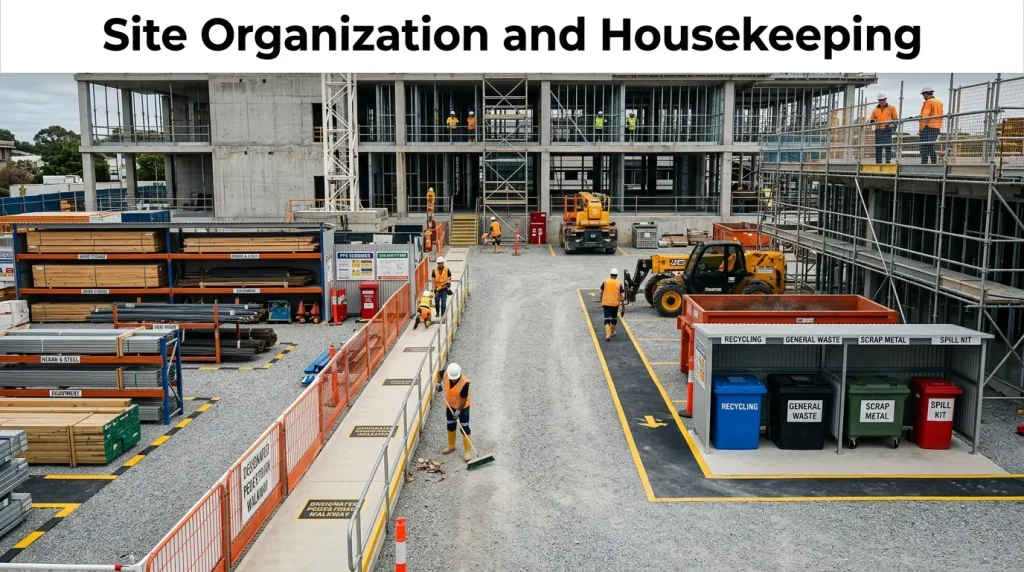
A well-organized site is safer, more productive, and easier to manage. Housekeeping is not a cosmetic concern. It is a fundamental safety practice. Cluttered sites have more slips, trips, and falls. Disorganized material storage creates falling object hazards. Poor waste management creates fire risks.
29.1 Daily Housekeeping Standards
- Clear all walkways of cords, hoses, debris, and materials at the start and end of every shift
- Stack and store materials off the ground on pallets or in racks, away from walkways and work areas
- Remove protruding nails from form lumber as soon as forms are stripped
- Dispose of combustible waste in metal containers with self-closing lids. Do not allow combustible scrap to accumulate.
- Assign end-of-shift cleanup responsibility specifically rather than leaving it to whoever is available
29.2 Dust Control
Construction dust from concrete cutting, sanding, and demolition creates both health hazards (silica, asbestos, lead) and fire hazards (fine combustible dust). A written dust control plan should specify:
- Wet methods for cutting and grinding operations that generate dust
- Local exhaust ventilation for enclosed spaces where dusty operations occur
- Respiratory protection requirements by task and exposure level
- Cleaning procedures: vacuum with HEPA filtration rather than sweeping or blowing dust
30. Construction Safety Checklists
30.1 Daily Pre-Shift Safety Checklist
- All workers have required PPE and it is in good condition
- Fall protection is in place for any work above six feet
- Excavations have been inspected by a competent person and are properly protected
- All walkways and access routes are clear
- Fire extinguishers are accessible and recently inspected
- Heavy equipment has completed a pre-operation inspection
- All electrical hazards are identified and protected
- Hot work and confined space permits are issued and current
- Toolbox talk has been conducted and documented
- Weather conditions have been assessed and accounted for in the work plan
- Emergency contact information is posted and all workers know the muster point
- Workers performing high-risk tasks have completed the pre-task JHA
30.2 Weekly Site Safety Inspection Checklist
- Scaffold inspection completed by competent person
- All ladders inspected and tagged by condition
- Housekeeping audit: materials stored correctly, walkways clear
- PPE inspection: verify condition of harnesses, respirators, and other critical PPE
- Fire extinguisher inspection tags current
- Safety signage: all required signs in place and legible
- First aid kit: fully stocked and accessible
- Near-miss and incident log reviewed
- Training records: verify all workers are current on required certifications
- Subcontractor safety coordination: confirm all subs are operating within site safety requirements
30.3 Equipment Pre-Operation Inspection Checklist
- Fluid levels checked: engine oil, hydraulic fluid, coolant, fuel
- Tire condition and inflation checked
- All lights, alarms, and gauges operational
- Backup alarm functional
- All guards and covers in place
- Seat belt or operator restraint functional
- Brakes and steering tested
- Controls labeled and responsive
- No unusual noises, leaks, or vibrations during startup
- Deficiencies noted in the equipment log and reported to maintenance
31. Frequently Asked Questions
What is the leading cause of construction deaths?
Falls from height are the leading cause of construction fatalities worldwide, followed by struck-by incidents, electrocution, and caught-in or caught-between incidents. These four categories, known as the Fatal Four, account for more than 60 percent of U.S. construction worker deaths.
What PPE is required on a construction site?
Minimum required PPE on most construction sites includes a hard hat, safety glasses, steel-toe or composite-toe boots, and high-visibility clothing. Additional PPE requirements depend on the tasks performed: fall arrest harnesses for work above six feet, respiratory protection for silica or chemical exposure, hearing protection for noise above 85 dB, and appropriate gloves for the materials being handled.
Who is responsible for construction site safety?
Safety responsibility is shared across all levels. The employer is legally responsible for providing training, equipment, and a safe work environment. Site supervisors are responsible for daily enforcement and hazard identification. Individual workers are responsible for following procedures, using PPE correctly, and reporting hazards. When multiple contractors work on the same site, a site safety coordinator role is often established to coordinate across employers.
What is the difference between OSHA 10 and OSHA 30?
OSHA 10 is a 10-hour awareness-level course covering basic construction hazard identification. OSHA 30 is a 30-hour course intended for supervisors and safety personnel, covering the same topics in greater depth plus safety program management. Both are offered through OSHA-authorized trainers. Neither is a substitute for task-specific training required by specific OSHA standards.
What is a competent person under OSHA?
A competent person is someone who is capable of identifying existing and predictable hazards and has the authority to take prompt corrective measures. OSHA requires a competent person for scaffold inspection, excavation assessment, fall protection planning, and other specific high-risk activities. A competent person must have training and experience specific to the hazards they are responsible for assessing.
What is a confined space and why is it dangerous?
A confined space is large enough for a worker to enter and perform work, has limited means of entry or exit, and was not designed for continuous worker occupancy. Permit-required confined spaces add a serious hazard such as a potentially hazardous atmosphere. They are dangerous because oxygen-deficient or toxic atmospheres can incapacitate workers almost instantly, and because limited egress makes rescue difficult. Would-be rescuers who enter without proper equipment to save a fallen colleague are themselves killed in a significant proportion of confined space fatalities.
How often should construction workers receive safety training?
New workers must receive site-specific orientation before beginning work. Short toolbox talks should occur before each shift or before beginning a new high-risk task. Formal retraining is required whenever a worker encounters a new hazard, a new piece of equipment, or a new task. Certifications such as crane operator credentials and scaffold erector qualifications must be renewed on schedule. After any incident or near-miss, targeted retraining for affected workers should occur.
What is a hot work permit?
A hot work permit is a written authorization for any work that produces sparks, open flame, or heat sufficient to ignite combustible materials: welding, cutting, brazing, grinding, and similar operations. The permit process confirms that combustibles have been removed or protected, that fire extinguishing equipment is on hand, and that a fire watch will remain in the area for at least 30 minutes after the work is complete.
Can a worker refuse to perform unsafe work?
Yes. Under OSHA Section 11(c), workers in the United States have the right to refuse work they reasonably believe presents a serious danger of death or physical harm. Workers who are disciplined or fired for refusing unsafe work or for reporting safety violations are protected from retaliation and can file a complaint with OSHA. Similar protections exist in the UK, EU member states, and most other developed countries.
What should I do if I see an unsafe condition on a construction site?
Report it to your supervisor immediately. If the condition presents an immediate danger to workers, use your stop-work authority to stop the work in that area until it is corrected. If your employer does not address serious safety violations, you can file a confidential complaint with OSHA. You do not need your employer’s permission to contact OSHA, and your employer cannot legally retaliate against you for doing so.
What is the hierarchy of controls?
The hierarchy of controls is a framework for selecting hazard control measures in order of effectiveness: elimination (remove the hazard entirely), substitution (replace a dangerous material or method with a safer one), engineering controls (physically separate workers from the hazard), administrative controls (change how work is done to reduce exposure), and personal protective equipment (protect the worker from the remaining hazard). Controls higher on the hierarchy are more effective because they reduce or eliminate the hazard itself rather than relying on worker behavior.
How do I calculate my company’s Experience Modification Rate?
Your Experience Modification Rate (EMR) is calculated by your workers compensation insurance carrier based on your company’s actual claims history compared to the expected claims for similar companies in your industry and state. An EMR of 1.0 is average. Above 1.0 means worse-than-average claims history, which results in higher premiums and can affect contract eligibility. Below 1.0 means better-than-average performance and results in premium discounts. Improving your EMR requires sustained reduction in claim frequency and severity over a multi-year period.
Final Thoughts
Construction safety is not a department, a poster on the wall, or a checkbox on a compliance form. It is the sum of hundreds of small decisions made every day by everyone on site, from the engineer who designed safe access into the structure to the worker who stops to pick up a nail before someone steps on it.
The sites that achieve genuinely low incident rates are not the ones with the thickest safety manuals. They are the ones where workers believe that safety is real, that reporting a hazard actually leads to a fix, that a near-miss investigation is not a blame exercise, and that management follows the same rules it enforces. Culture does the work that paper cannot.
Every topic covered in this guide has been the subject of a fatal accident. Fall protection standards exist because workers died from falls. Trench shoring requirements exist because trench collapses buried workers alive. Asbestos regulations exist because thousands of workers who did not know they were being harmed developed cancer decades later. The knowledge embedded in these standards was purchased at a very high price.
Apply it consistently. Start with what you do not have in place today, prioritize by risk, and build from there. The goal is not a perfect document. The goal is a worker who comes home safe at the end of every shift.
Related Topics: Construction Safety Training, Fall Protection Systems, OSHA Construction Standards, Scaffold Safety, Confined Space Entry, Excavation Safety, PPE for Construction, Job Hazard Analysis, Construction Site Inspection, Heat Illness Prevention