Introduction: What Is Construction Safety?
Construction safety is the system of practices, rules, and daily habits that prevent people from being killed or injured while building. It sits on top of legal frameworks like OSHA 29 CFR 1926 in the US and the CDM Regulations 2015 in the UK, but the law is only the floor. Real construction safety lives in the decisions a foreman makes at 7 a.m. before anyone picks up a tool.
Construction safety means identifying hazards on a job site, controlling or removing them before work starts, and enforcing those controls every single shift. It covers everything from fall protection and electrical safety to mental health support for workers. It’s a legal requirement, not an optional extra, and the responsibility for it sits with everyone on site, from the principal contractor down to the newest labourer.
I’ve walked plenty of sites where the safety binder in the office looked flawless and the actual site told a different story. That gap between paperwork and practice is where most incidents happen. So instead of repeating the standard definition over and over, this guide digs into the parts most articles skip: what actually changes behaviour on site, where the money really goes when safety fails, and why the biggest killer in construction isn’t even on OSHA’s radar.
Why Falls Keep Winning (And What Nobody Says About It)
Everyone knows falls are the top killer in construction. What gets skipped is why the number hasn’t dropped much despite fall protection being the most cited OSHA standard for over a decade.
Here’s the uncomfortable part: most fatal falls aren’t from workers ignoring the rules entirely. They’re from workers who wore a harness but didn’t tie off correctly, or tied off to an anchor point that wasn’t rated for the load. A harness sitting unused in a bag doesn’t count as compliance, and neither does one that’s clipped to the wrong thing.
Field-tested fixes that actually move the needle:
- Pre-task anchor point checks, not just harness checks. The harness is only as good as what it’s attached to.
- Six-foot rule enforcement at height, not just at the edge. Interior floor openings and skylights kill people too, and they get less attention than roof edges.
- Rotating who does the daily height inspection. One person doing it every day starts seeing what they expect to see, not what’s actually there.
The Hazard Categories, Ranked by What Actually Happens on Site
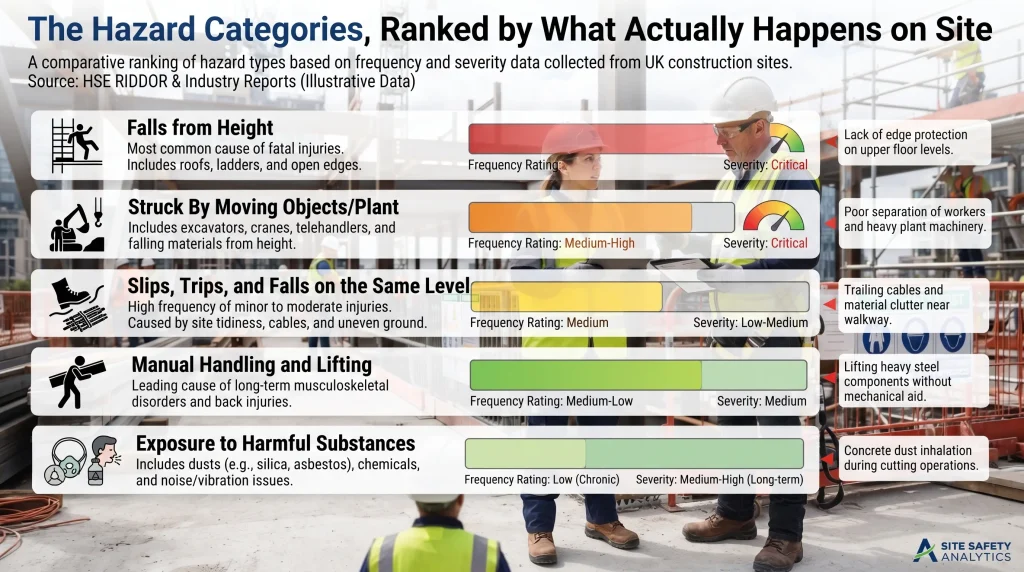
The Fatal Four gets cited constantly, so here’s the version that matters for day-to-day planning: which hazards cause the most near-misses, because near-misses are where you catch problems before someone gets hurt.
| Hazard Category | Where It Actually Shows Up | Most Overlooked Control |
|---|---|---|
| Falls | Roof edges, skylights, unguarded floor openings, ladders on uneven ground | Anchor point rating, not just harness presence |
| Struck-by | Reversing vehicles, swinging loads, material stacked near walkways | Spotter fatigue during long shifts |
| Electrocution | Damaged extension cords, unmarked buried lines, wet conditions with power tools | Daily visual cord inspection, not annual only |
| Caught-in/between | Unshored trenches, unguarded conveyor points, vehicle-to-structure gaps | Soil type assessment before shoring, not after digging starts |
This table isn’t a repeat of hazard definitions. It’s meant to be used at a toolbox talk: pick one row, ask your crew where that shows up on today’s specific task, and fix it before the shift starts.
Hazards That Barely Make It Into Safety Plans
A lot of safety plans are built around the big four and then stop. Two categories get consistently underweighted in practice, even though they cause real long-term harm.
Heat stress doesn’t fit neatly into an OSHA subpart the way falls do, which is probably why it gets less airtime. But on a summer roofing job or inside an unventilated mechanical room, heat illness can put someone down faster than most people expect. Watch for confusion and stopped sweating, not just complaints of feeling hot. By the time a worker says they feel unwell from heat, they may already be past the point of self-managing it.
Repetitive strain from tool vibration rarely gets discussed outside specialist trades, yet operators running jackhammers, impact drivers, or compactors for years develop hand-arm vibration syndrome. It’s slow, it’s not dramatic, and it almost never shows up in incident reports because it doesn’t cause a single traceable event. Rotating tasks and limiting continuous tool time reduces it, but only if someone’s actually tracking exposure hours, which most sites don’t.
The Legal Framework, and Where It Actually Bites
OSHA’s 29 CFR 1926 and the UK’s CDM 2015 set the baseline duties: employers must provide a hazard-free workplace, supply PPE at no cost, and let workers report problems without retaliation. What most guides leave out is how enforcement actually plays out on the ground.
An OSHA inspector doesn’t need a warrant if a site invites a walkthrough after a complaint, and refusing entry doesn’t stop the citation process, it just adds a warrant request to the timeline. Private worker interviews happen without a supervisor present by design, specifically so workers can speak honestly. If your site culture means workers would say something different in a private interview than they would in front of their foreman, that’s the actual safety gap, not the paperwork.
Under CDM 2015, the client carries duties too, not just the contractor. A client who appoints a principal designer without checking their competence can be held accountable if things go wrong. That surprises a lot of first-time developers who assume liability sits entirely with the builder.
Who’s Actually on the Hook When Something Goes Wrong
Legal responsibility for site safety doesn’t sit with one person, and it doesn’t split evenly either. Here’s how it plays out when an incident actually gets investigated:
- The principal contractor answers first, regardless of who employed the injured worker. Site control equals liability in most enforcement actions.
- Subcontractors can’t outsource their own worker’s safety just because they signed onto someone else’s site rules. If their own crew wasn’t trained or equipped properly, that’s on them directly.
- Individual supervisors face personal exposure in willful violation cases, particularly where an incident report shows they knew about a hazard and let work continue anyway.
- Workers rarely face liability for injuries to themselves, but tampering with safety equipment or bypassing a lockout system shifts that calculus fast.
The pattern investigators look for is simple: who had the authority to stop the work, and did they use it. That question decides more citations than any checklist.
What Separates a Site That Feels Safe From One That Actually Is
Plenty of sites look organised on the surface: signage everywhere, hard hats on every head, a tidy induction folder. None of that guarantees the crew would actually stop work if something felt wrong.
The real test is simpler than any audit: does a new labourer feel comfortable telling a twenty-year veteran to put a harness on? On sites where that answer is yes, incident rates run noticeably lower, even when the paperwork looks identical to a site where the answer is no.
A few things build that dynamic, based on what I’ve seen work in practice:
- Supervisors admitting their own near-misses out loud. It signals that reporting isn’t just for junior staff.
- Fixing small hazards within the same shift, not logging them for next week’s meeting. Delay teaches workers that reporting doesn’t change anything.
- Never using a near-miss report as evidence against the person who filed it. The moment that happens once, reporting drops off a cliff.
The Money Side Nobody Budgets For Properly

Fines get the headlines, but they’re rarely the biggest cost. An experience modification rate hike from one serious injury follows a contractor for three years, quietly inflating every workers’ comp premium on every project during that window, not just the one where the incident happened.
There’s a less obvious cost too: bid eligibility. Public sector contracts and increasingly large private developers now screen EMR and OSHA 300 history before a bid even gets opened. A contractor with a clean safety record isn’t just avoiding fines, they’re staying in rooms that unsafe competitors get locked out of entirely.
And then there’s the cost that never shows up on a spreadsheet: crew retention. Skilled tradespeople talk to each other. A site known for cutting corners on safety struggles to keep good workers once word gets around, and replacing experienced crew with green labour raises incident risk further. It’s a cycle that starts with one skipped shoring inspection and compounds for years.
Mental Health: The Risk Factor Safety Plans Still Ignore
Construction has one of the highest suicide rates of any industry, roughly double the national average across the US and UK, and more construction workers die by suicide annually than in workplace accidents. Yet most site safety plans don’t mention it at all.
Part of the problem is structural. Project-based work means constant uncertainty about the next job. Physical pain from years of manual labour gets normalised instead of treated. And a culture built around toughing things out makes early disclosure rare, so by the time a crisis becomes visible, it’s often already severe.
Practical steps that cost almost nothing but change outcomes:
- Rotate a mental health topic into toolbox talks the same way you’d rotate a physical hazard topic, not as a once-a-year event
- Post crisis line numbers where workers actually see them daily: welfare cabins, not just noticeboards buried in paperwork
- Train supervisors to notice behavioural shifts, since withdrawal and irritability show up before anyone says anything directly
- Make sure Employee Assistance Programme access is something every worker on site knows about, including subcontractor crews who often get left out of internal comms entirely
Building a Safety Plan That Survives Contact With a Real Site
Generic templates fail because they don’t reflect the actual sequence of work. A plan copied from a previous project doesn’t know that this site has overhead lines forty feet from the crane radius, or that the excavation crosses a known utility corridor.
A plan that holds up under real conditions works through the hierarchy of controls in order, starting with removing the hazard entirely wherever that’s possible, then substitution, engineering controls, administrative controls, and PPE last. PPE gets treated as the primary defence far too often. It’s the backstop, not the plan.
Name actual people against each responsibility, not job titles. “Site Safety Manager” on a document means nothing if the crew doesn’t know who that person is by name and face. And test emergency procedures before you need them: a muster point that looks fine on paper can turn into a bottleneck the first time twelve trades try to use it at once.
FAQ
Does construction safety training expire?
Most certifications do. OSHA 10-hour and 30-hour cards don’t officially expire, but many states and contractors require refreshers every few years, and site-specific inductions typically need renewal for any absence longer than 90 days.
Can a worker refuse unsafe work without losing their job?
Yes, under OSHA’s General Duty Clause, workers have a protected right to refuse work they reasonably believe poses imminent danger, and retaliation for that refusal is itself a violation employers can be cited for.
What’s the difference between a hazard and a risk in construction?
A hazard is anything with the potential to cause harm, like an unguarded trench. Risk is the likelihood that hazard actually causes harm, combined with how severe the outcome would be. A trench next to a busy walkway is a higher risk than the same trench in an isolated area, even though the hazard itself is identical.
Who pays for PPE on a construction site?
Employers, by law. OSHA requires PPE be provided at no cost to the worker, with limited exceptions for everyday items like standard work boots or prescription safety glasses in some jurisdictions.
How long do OSHA violations stay on a contractor’s record?
There’s no automatic expiry, but repeat and willful violation classifications typically look back five years from the current citation date when determining penalty severity.
Does bad weather legally stop construction work?
Not automatically. There’s no blanket OSHA weather shutdown rule, but specific conditions like lightning within a set radius, high wind affecting crane operations, or ice on elevated surfaces trigger stop-work obligations under general duty and equipment-specific standards.
What’s a competent person under OSHA, and how is it different from a certified one?
A competent person is someone the employer designates as capable of identifying hazards in a specific area, like excavation, based on training and experience, with authority to correct them. It doesn’t require a formal certificate; it requires documented, demonstrable knowledge and the authority to act on it.
Do small residential construction sites need the same safety standards as large commercial projects?
Legally, yes. OSHA 1926 applies regardless of project size, though enforcement priority and inspection frequency tend to focus on larger or higher-risk sites. A two-person residential crew working at height still needs fall protection under the same six-foot rule as a commercial high-rise.