
By Engineer Jack Henry
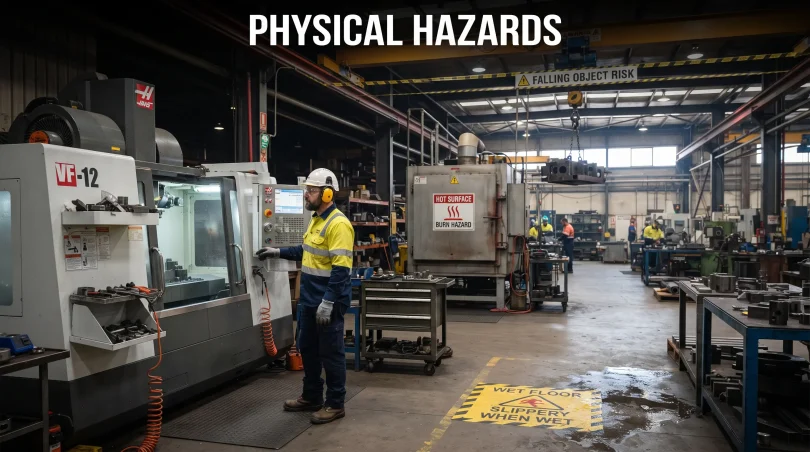
A physical hazard is anything in a work environment that can injure the body through direct energy transfer – think noise, vibration, radiation, extreme heat or cold, electricity, and moving machinery. Unlike chemical or biological hazards, physical hazards don’t need a reaction or infection to hurt someone; contact alone is enough. OSHA, NIOSH, and the ILO all treat them as one of the largest categories of preventable workplace injury, and the fix almost always comes down to controlling exposure before it happens rather than treating the injury after.
Physical Hazards vs. Chemical, Biological, and Ergonomic Hazards
People mix these up constantly, and it matters for your safety paperwork. A spilled chemical is a chemical hazard because harm comes from a reaction with tissue. A moldy HVAC system is biological because harm comes from organisms. A physical hazard skips all of that – a forklift doesn’t need to “react” with you to break your leg. That distinction changes how you document incidents and which OSHA standard applies, so get it right on your risk register from day one.
Ergonomic hazards get lumped into “physical” a lot too, but most regulators (OSHA included) treat them as a separate subcategory because the injury mechanism is cumulative strain, not a single energy transfer event. Track them on the same hazard map, just under their own tag.
Types of Physical Hazards in the Workplace
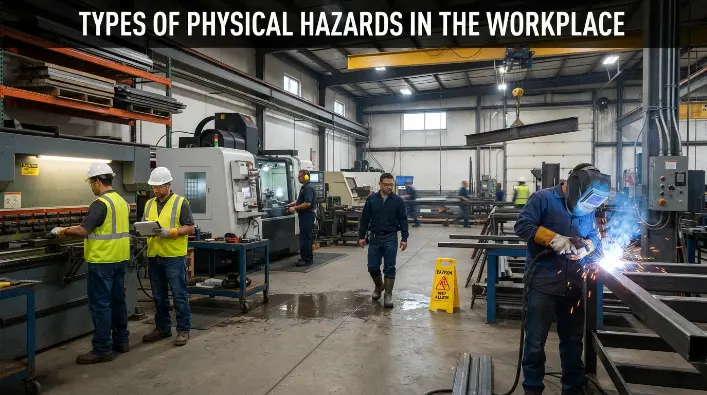
Here’s the full breakdown with the actual exposure limits most safety guides leave out.
| Hazard Type | Common Sources | Primary Health Effect | Exposure Limit / Standard |
|---|---|---|---|
| Noise | Machinery, power tools, generators, alarms | Permanent hearing loss, tinnitus | OSHA PEL: 90 dBA over 8-hr TWA (action level 85 dBA) |
| Vibration | Grinders, jackhammers, off-road vehicles | Hand-arm vibration syndrome (HAVS), low back injury | ISO 5349 exposure action value: 2.5 m/s² (8-hr) |
| Radiation (ionizing) | X-ray equipment, CT scanners, radioisotopes | DNA damage, cataracts, cancer risk | NRC annual dose limit: 5 rem (50 mSv) whole body |
| Radiation (non-ionizing) | UV light, welding arcs, lasers, sunlight | Skin burns, eye damage, skin cancer | ACGIH TLVs vary by wavelength and duration |
| Extreme heat | Foundries, roofing, outdoor summer work | Heat stroke, heat exhaustion, heat cramps | NIOSH REL: heat index >103°F triggers work/rest cycles |
| Extreme cold | Cold storage, winter outdoor work | Frostbite, hypothermia | NIOSH guidance below 40°F with wind chill factored in |
| Electrical | Live wiring, faulty equipment, arc flash | Electrocution, burns, cardiac arrest | OSHA 1910 Subpart S / NFPA 70E arc flash boundaries |
| Mechanical / machinery | Unguarded belts, gears, presses, conveyors | Crush injuries, amputations, lacerations | OSHA 1910.212 machine guarding |
| Slips, trips, falls | Wet floors, clutter, unprotected edges, ladders | Fractures, head trauma, fatalities | OSHA 1910 Subpart D walking-working surfaces |
| Falling objects | Overhead storage, construction sites, cranes | Head injury, crush injury | OSHA 1926.501 (construction fall/overhead protection) |
| Poor lighting | Warehouses, stairwells, night shifts | Missed hazards, eye strain, secondary falls | OSHA/IES recommends 10–20 fc for general work areas |
Physical Hazard Examples by Industry
Generic hazard lists are fine for training slides, but they don’t help you prioritize a real safety budget. Here’s where the injuries actually cluster.
Construction
Falls remain the single deadliest physical hazard on a job site. Federal data going back over a decade shows fatal fall injuries climbed roughly 25 percent between 2011 and 2016, with carpenters, roofers, and truck drivers taking the biggest hit. Electrical fatalities cluster here too: electricians, roofers, painters, and laborers together account for a large chunk of all electrocution deaths, mostly from contact with overhead lines or unguarded panels.
Manufacturing
Machine guarding failures are the recurring theme. Tens of thousands of workers lose time to machine-related injuries every year, and a meaningful share of those cases keep people out of work for a month or more. Lockout/tagout gaps, not missing PPE, are usually the actual root cause when auditing these floors.
Healthcare
This industry gets overlooked in generic “physical hazard” content, which is a mistake. Nurses and techs deal with laser burns from surgical procedures, ionizing radiation from diagnostic imaging, and noise levels in NICUs and ICUs that can exceed 90–100 decibels, well above what the WHO recommends for patient areas. Hospitals also report elevated noise among the top workplace complaints in nurse surveys.
Warehousing and Logistics
Forklifts, conveyor systems, and repetitive manual handling dominate here. Confined space incidents also show up more than people expect — storage tanks, silos, and below-grade utility vaults account for a steady stream of fatalities every year, often because rescuers get hurt trying to help a trapped coworker without proper atmospheric testing first.
How to Identify Physical Hazards Before They Cause an Injury
Most companies find hazards after an incident report. That’s backwards. Here’s the sequence to walk a site through:
- Walk the floor with a blank checklist, not a pre-filled one. Pre-filled checklists make you look for what you expect, not what’s there.
- Interview the people doing the task, not their supervisor. The person running the grinder knows about the vibration complaint nobody logged.
- Check maintenance logs against actual equipment condition. A guard listed as “installed” on paper is sometimes propped open in practice.
- Measure, don’t estimate. A sound level meter or a simple lux meter costs less than one workers’ comp claim. Guessing at noise or lighting levels is how programs fail audits.
- Document near-misses separately from injuries. Near-miss data predicts the next incident far better than injury data does, because it captures the hazards that haven’t hurt anyone yet.
Risk Assessment for Physical Hazards
Once you’ve found the hazard, rank it. A simple likelihood-times-severity score works well, but the part most people skip is reassessing after every control change, not just once a year.
- Likelihood: How often is a worker exposed, and under what conditions does exposure spike (shift changes, seasonal heat, equipment age)?
- Severity: What’s the realistic worst-case outcome, not the average one? A machine guard failure that “usually” causes a scrape can occasionally cause an amputation.
- Exposure duration: A five-minute daily task near a hazard carries different risk than an eight-hour shift next to it, even if the hazard itself is identical.
Score each hazard, then sort your action list by score, not by which fix is cheapest. That’s the step most small businesses get wrong under budget pressure.
Hazard Control: The Hierarchy That Actually Works
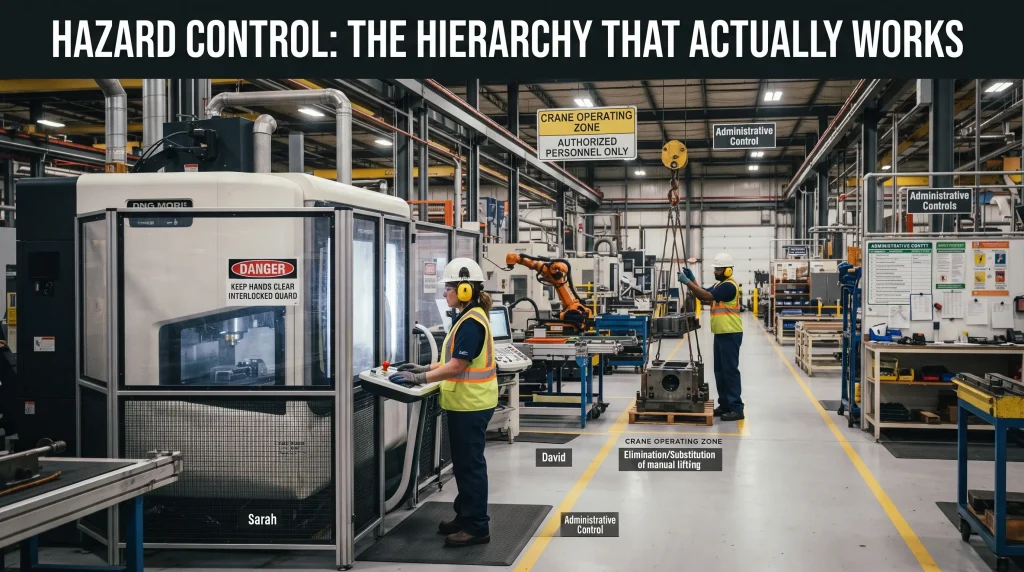
The hierarchy of controls isn’t new information, but it’s rarely mapped to physical hazards specifically. Here’s how it plays out in practice.
- Elimination: Remove the hazard entirely. Route foot traffic away from an overhead crane path instead of posting a warning sign.
- Substitution: Swap a louder tool for a quieter one, or a manual pallet jack for a powered lift that reduces vibration exposure.
- Engineering controls: Machine guards, sound enclosures, local exhaust, GFCIs, non-slip flooring. These fix the hazard at the source and don’t rely on human behavior.
- Administrative controls: Job rotation to limit vibration or heat exposure time, scheduled work/rest cycles, better lighting during night shifts.
- PPE: The last line of defense, not the first. If PPE is your only control, the hazard is still fully present — you’re just hoping the gear holds.
Sites that lean on PPE as step one usually have weaker safety cultures, not stronger ones. Excellent PPE compliance paired with terrible injury rates is a common pattern when nobody fixes the actual source.
Personal Protective Equipment for Physical Hazards
Match the gear to the specific energy transfer, not a generic “safety kit.”
- Noise: Earplugs (NRR 25–33) or earmuffs for tools above 85 dBA
- Vibration: Anti-vibration gloves, though these reduce, not eliminate, HAVS risk
- Radiation: Lead aprons, dosimeters, UV-rated eyewear
- Extreme temperature: Cooling vests, insulated gloves, moisture-wicking layers
- Electrical: Insulated gloves rated to the voltage, arc-rated clothing
- Mechanical: Cut-resistant gloves, steel-toe boots, face shields near grinding operations
- Falls: Full-body harness with shock-absorbing lanyard, anchored to a rated point, not a random pipe
Common Mistakes in Physical Hazard Programs
After years of site audits, the same handful of gaps show up over and over.
- Noise dosimetry done once, never repeated. Equipment wear changes noise output over time. A quiet machine at installation isn’t quiet three years later.
- PPE issued but never fit-tested. A hard hat that doesn’t fit properly, or gloves that are the wrong size, get taken off within an hour.
- Heat stress plans that ignore humidity. Temperature alone doesn’t predict heat illness risk. Two sites at the same temperature can have very different injury rates depending on humidity and workload.
- Lighting audits skipped in warehouses. Poor lighting is rarely the direct cause of an injury report, but it’s frequently the hidden contributor behind a slip or a struck-by incident.
- Confined space rescue plans that exist on paper only. If your rescue team has never practiced the actual entry, you don’t have a rescue plan – you have a document.
Frequently Asked Questions
What are the 5 main types of physical hazards?
Most safety frameworks group them as noise, radiation, extreme temperature, vibration, and electrical hazards, though mechanical hazards and slips, trips, and falls are often added as a sixth and seventh category depending on the industry standard being used.
What is an example of a physical hazard at work?
A forklift operating in a warehouse aisle is a physical hazard because it can strike, crush, or run over a worker through direct contact, regardless of the forklift’s condition or maintenance history.
How is a physical hazard different from an ergonomic hazard?
A physical hazard causes injury through a single energy transfer event, like an electric shock. An ergonomic hazard causes injury through repeated strain over time, like a warehouse picker developing a shoulder injury from months of overhead reaching.
Can poor lighting really be classified as a physical hazard?
Yes. Poor lighting itself doesn’t injure anyone directly, but OSHA and NIOSH classify it as a physical hazard because it directly increases the likelihood of falls, struck-by incidents, and machine-related injuries in low-visibility areas.
What’s the OSHA noise limit before hearing protection is required?
OSHA sets the action level at 85 dBA averaged over an 8-hour shift, and the permissible exposure limit at 90 dBA. Hearing conservation programs, including protection and monitoring, are required once workers cross the action level.
Do office jobs have physical hazards too?
Yes, though the risk profile is lower. Trip hazards from loose cables, poor workstation lighting, and electrical hazards from overloaded power strips are the most common physical hazards found in office environments.
What’s the fastest way to reduce physical hazard risk on a tight budget?
Administrative controls, like adjusting shift schedules to limit heat or vibration exposure, cost almost nothing and can be implemented immediately, while engineering fixes are being budgeted and installed.
Who is legally responsible for controlling physical hazards at work?
Under OSHA’s General Duty Clause, employers are legally required to provide a workplace free from recognized hazards that could cause death or serious physical harm, which includes physical hazards even when no specific OSHA standard names the exact hazard.
AUTHOR BIO: Jack Henry is a safety engineer specializing in construction site safety, fall protection systems, and workplace hazard prevention.