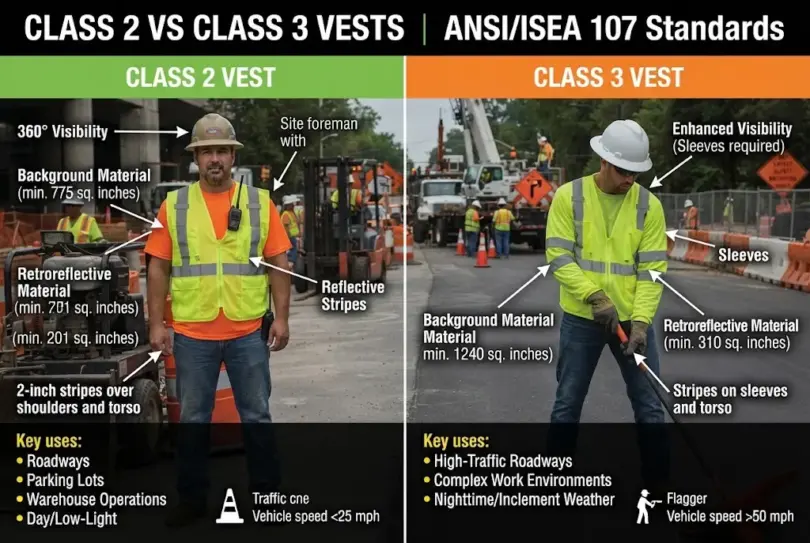

Class 2 vs Class 3 Vest
A Class 2 vest suits workers exposed to traffic moving 25 to 50 mph in decent light. A Class 3 vest is for traffic above 50 mph, night shifts, or bad weather, and it adds sleeves plus about 60% more fluorescent fabric. If you can’t decide, Class 3 is always compliant where Class 2 is required.
What Actually Differs on the Garment
The Core Numbers
These figures come from ANSI/ISEA 107-2020, the edition we work from. Speed is covered above, so this table sticks to what is physically on the vest.
| Requirement | Class 2 | Class 3 |
|---|---|---|
| Fluorescent background | 775 sq in | 1,240 sq in |
| Retroreflective or combined-performance material | 201 sq in | 310 sq in |
| Minimum tape width | 1.38 in (35 mm) | 2 in (50 mm) |
| Smallest-size background minimum | 540 sq in | 1,000 sq in |
| Arm coverage | Not required | Required |
Why Small Sizes Matter
You May Also Like
Hard Hat Expiration: How Long They Last and When to Replace Yours
ANSI Z87.1: How to Read the Markings on Your Safety Glasses (2026 Guide)
OSHA 10 vs OSHA 30: Which One Do You Actually Need
Safety Equipment Inspection: A Practical Guide to What, When, and Who
Workplace Safety Equipment: A Complete Guide to Protecting Your Team
Check the smallest-size row if you buy for smaller workers. A small Class 3 garment is allowed less fabric than a large one, but it still has to carry its Class 3 label.
What the Extra Fabric Buys You: Seconds
The Distance Math
Class 3 carries roughly 60% more background material and 54% more reflective tape. That sounds abstract until you convert it to time.
ANSI describes Class 3 as recognizable from about 1,280 feet (390 meters). A car at 50 mph covers that distance in about 17.5 seconds. At 65 mph it takes about 13.4 seconds, and at 25 mph about 35 seconds.
What That Means for Drivers
Those are our own calculations, and they show the problem. A faster road gives the driver less time to notice, decide, and brake, so the garment has to do its work earlier.
When to Choose Class 3 Even Below 50 mph
Four Conditions That Override the Speed Limit
Speed is the headline rule, but the posted limit tells you only part of the story. Picture a utility crew on a 35 mph road at 5 a.m. in drizzle. The speed says Class 2, but the conditions say Class 3.
Darkness
Tape works by returning headlight beams, so at night it does most of the work. More tape means a larger, more recognizable shape.
Rain, Fog, and Glare
Fluorescent color loses punch in low contrast. Sleeves help drivers read a human outline instead of a blob.
Busy Backgrounds
Orange cones, parked trucks, and construction clutter can swallow a vest. Extra material and arm bands separate the worker from the scenery.
Divided Attention
A flagger watching traffic can still see it coming. A worker bent over a manhole or running a saw cannot, and that is where Class 3 pays for itself.
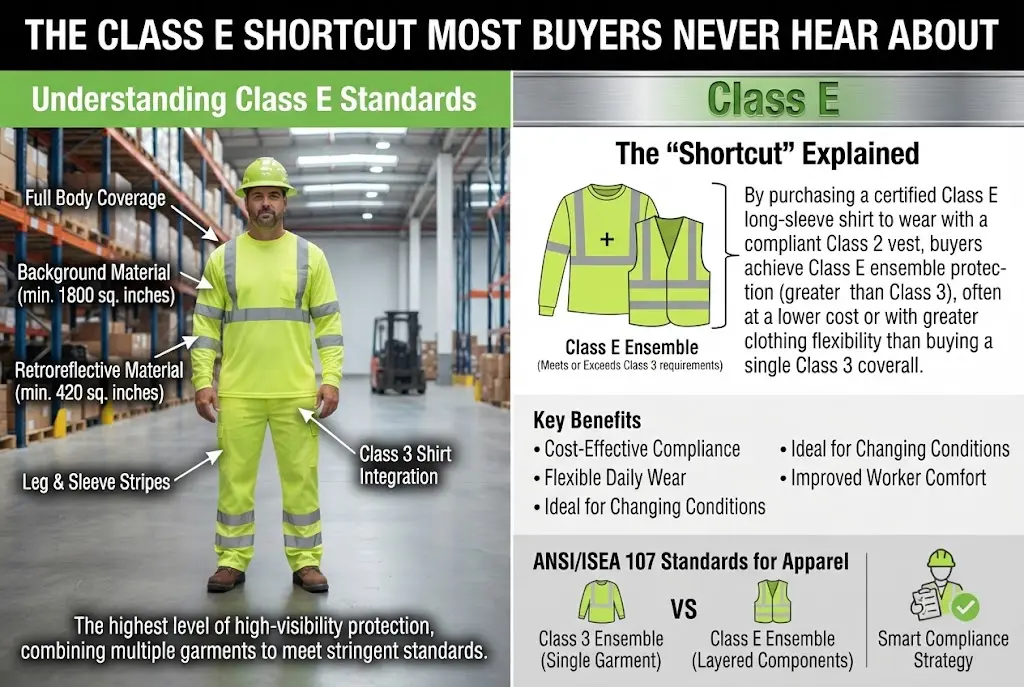
The Class E Shortcut Most Buyers Never Hear About
How the Combination Works
Class E covers reflective pants, shorts, or gaiters. Worn alone, they meet no class. Worn with a Class 2 top, the ensemble is rated Class 3.
What to Verify First
This matters for crews that already own Class 2 vests. Adding compliant Class E trousers can lift the full outfit to Class 3 without replacing every top. Confirm the pants carry a current ANSI/ISEA 107 label before you count on it.
What the Rules Actually Require
MUTCD and Federal Highway Rules
The standard itself is voluntary. The pressure comes from elsewhere.
- MUTCD Section 6C.05: Workers in the right-of-way who are exposed to traffic or construction equipment must wear compliant high-visibility apparel.
- 23 CFR Part 634: For federal-aid highways, that apparel must meet ANSI/ISEA 107 Performance Class 2 or 3.
How OSHA Fits In
No standalone OSHA rule says “wear ANSI 107 gear.” Enforcement runs through specific rules and the General Duty Clause, so your site’s hazard assessment carries real weight.
Why Class 2 Is a Floor, Not a Target
Class 2 is the legal minimum in a public roadway work zone, not the recommended choice for every job. Your employer, state DOT, or contract may set a higher bar, so check the project documents.
Field Mistakes That Quietly Cancel Your Rating
You May Also Like It:
Types of Safety Shoes: The Complete Guide for Every American Worker
New Balance Safety Shoes: The Complete Buying Guide
Safety Shoes Meaning: What They Are, How They Work, and Why They Matter
What Are Safety Shoes? Types, Standards, and How to Pick the Right Pair
Things That Hide the Tape
A vest can be labeled correctly and still fail on the job. These are the ones we see most often.
- Tool belts and packs: They cover reflective bands. Nothing should be worn over the vest, which is why fall-protection versions have a cutout for the back D-ring.
- Hoods and layers: A hood that flops down the back, or a jacket worn over the vest, hides material the class requirement depends on.
Things That Wear the Vest Out
- Tired tape: Tape that is cracked, peeling, or gray no longer returns light as it did when new. The label still says Class 3, but the performance is gone.
- Faded or dirty fabric: Heavy soil and sun fade dull the fluorescent color, and the vest drifts below its rating even though it is undamaged.
The Fit Problem
A vest that is too tight pulls the tape out of position. One that is too loose bunches and hides it.
How to Check a Vest in Under a Minute
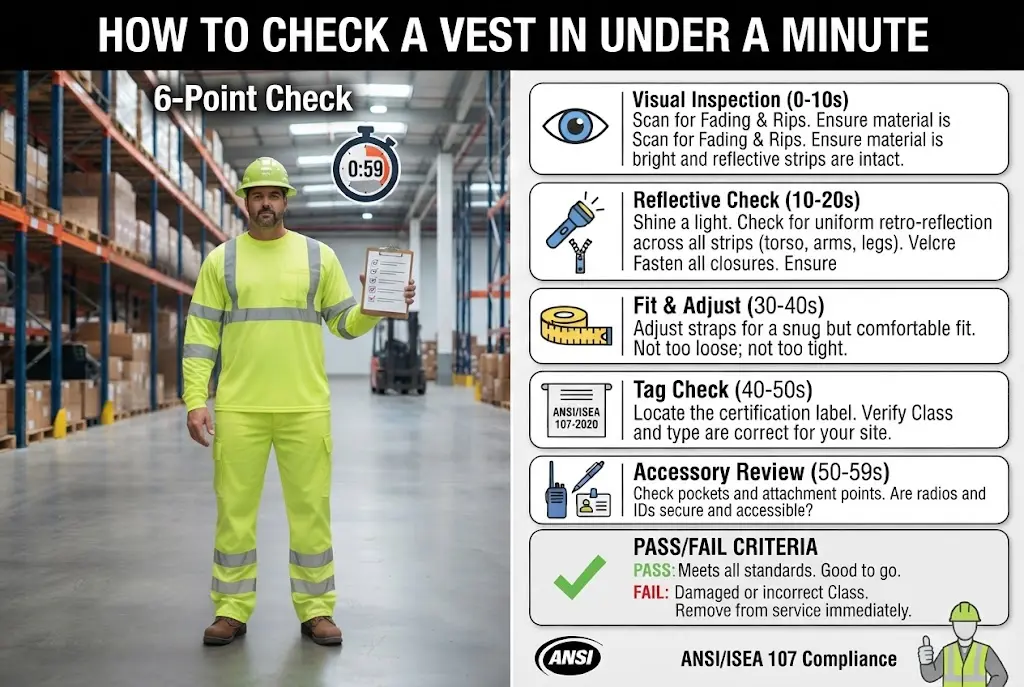
You don’t need a lab to screen a vest. Run through these steps before you buy or accept a delivery.
- Read the label. It should show the type letter, the class number, and the ANSI/ISEA 107 edition. Many labels also list care instructions, sometimes with a maximum wash count.
- Look for sleeves. No sleeves means it cannot be Class 3, whatever the listing claims.
- Measure the tape. Roughly 2 inches wide suggests Class 3 and about 1.4 inches suggests Class 2. Split-trim designs can use narrower strips, so treat this as a screening step, not proof.
- Check the color. It should be fluorescent yellow-green or orange-red, not dull or pastel.
- Reject Class 1 for roadwork. It belongs to Type O, meant for low-speed settings away from public traffic.
Quick Picks by Job
Use this as a starting point, then adjust for light and weather using the conditions above.
| Job | Usual pick | Why |
|---|---|---|
| Highway crew, flagger | Class 3 | High speeds and constant exposure |
| Tow operator, roadside rescue | Class 3 | Often night work on live lanes |
| Surveyor on local roads | Class 2 | Moderate speeds, daytime |
| Warehouse near forklifts | Class 2 | Equipment risk, no public traffic |
| School crossing guard | Class 2 | Low speeds, though early-morning fog may call for Class 3 |
| Night utility repair | Class 3 | Darkness outweighs speed |
When to Buy Class 3 for the Whole Crew
The Paperwork Problem
Mixed crews create headaches. Someone moves from a daytime site to a night job, and now half the vests are the wrong class. Buying Class 3 across the board removes that guesswork.
The Trade-offs
Sleeves run warmer, so choose mesh fabric for summer and check whether breakaway closures are needed near moving machinery. We would standardize on Class 3 for any crew that touches a public roadway even part of the time, and keep Class 2 for fixed, low-speed sites.
Frequently Asked Questions
What do Type R, Type P, and Type O mean on a vest label?
They describe the work setting. Type R is for roadway workers, Type P is for public safety personnel such as police and fire, and Type O is for off-road work with no public traffic. Types R and P come in Class 2 and Class 3, while Type O is Class 1 only.
Can I wear two Class 2 vests to make a Class 3?
No. The rating belongs to a garment or tested ensemble, not to layers. Doubling up also covers tape on the lower layer, which reduces visibility.
Does the color of the vest change its class?
No. Fluorescent yellow-green and orange-red can both reach Class 2 or Class 3. Choose the color that contrasts most with your surroundings, such as orange against green vegetation.
How long does a safety vest last?
There is no fixed expiry. One supplier suggests about six months for daily heavy wear and up to three years for moderate use. Replace it when the tape cracks or peels, or when the fabric fades.
Is a Class 1 vest ever fine?
Yes, for low-speed areas away from public traffic, such as parking attendants. It is not suitable for roadwork.
Can I add a company logo to a vest?
Yes, but graphics cannot eat into the required material. One supplier guideline lists limits of 72 sq in for non-contrasting graphics and 22 sq in for contrasting ones.
Does washing damage the rating?
It can if you ignore the label. Follow the care instructions, avoid fabric softener and bleach, and retire vests that reach their listed wash limit.
What is combined-performance material?
It is tape that is both fluorescent and retroreflective. It counts toward both the background and reflective requirements, which is why some vests use stripes that match the vest color.
You May Also Like It:
Skylight Fall Protection: What OSHA Actually Requires and How to Get It Right
Skylight Screen vs Cover vs Guardrail: What’s the Real Difference?
Best Fall Protection Harness for Roofers: A Field-Tested Comparison
Fall Protection Systems: A Practical Guide to Types, Selection, and Compliance
Fall Protection: The Complete Guide to Keeping Workers Safe at Heights