
Safety Shoes Meaning
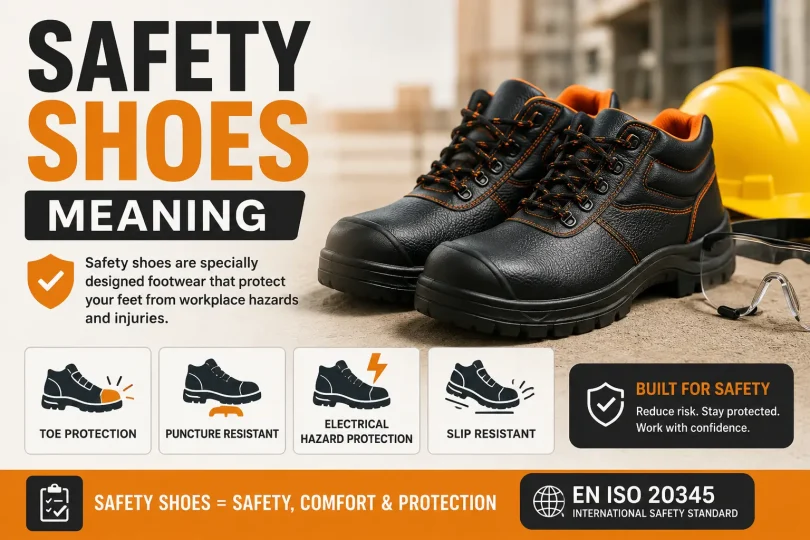
Safety shoes are reinforced work footwear designed to protect your feet from workplace hazards such as falling objects, sharp punctures, electrical shocks, chemical splashes, and slippery surfaces. Unlike regular shoes, they are built to meet specific safety standards and are classified as personal protective equipment (PPE). The term is often used interchangeably with “safety boots,” though boots extend higher up the ankle.
Not All Work Shoes Are Safety Shoes
This is one of the most common misunderstandings on job sites. A sturdy-looking boot from a general retailer is not a safety shoe unless it carries a certified protection marking. The difference is not cosmetic. It is structural.
Certified safety shoes are engineered with reinforced components that have been tested against measurable impact and compression forces. A regular work shoe, no matter how thick the sole looks, offers none of that tested assurance.
If the shoe does not show a certification mark, it is not safety footwear. Full stop.
What Goes Inside a Safety Shoe
The Anatomy of Certified Safety Footwear
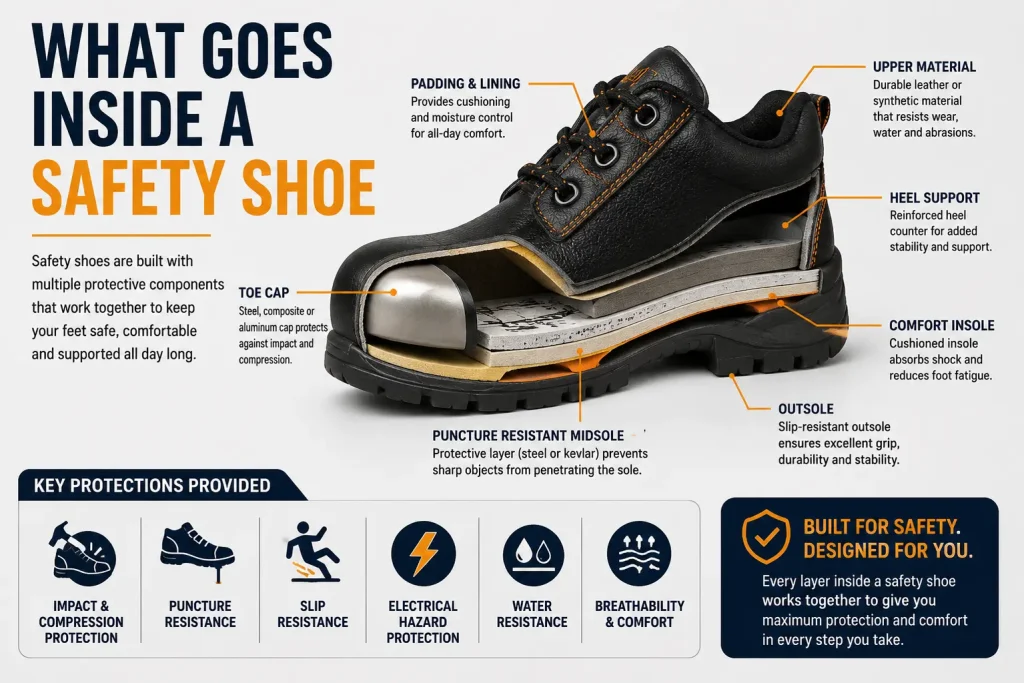
Understanding what makes safety shoes different from standard footwear starts with their construction. Each component serves a specific protective purpose.
- Toe cap: The most recognisable feature. Made from steel, composite material, or aluminum. Protects against objects falling on or rolling over the foot.
- Midsole: A puncture-resistant layer, often steel or Kevlar, built between the insole and outsole. Stops sharp objects like nails from piercing through the bottom of the shoe.
- Outsole: Designed for grip on slippery, oily, or uneven surfaces. Rubber for chemical resistance, polyurethane for durability, nitrile rubber for heat resistance.
- Upper: The outer body of the shoe. Full-grain leather, suede, or synthetic fabric depending on the hazard environment.
- Insole and footbed: Often overlooked but critical for all-day comfort. Anti-fatigue insoles reduce strain on workers standing for 8 to 12-hour shifts.
- Heel counter: A stiffened section at the back of the shoe that stabilises the ankle and prevents rolling on uneven ground.
No single component works in isolation. A shoe with a steel toe but no puncture-resistant midsole leaves a worker vulnerable wherever nails or scrap metal are underfoot.
The Types of Safety Shoes
And When Each One Actually Applies
Competitors tend to lump all safety shoes into one category. In practice, there are distinct types engineered for different risks. Choosing the wrong type can be as dangerous as wearing no protection at all.
Steel-Toe Safety Shoes
The most common type. Rated to withstand up to 200 joules of impact force. Best for construction, warehousing, and heavy manufacturing where falling objects are the primary risk.
Composite-Toe Safety Shoes
Made from carbon fibre, Kevlar, or fibreglass. Lighter than steel and fully non-conductive, making them ideal for electricians, airport workers, and security personnel who pass through metal detectors.
Aluminum-Toe Safety Shoes
A middle ground: lighter than steel but stronger than most composites. Common in general industry where toe protection is needed but weight is a concern.
Metatarsal Guard Shoes
Extend protection beyond the toe cap to cover the top of the foot. Essential in steel mills and heavy manufacturing where large, heavy objects could fall at an angle rather than straight down.
Electrical Hazard (EH) Shoes
Sole and heel are tested to insulate against open electrical circuits up to 18,000 volts under dry conditions. Used by electricians, utility workers, and anyone working around live circuits.
Anti-Static and ESD Shoes
Manage static electricity through controlled discharge to prevent dangerous build-up. Used in electronics manufacturing, fuel handling, and pharmaceutical facilities. Anti-static is not the same as electrical hazard protection.
Chemical-Resistant Safety Shoes
Outsoles and uppers made from materials that resist corrosive liquids and solvents. Standard in laboratories, chemical processing plants, and agriculture.
Slip-Resistant Safety Shoes
High-grip outsoles for wet, oily, or greasy floors. SRC is the highest rating under EN ISO 20345. Common in food processing, commercial kitchens, and hospitality.
Puncture-Resistant Safety Shoes
A reinforced midsole protects against sharp objects penetrating from below. Recommended on demolition sites, roofing jobs, and recycling facilities where nails, glass, and scrap are underfoot.
Many shoes combine several of these features. An electrician on a construction site may need a composite toe, an EH rating, and a slip-resistant outsole simultaneously.
Safety Certifications and Markings
What the Codes on Your Shoe Actually Mean
None of the major competitor articles cover this. It is arguably the most important practical information a buyer needs before purchasing.
European Standard: EN ISO 20345
The governing standard across the EU and UK. Shoes carry a letter-based rating stamped inside the shoe:
- SB (Safety Basic): Steel toe cap rated to 200 joules of impact. The absolute minimum certification.
- S1: SB + anti-static properties + energy-absorbing heel + closed seat region.
- S2: S1 + resistance to water penetration and absorption.
- S3: S2 + penetration-resistant midsole + cleated outsole. Standard on most European construction sites.
- S4 / S5: Same S1/S3 progression applied to wellington or rubber boot styles.
- SRC: The highest slip-resistance rating. Tested on both ceramic tile with detergent (SRA) and steel with glycerol (SRB).
American Standard: ASTM F2413
US safety footwear is tested and labelled under ASTM F2413. Look for these markings on the label inside the shoe:
- I/75 C/75: Impact and compression resistance tested at 75 foot-pounds each.
- EH: Electrical hazard, insulated against open circuits.
- PR: Puncture-resistant midsole.
- SD: Static dissipative.
- MT: Metatarsal protection.
Buying rule: Always look for the certification stamp inside the shoe or on the box. If a manufacturer cannot point you to a specific tested standard, walk away.
Safety Shoes vs Safety Boots

The Practical Difference
The terms are used loosely, but there is a real functional distinction worth understanding.
- Safety shoes sit below the ankle, similar to a trainer or oxford in profile. Lighter, easier to move in, better suited for indoor or light industrial environments.
- Safety boots extend above the ankle. They provide additional ankle support and side protection from debris, making them preferable on construction sites, outdoor work, or uneven terrain.
The toe cap protection standard is identical in both. The difference is coverage area and environment suitability. Some workers default to safety shoes because they are more comfortable. On a site with ankle roll risk or falling debris from height, that comfort trade-off is not worth making.
Safety Shoes vs Protective Footwear
Why the Distinction Matters for Compliance
Protective footwear is the broader category. Safety shoes sit within it.
All safety shoes are protective footwear. Not all protective footwear qualifies as safety shoes.
Anti-chemical boots worn in a laboratory are protective footwear. But if they lack a tested toe cap meeting EN ISO 20345 or ASTM F2413, they are not “safety shoes” in the certified sense. Knowing this distinction matters when reading PPE requirements on a job site.
Who Is Required to Wear Safety Shoes
Legal Requirements by Region
OSHA (USA): Under 29 CFR 1910.136 and 1926.96, employers must ensure workers wear protective footwear where there is a risk of foot injuries from falling or rolling objects, piercing hazards, or electrical hazards.
HSE (UK): The Personal Protective Equipment at Work Regulations 1992 require employers to provide appropriate protective footwear wherever a risk assessment identifies a hazard.
Industries Where Safety Shoes Are Mandatory or Strongly Recommended
- Construction and demolition
- Manufacturing and assembly lines
- Warehousing and logistics, especially forklift environments
- Mining and quarrying
- Oil, gas, and chemical processing
- Metalworking and foundries
- Electrical installation and maintenance
- Food processing (slip risk is the primary hazard)
- Tree surgery and landscaping
If you are unsure whether your role requires them, the better question is: what is the risk if they are not worn? That reframe is more useful than waiting for explicit instructions.
How to Choose the Right Safety Shoe
A Step-by-Step Practical Checklist
Most guidance on this stays vague. Here is a concrete, step-by-step approach:
- Step 1: Identify your specific hazards first. Walk the job site and list actual risks: falling objects, sharp floors, electrical exposure, chemical splash, slippery surfaces. Your hazard profile determines your shoe type.
- Step 2: Check the required standard. Many sites specify a minimum, such as S3 in Europe or ASTM F2413-18 in the USA. Meet that minimum as a floor, not a ceiling.
- Step 3: Match the toe cap material to your environment. Steel is strongest but conducts electricity and temperature. Composite is lighter and non-conductive. Aluminum splits the difference.
- Step 4: Consider the outsole for your surface. Rubber for chemicals, polyurethane for durability, nitrile for heat. SRC-rated outsoles matter enormously in food and logistics environments.
- Step 5: Get the fit right. Allow roughly a thumb’s width between your longest toe and the end of the toe cap. Too tight causes blisters; too loose and the foot slides forward on impact.
- Step 6: Account for your socks. If you wear thick thermal socks in winter, size the shoe with those on.
- Step 7: Know the replacement timeline. Most safety shoes are rated for 12 months of regular industrial wear. A toe cap that has already absorbed a hard impact may not protect adequately a second time.
Caring for Safety Shoes
Maintenance That Keeps the Protection Intact
Proper care extends the life of safety shoes and keeps the protective components effective.
- Clean after every shift if working in mud, chemical environments, or food processing. Contaminants degrade materials faster than regular wear.
- Dry naturally. Never put safety shoes on a direct heat source. It warps the sole and weakens adhesive bonds.
- Treat leather uppers. If your uppers are full-grain leather, condition them monthly to prevent cracking and loss of water resistance.
- Check the midsole periodically. Puncture-resistant midsoles can fatigue over time. If the sole feels noticeably softer than when new, the protection rating may be compromised.
- Replace on schedule. The 12-month guideline applies to standard industrial use. Heavy site conditions or chemical exposure may shorten that significantly.
Frequently Asked Questions
1. Are safety shoes the same as steel-toe boots?
Not exactly. Steel-toe boots are one type within the safety footwear category. Safety shoes can also feature composite, aluminum, or other certified toe cap materials. Steel-toe describes the material; safety shoe describes the certification category.
2. Can I wear safety shoes if I have wide feet or use orthotic insoles?
Yes. Many brands now offer wide-fit certified safety shoes. If you use custom orthotics, look for shoes with a removable footbed so the orthotic fits properly without pushing your foot into the toe cap.
3. How do I know if my safety shoes are still safe after a heavy impact?
If a safety shoe absorbs a significant impact, retire it even if it looks undamaged on the outside. The toe cap may have deformed internally in ways that are not visible, reducing its ability to protect from a second impact.
4. Are safety shoes required by law?
In most jurisdictions, employers are legally required to provide or mandate safety footwear wherever a risk assessment identifies a foot hazard. In the USA, OSHA 29 CFR 1910.136 covers this. In the EU and UK, equivalent PPE regulations apply.
5. What is the difference between S1, S2, and S3 rated safety shoes?
All three include a 200-joule-rated toe cap. S1 adds anti-static and energy-absorbing heel properties. S2 adds water resistance on top of S1. S3 adds a puncture-resistant midsole and a cleated outsole on top of S2, making it the most protective of the three.
6. Do safety shoes protect against electric shock?
Some do, specifically those carrying an EH (Electrical Hazard) rating. Anti-static shoes manage static discharge but do not protect against live electrical circuits. Never assume anti-static equals electrical hazard protection. Check the specific rating on the label.
7. Can safety shoes be worn as everyday footwear?
Physically, yes. Many modern safety shoes look like regular trainers or smart shoes. However, daily casual use accelerates wear on the protective components. If you also rely on them for work, replace on schedule regardless of how the exterior looks.
8. How long do safety shoes typically last?
Under standard industrial use, 12 months is the benchmark cited by most certifying bodies. Heavy site use, chemical exposure, or frequent impacts can shorten that considerably. Inspect monthly and replace earlier if soles are worn smooth, toe caps are visibly deformed, or the upper is splitting at the welt.