


Safety Shoes UK
If you work on a construction site, in a warehouse, a cold store, or any environment where your feet face real risk, the right safety shoes are not optional. They are a legal requirement, and more importantly, they could prevent a life-changing injury.
This guide covers everything: safety standards, industry-specific needs, how to get the right fit, price ranges, and the questions most buyers forget to ask. Whether you are buying for yourself or sourcing footwear for a team, this is the only guide you need.
What Are Safety Shoes? (And Why They Matter in the UK)
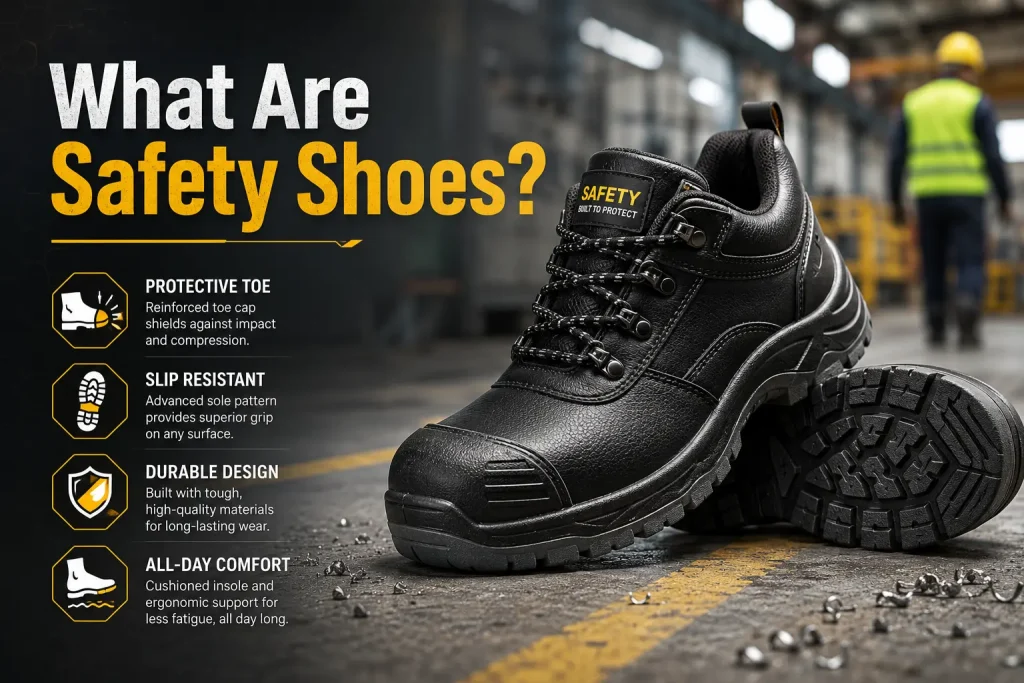
Safety shoes, also called protective footwear or safety boots, are specially engineered footwear designed to protect your feet from workplace hazards. In the UK, employers are legally required under the Personal Protective Equipment at Work Regulations 1992 to provide appropriate PPE, including protective footwear, when a risk assessment identifies a hazard.
Common hazards that safety shoes protect against:
- Falling or rolling objects crushing toes
- Sharp objects puncturing the sole
- Slipping on wet, oily, or uneven surfaces
- Electrical hazards and static discharge
- Extreme heat or cold
- Chemical spills
- Ankle twists on rough terrain
UK Safety Footwear Standards Explained Simply
Most buyers overlook this section. Do not skip it. Every pair of legitimate safety shoes sold in the UK must meet EN ISO 20345:2022 (the current standard, replacing the 2011 version).
Basic Protection Ratings
| Rating | What It Means |
| S1 | Basic toe cap, antistatic, oil-resistant sole, closed heel. Good for light industrial work. |
| S2 | Everything in S1, plus water resistance in the upper. |
| S3 | Everything in S2, plus a midsole to protect against nail puncture. Most common for construction. |
| S3L | Like S3 but with a flexible, lightweight midsole. Comfortable for all-day wear. |
| S3S | Like S3 but with a stiffer, more robust midsole. Better for harsher environments. |
Additional Protection Codes to Know
| Code | What It Protects Against |
| ESD | Electrostatic discharge. Essential in electronics, IT, and some chemical environments. |
| HI | Heat insulation. Sole resists heat from hot surfaces up to 150 degrees Celsius for 30 minutes. |
| CI | Cold insulation. Insole insulates against cold up to minus 17 degrees Celsius. Vital for cold store work. |
| HRO | Heat-resistant outsole. Withstands surfaces up to 300 degrees Celsius. Critical in foundries. |
| WR | Whole shoe water resistance. |
| SR | Slip resistance on ceramic tile and steel surfaces. |
Quick tip: Always check the label inside the shoe for the full rating code. A shoe marked S3 ESD CI, for example, protects against puncture, electrostatic discharge, and cold insulation.
Types of Safety Footwear: Which Style Suits Your Job?

Safety Trainers
Lightweight, breathable, and close in appearance to regular sports trainers. Popular in logistics, light manufacturing, and service industries where you are on your feet all day but the hazards are moderate. Usually rated S1 or S1P.
Best for: Warehouses, retail stockrooms, airports, light assembly.
Safety Shoes (Low Cut)
A mid-height option offering toe cap and midsole protection with a more professional look. Often worn by engineers, supervisors, and workers in food production.
Best for: Food manufacturing, engineering, office-adjacent site roles.
Safety Boots (Mid and High Cut)
The most common choice on UK construction sites. High-cut boots provide ankle support and are rated S3 as standard. Lace-up, zip-sided, and Chelsea boot styles are all available.
Best for: Construction, utilities, groundwork, landscaping, agriculture.
Freezer and Cold Store Safety Boots
A specialist category that most general safety footwear guides ignore completely. If you work in a chiller (0 to 5 degrees Celsius) or a freezer room (below 0 degrees Celsius), you need boots specifically rated for those temperatures. Look for the CI (cold insulation) rating and insulation measured in Tog or temperature thresholds.
Best for: Cold storage, food distribution, pharmaceutical cold chain, frozen food retail.
Rubber and Wellington Safety Boots
Fully waterproof, chemical-resistant, and easy to clean. Available with steel or composite toe caps. Essential where standing water, mud, or chemical splash is present.
Best for: Agriculture, construction groundwork, sewage, chemical processing, fish processing.
Temperature guide for cold store workers:
| Environment | Temperature Range | Footwear Needed |
| Ambient warehouse | Above 5 degrees C | Standard S3 with good insole |
| Chiller | 0 to 5 degrees C | CI-rated boot with thermal lining |
| Freezer | Below 0 to minus 25 deg. C | Specialist freezer boot, rated insulation, moisture management |
Toe Cap Materials: Steel vs. Composite vs. Aluminium
| Material | Pros | Cons | Best For |
| Steel | Very strong, cost-effective | Heavier, conducts heat and cold, sets off metal detectors | Construction, heavy industry |
| Composite | Lightweight, non-conductive, no metal detector issues | Slightly more expensive | Cold store, food, aviation, electronics |
| Aluminium | Lighter than steel, more toe space | Thinner cap than steel | Comfort-focused workers in moderate risk environments |
How to Get the Right Fit: The Advice Most Brands Skip
A safety shoe that does not fit properly is almost as dangerous as wearing no safety shoe at all. Blisters, pressure points, and fatigue from poorly fitting footwear cause workers to remove their PPE and take shortcuts.
Measuring Your Foot Correctly
- Measure both feet. Most people have one foot slightly larger than the other. Always size for the larger foot.
- Measure at the end of the day. Feet swell throughout your shift. A shoe that fits at 8am may be too tight by 3pm.
- Measure length AND width. Many manufacturers now offer wide-fit (EE) and extra-wide (EEE) options.
- Allow 10 to 15mm of space between your longest toe and the end of the shoe to prevent toe cap contact when walking downhill.
Mondopoint Sizing
Some premium brands such as uvex offer a Mondopoint sizing system, which measures both foot length and width in millimetres and gives a precise fit code. If you have struggled to find comfortable safety footwear in the past, seek out a brand offering this system.
Insoles Make a Significant Difference
The insoles that come with most safety footwear are functional but basic. Aftermarket insoles shaped for low, medium, or high arches can dramatically improve comfort on long shifts. If you are standing on hard floors for 8 to 12 hours, this is worth the additional cost.
Safety Footwear for Women: A Dedicated Section
Women’s safety footwear has historically been an afterthought: men’s styles re-released in pink, or simply smaller sizes of the same shoe. This is changing, but not fast enough.
Women’s feet have different proportions to men’s. They tend to have:
- A narrower heel relative to the forefoot
- A higher arch
- A wider ball of the foot relative to the heel
When buying safety shoes for women, look for:
- Shoes specifically designed for women, not just available in women’s sizes
- A narrower heel cup
- Arch support appropriate for the foot shape
- Accurate width options
Several brands including uvex and Portwest now offer genuine women’s safety footwear ranges. Do not let your employer tell you that unisex sizing is good enough.
Industry-by-Industry Guide to Safety Footwear
Construction
Minimum standard: S3
Look for: High ankle support, midsole puncture protection, slip-resistant outsole, waterproofing (WR).
Tip: If operating heavy plant machinery, check whether the footwear is compatible with foot pedal controls.
Warehousing and Logistics
Minimum standard: S1 or S1P
Look for: Lightweight design for all-day wear, slip resistance on smooth floors, ESD protection if near sensitive electronics.
Tip: Antifatigue insoles are particularly valuable here. Concrete floors have a cumulative impact on knees and hips.
Cold Storage and Freezer
Minimum standard: S3 CI (chiller) or specialist freezer boot
Look for: CI-rated insulation, thermal lining, moisture management, non-crack rubber sole.
Tip: Rubber soles can harden and lose grip in very cold conditions. Replace footwear before this happens, not after.
Manufacturing and Engineering
Minimum standard: S2 or S3
Look for: ESD in electronics environments, HRO soles in heat-exposure areas, slip resistance on oily surfaces.
Tip: Match the specific hazard code to the actual risks present on your floor.
Agriculture and Horticulture
Minimum standard: S5 or wellington-style
Look for: Waterproofing, resistance to agricultural chemicals, comfort over uneven ground.
Tip: Wellington boots with composite toe caps are the most practical choice for outdoor agricultural work.
Food Processing
Minimum standard: S2 or S3
Look for: Easy-clean uppers, non-marking soles, composite toe cap, white or light colours where hygiene requires.
Tip: Composite toe caps are essential, as many food factories use metal detectors on the production floor.
How Much Do Safety Shoes Cost in the UK?
Price varies widely. Here is a realistic guide:
| Budget Range | What You Get |
| Under £30 | Basic S1 trainers, entry-level composite toe. Suitable for light, occasional use only. |
| £30 to £60 | Good quality S3 boots from recognised brands. Adequate comfort. Suitable for most general site work. |
| £60 to £100 | Premium comfort features, better lining materials, improved slip resistance, wider sizing options. |
| £100 to £150+ | Top-tier footwear with BOA fit systems, Gore-Tex waterproofing, specialist cold store ratings. |
Important: The cheapest option is rarely the best value. A £25 boot that lasts three months costs far more in the long run than a £90 boot that lasts two years and keeps you comfortable. Factor in replacement frequency and the cost of absence through foot injury.
Legal Requirements: What UK Employers Must Provide
Under the Health and Safety at Work Act 1974 and the PPE at Work Regulations 1992, UK employers must:
- Carry out a risk assessment to identify foot hazards.
- Provide appropriate PPE, including safety footwear, free of charge.
- Ensure the PPE meets the relevant EN ISO standard.
- Train workers on how to use and maintain their PPE.
- Replace worn or damaged footwear promptly.
Workers must wear the footwear provided. Refusing to wear PPE can be grounds for disciplinary action and, more importantly, voids the employer’s liability if an injury occurs. Self-employed workers and sole traders are responsible for sourcing their own compliant footwear.
How to Make Safety Shoes Last Longer
Good safety footwear is an investment. Look after it and it will last significantly longer.
Daily Habits
- Clean mud, oil, and debris from the sole and uppers after each shift.
- Allow boots to dry naturally. Do not place them directly on a radiator, as this degrades adhesive and dries out leather.
- Remove insoles overnight to allow them to air.
Weekly
- Apply appropriate conditioner to leather uppers to prevent cracking.
- Check the sole for wear, especially around the heel and toe area.
- Check laces for fraying and replace before they snap mid-shift.
When to Replace
- The midsole protection is compromised (press firmly into the sole to check for softness).
- The toe cap is exposed or cracked.
- Grip on the outsole is worn flat.
- The upper is separating from the sole.
- You are experiencing new foot, ankle, or knee pain. This often signals the cushioning has broken down.
Common Mistakes to Avoid
- Buying on price alone. The cheapest boot in the catalogue often fails the fastest and causes the most discomfort.
- Ignoring the width. More foot injuries come from poorly fitted boots than from falls. Get the width right.
- Not checking the standard. Some low-cost imports carry fake or outdated certifications. Buy from reputable UK suppliers.
- Buying summer boots for cold store work. A standard S3 boot provides no meaningful cold insulation. Match the footwear to the temperature.
- One pair for everything. If you work across environments, you may need more than one pair.
- Skipping the insole upgrade. Factory insoles are a starting point, not a finishing point.
Top Safety Shoe Brands Available in the UK
These brands consistently produce compliant, high-quality footwear available through UK suppliers:
- uvex: German engineered, excellent fit systems, strong sustainability credentials, wide EN ISO rating range.
- Portwest: Irish brand with a huge range across all industries. Strong value at all price points.
- Snickers Workwear: Renowned for workwear quality. Footwear built with the same attention to fit and long wear.
- JCB Safety: Strong heritage in construction-focused footwear. Trusted by UK tradespeople.
- Dunlop: Wellington boot specialist with longstanding UK credibility for agricultural and chemical environments.
- Beeswift: Strong budget-to-mid-range option, wide availability across UK distributors.
- FlexiTog: Specialist in cold store and freezer safety footwear. The go-to choice for food logistics workers.
- Heckel (by uvex group): Specialist in demanding industrial environments, good composite cap range.
Quick Reference: Buying Checklist
Before you buy, tick these off:
- You have identified the hazards in your workplace.
- You know the required EN ISO rating for your environment.
- You have measured both feet at the end of the day.
- You know your width as well as your length.
- You have considered whether you need men’s, women’s, or gender-neutral sizing.
- You have checked whether your employer provides footwear free of charge.
- You have set a realistic budget based on daily wear frequency.
- You have confirmed the supplier is a reputable UK source selling CE-marked footwear.
Final Thoughts
Safety shoes in the UK are not all the same, and choosing the wrong pair is a genuine risk. The most important decisions come down to knowing your workplace hazard rating, getting the fit right, and matching the boot to the temperature and conditions of your specific role.
The brands and features exist to cover every working environment in the country. The hard part is cutting through the noise and making the right call for your situation. Use this guide as your starting point, and do not compromise on fit or on the correct safety standard for your industry.
Your feet carry you through every shift. They deserve the right protection.
You May Also Like It:


