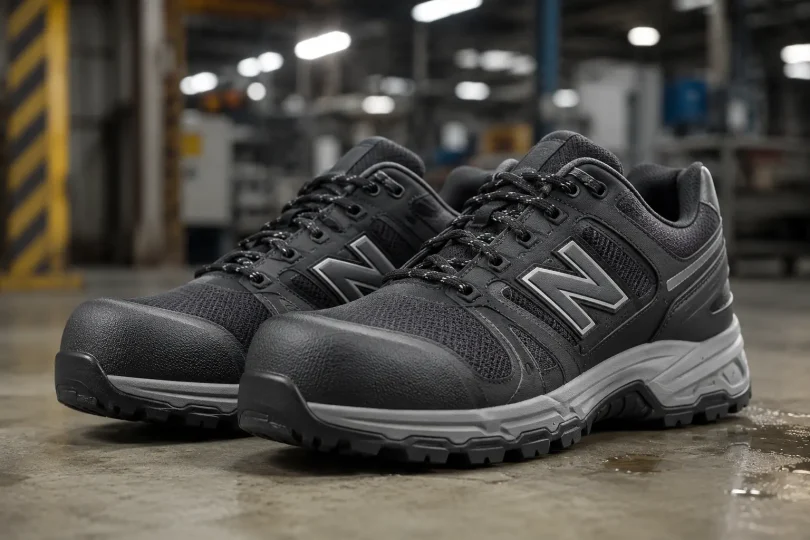


New Balance Fresh Foam Cremorne Composite Toe Safety Shoes for Men
Non-Slip, Electrical Hazard, Black/Grey, Low-Rise
As an Amazon Associate, we may earn from qualifying purchases. Prices and availability may change.
New Balance Safety Shoes: The Complete Buying Guide for 2026
The New Balance Fresh Foam Cremorne is the best New Balance safety shoe for most workers in 2026. It carries full ASTM F2413 and CSA certification, uses a lightweight composite toe, and delivers genuine athletic cushioning across a 10- or 12-hour shift. If weight or Static Dissipative protection is your priority, choose the Elite Lite instead.
Why New Balance Safety Shoes Outperform Traditional Work Boots
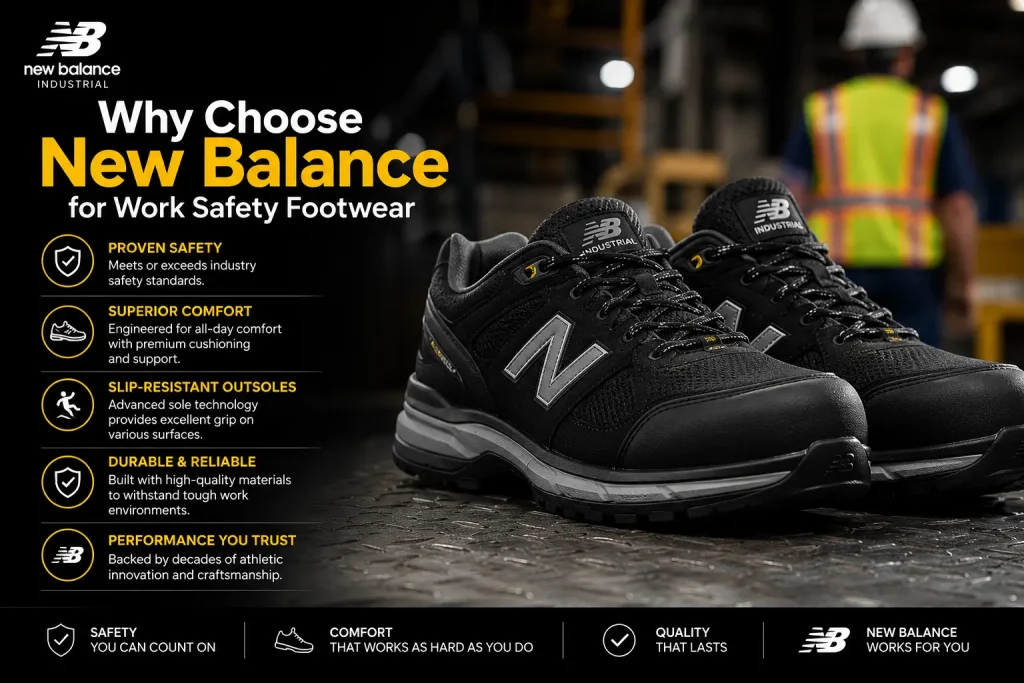
Most safety footwear brands started in the boot industry and added comfort as an afterthought. New Balance did the opposite. They spent over a century refining biomechanical cushioning for runners, then applied that exact engineering to worksite footwear.
The result is a lineup that solves the most common complaint workers have: feet that ache by hour six of a twelve-hour shift.
Lighter weight. Most New Balance safety models come in under 400 grams per shoe, reducing leg fatigue significantly compared to traditional steel-toed boots.
Superior cushioning. Fresh Foam midsole compounds, originally developed for marathon training, now sit under workers’ feet on concrete floors every day.
Real width options. New Balance offers 2E (wide) and 4E (extra-wide) fits across most safety models. Very few safety footwear brands do this.
Athletic toe box geometry. The last shape follows the natural foot contour instead of the boxy, flat build common in traditional work boots.
New Balance work safety footwear is distributed across North America through SureWerx and authorized industrial retailers.
Safety Certifications: What the Labels Actually Mean
Understanding certifications before you buy saves you from purchasing the wrong shoe for your job site. Here is a plain breakdown of every rating you will see on New Balance safety footwear.
ASTM F2413 (US Standard)
This is the current US safety standard for protective footwear. The 2018 revision (ASTM F2413-18) is the active benchmark. It covers toe impact and compression resistance, sole penetration resistance, and electrical hazard protection on EH-rated models. If you work in the United States, confirm this marking is on the shoe label before buying.
CSA (Canadian Standard)
CSA is the Canadian equivalent of ASTM. Canadian job sites almost universally require CSA-certified footwear. New Balance produces CSA-certified versions of their core models specifically for the Canadian market. Check with your employer or site safety officer for the specific CSA grade your workplace requires.
Composite Toe vs. Steel Toe
Every current New Balance safety shoe uses a composite toe cap. Composite provides identical impact and compression protection under both ASTM and CSA standards, but it is lighter, non-conductive, and passes through metal detectors without triggering them. For most workers in 2026, composite is simply the better choice.
SD (Static Dissipative)
The SD sole slowly drains static electrical charges from your body, reducing the risk of electrostatic discharge. Critical in electronics assembly, pharmaceutical plants, and cleanroom environments. Only the Elite Lite SD configuration carries this rating in the New Balance lineup.
EH (Electrical Hazard)
EH-rated soles act as a secondary insulator if you contact an open live circuit. This adds meaningful protection for electrical trade workers and maintenance staff. Not every New Balance model carries EH, so check the specific product listing.
Every New Balance Safety Shoe Model Reviewed for 2026
New Balance Fresh Foam Cremorne: Best All-Around Pick
Best for: Workers on their feet all day on concrete, warehouse floors, or healthcare environments.
Price range: $120 to $160 USD at authorized retailers.
The Cremorne is the flagship model and the right starting point for most buyers. The Fresh Foam midsole is the same compound used in New Balance’s top running shoes. Workers coming from traditional safety boots often describe the difference as dramatic by the end of a long shift.
Key specs:
• Composite safety toe, ASTM F2413-18 and CSA certified
• Slip-resistant, heat-resistant, and EH-rated outsole
• Available in low and mid-height versions
• Men’s and women’s purpose-built lasts
• Width options: D (standard), 2E (wide), 4E (extra-wide)
Pros: Best cushioning in the lineup. Looks like an athletic shoe. Genuinely versatile.
Cons: Higher price point. Not suited for rough outdoor terrain.
New Balance Elite Lite: Lightest Option and SD Pick
Best for: Electronics workers, cleanroom staff, or anyone who needs the lightest possible safety shoe.
Price range: $90 to $130 USD.
The Elite Lite strips away non-essentials to hit the lowest weight in the lineup. It is also the only model offering an SD (Static Dissipative) configuration, which makes it the default choice for ESD-sensitive environments.
Key specs:
• Composite safety toe, ASTM F2413-18 and CSA certified
• SD sole configuration available for electronics and cleanroom use
• Mesh upper panels for breathability
• Width options: D (standard), 2E (wide) on select configurations
Pros: Lightest model. SD-rated option. Lower price.
Cons: Less cushioning than the Cremorne. Mesh upper less durable in harsh environments.
New Balance Calibre: Best for Construction and Outdoor Work
Best for: Construction workers, landscapers, and anyone who needs ankle support on uneven terrain.
Price range: $140 to $180 USD.
The Calibre is the only boot-style option in the lineup. It trades some cushioning for real ankle protection and a lug outsole that grips on rough terrain. If your job takes you up ladders or across uneven ground regularly, the low-profile Cremorne is the wrong tool.
Key specs:
• Mid-height cut for ankle support
• Composite safety toe, ASTM F2413-18 and CSA certified
• EH-rated on select configurations
• Aggressive lug outsole for traction on mud, gravel, and uneven surfaces
Pros: Genuine ankle protection. Aggressive outsole traction. EH option available.
Cons: Heavier than Cremorne or Elite Lite. Less comfortable for light indoor work.
New Balance Speedware: Agile Lightweight Option
Best for: Workers who want a lighter, more agile fit than the Cremorne.
Price range: $100 to $140 USD. Regional availability varies.
The Speedware sits between the Cremorne and Elite Lite in terms of cushioning and weight. Less widely distributed than other models, so confirm availability with an authorized retailer before planning around it.
Women’s New Balance Safety Shoes: Actually Purpose-Built
Most safety footwear brands scale down men’s lasts and call it a women’s shoe. The fit problems this creates are well-documented: heel slip, toe box pinching, and arch placement that does not match women’s biomechanics.
New Balance builds their women’s safety footwear on separate lasts designed from women’s foot measurements.
Narrower heel cup: Prevents heel slip during active movement.
Shaped toe box: Based on women’s foot geometry, not a shrunk men’s last.
Correct arch placement: Matched to women’s biomechanics.
Same certifications: As men’s versions, no protection compromise.
The Fresh Foam Cremorne Women’s is available in composite toe, ASTM and CSA certified, in both low and mid-height versions. If you have spent years tolerating men’s safety shoes because women’s options were uncomfortable, the fit difference here is noticeable immediately.
Which New Balance Safety Shoe Fits Your Job
| Job Environment | Best Model | Key Reason |
| Warehouse / Distribution | Fresh Foam Cremorne | Best cushioning on concrete all day |
| Healthcare / Hospitality | Cremorne or Elite Lite | Athletic look, slip-resistant, all-day comfort |
| Construction / Outdoor | Calibre | Ankle support, lug outsole, EH option |
| Electronics / Cleanroom | Elite Lite SD | Only model with SD certification |
| Light Industrial / Manufacturing | Cremorne or Elite Lite | Composite toe, versatile outsole, all-day comfort |
| Electrical Trades / Maintenance | Calibre EH | Secondary insulation against live circuits |
Sizing: Getting It Right the First Time
New Balance safety shoes follow the same sizing as their athletic line. If you wear a New Balance running shoe in a specific size, start there for safety footwear.
Practical sizing tips:
• Go half a size up if you wear thick work socks or compression socks
• Try shoes on in the afternoon since feet swell over the course of a day
• Break-in time is minimal. The Fresh Foam cushioning is comfortable from the first wear
Width guide:
• B (Narrow): Narrower feet, most common in women’s models
• D (Standard): Average width, the default if no code is shown
• 2E (Wide): For feet that feel cramped in standard safety shoes
• 4E (Extra-Wide): For feet that need significantly more room across the ball
How to Make Your New Balance Safety Shoes Last Longer
Daily habits:
• Remove shoes after every shift and let them air out fully
• Loosen laces completely when removing to reduce stress on upper stitching
• Alternate between two pairs to give each 24 hours to decompress and dry
Weekly cleaning:
• Wipe uppers with a damp cloth and mild soap
• Scrub outsole grooves with a stiff brush to clear debris
• Never machine wash or tumble dry. Heat destroys the adhesive and breaks down the foam midsole
When to replace: Every 12 to 18 months under daily use. Watch for flat midsole, worn-smooth outsole, cracking at the toe cap, or upper separation along any edge.
New Balance vs. Competitors: The Honest Comparison
Timberland PRO ($100-$200): Strong on rugged durability and retail availability. Heavier than New Balance and less advanced on cushioning technology.
Red Wing ($200-$400): Best track record for extreme durability in heavy-industry settings. Significantly heavier and considerably more expensive. Not worth the premium for light-to-moderate work environments.
Keen Utility ($110-$200): Their standard wide toe box is genuinely good. Bulkier profile than New Balance and fewer width options overall.
Caterpillar ($80-$160): Competitive pricing and a wide model range. Cushioning and athletic feel are below New Balance across the lineup.
Where New Balance wins: Cushioning over a long shift, lightweight construction, and width options for wider feet. Where it is weaker: a smaller catalog than legacy boot brands.
Where to Buy Genuine New Balance Safety Shoes in 2026
United States:
• Lehigh Safety Shoes (lehighsafetyshoe.com)
• Grainger for industrial buyers
• SureWerx retailer locator at surewerxfootwear.com
Canada:
• Work Authority (workauthority.ca) for full CSA-certified lineup
• Marks Work Wearhouse for in-store access
• SureWerx dealer locator by province
A note on online marketplaces: Counterfeit safety shoes exist and sometimes carry certification markings the product never passed. If a price looks too low for a certified safety shoe, it probably is. Stick to the authorized dealer list.
FAQ: Long-Tail Questions Workers Actually Search
Are New Balance safety shoes worth the price compared to cheaper brands?
For workers on their feet for 8-plus hours daily, yes. The Fresh Foam cushioning reduces fatigue meaningfully compared to budget safety shoes, which typically use basic EVA foam that compresses flat within months. The price difference pays back in energy and comfort across a full work year.
Can I use New Balance safety shoes for jobs that require slip resistance on wet floors?
Yes, but check the specific outsole slip-resistance rating on the product listing against your workplace requirements. Healthcare facilities and food processing plants sometimes require a minimum coefficient of friction rating. Both the Cremorne and Elite Lite carry slip-resistant outsoles, but confirm the exact rating matches your employer’s specification.
Do New Balance safety shoes work for plantar fasciitis?
The Fresh Foam Cremorne is the best choice for plantar fasciitis sufferers. The midsole provides firm arch support with deep cushioning underfoot. Some workers also add aftermarket orthotics, which fit well given the roomy toe box on the 2E and 4E width options.
What is the difference between the Cremorne low and mid-height versions?
The low version is a standard shoe height, better for lighter work environments and workers who prefer ankle mobility. The mid-height version adds ankle coverage for environments with more lateral movement risk. Both carry identical safety certifications.
Are New Balance safety shoes approved by OSHA?
OSHA does not approve specific shoe brands. OSHA 1910.136 requires foot protection that meets ASTM F2413 standards. New Balance safety shoes carry ASTM F2413-18 certification, which satisfies this requirement. Confirm with your workplace safety officer that the specific model meets any additional site requirements.
Can I order New Balance safety shoes through my employer’s footwear allowance program?
Yes. Lehigh Safety Shoes and similar authorized retailers run employer footwear allowance programs. Many workers can order New Balance models through their company’s program with zero or reduced out-of-pocket cost. Ask your HR or safety department for program details before buying retail.
How do New Balance safety shoes hold up in cold-weather environments like freezer warehouses?
The composite toe is a real advantage here. Steel toe caps conduct cold directly to your toes in sub-zero environments. Composite toe caps do not. For freezer warehouse work, pair a New Balance composite toe model with thermal work socks in the appropriate width size.
Are there New Balance safety shoes for workers with diabetic foot conditions?
The 4E (extra-wide) options in the Cremorne line accommodate additional volume that diabetic footwear often requires. However, workers with diabetic foot conditions should consult a podiatrist before selecting safety footwear, as clinical diabetic footwear has specific depth and internal construction requirements that standard safety shoes may not fully meet.
Final Verdict
The Cremorne is the right shoe for most workers in 2026. Wide fit options, strong cushioning, and certified protection across both the US and Canadian markets make it the practical default.
Choose the Elite Lite if you need SD protection or are watching your budget. Choose the Calibre if your job puts you on rough outdoor terrain where ankle support is not optional.
New Balance built a safety line around the single biggest problem workers face: feet that hurt by the end of a long shift. That focus shows in every model they make.
You May Also Like It: