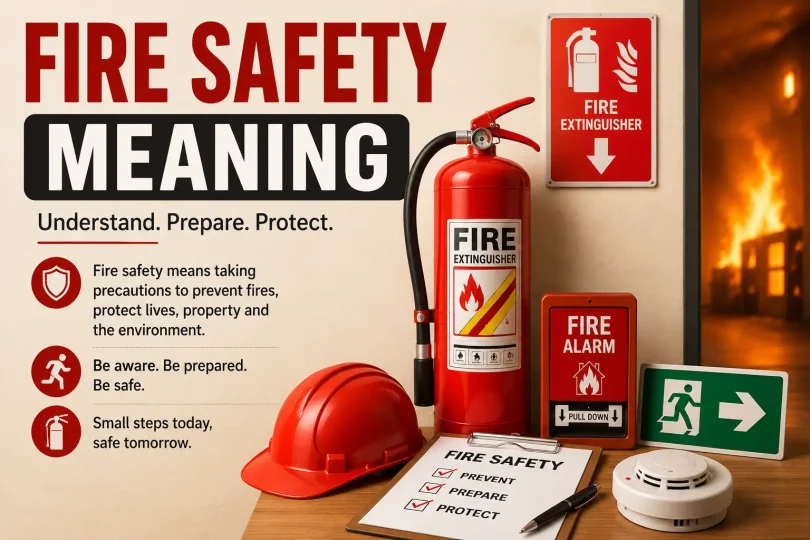

Fire Safety Meaning
Fire safety refers to the set of practices, measures, and systems designed to prevent fires from starting, limit their spread if they do, and protect people and property from harm. It covers everything from removing ignition risks before a fire occurs to having the right equipment and exit routes ready if one breaks out. In short, fire safety is both a mindset and a system, not a single action or device.
Why Fire Safety Is More Serious Than Most People Realize
The numbers are sobering. In the United States alone, fire departments respond to a fire every 23 seconds. According to the National Fire Protection Association (NFPA), residential fires cause over 2,500 deaths annually, with direct property losses exceeding $15 billion per year.
What makes those figures striking is that the vast majority of those fires were preventable.
Fire safety exists precisely to close that gap: between what people know they should do and what actually protects them when it matters most. It applies in every setting, from a studio apartment to a hospital to a large manufacturing plant.
Fire Safety vs. Fire Protection vs. Fire Prevention: The Difference That Matters
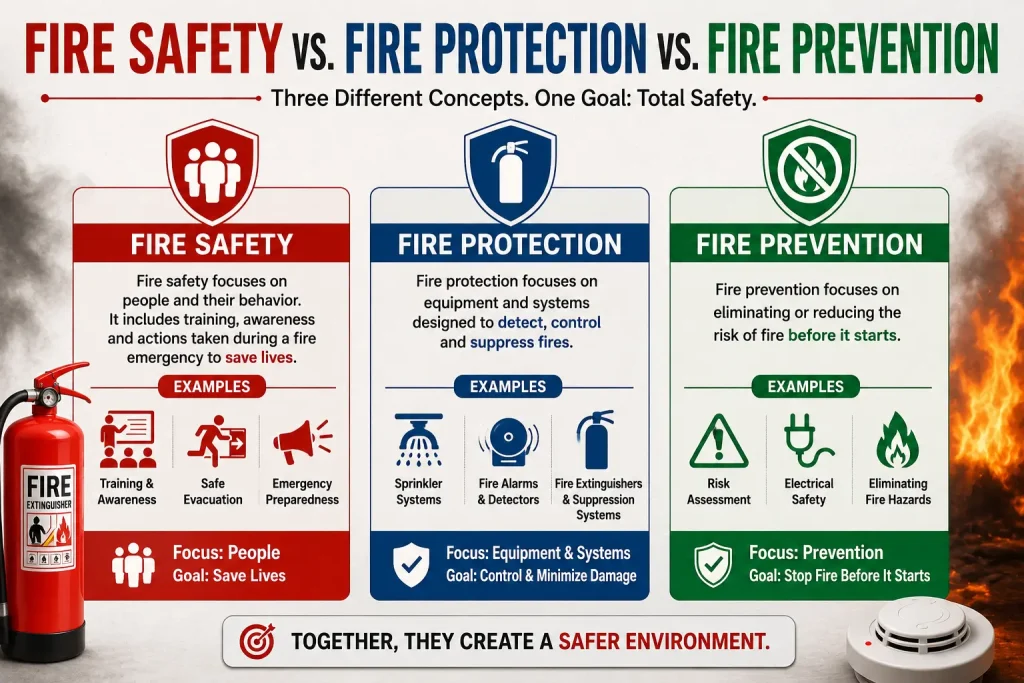
Most people use these three terms interchangeably. They mean different things, and confusing them leads to real gaps in how buildings and people are kept safe.
- Fire safety is the umbrella concept. It covers the entire system of keeping people and property protected from fire-related harm, including prevention, detection, suppression, and evacuation.
- Fire prevention is the proactive side. It means identifying and eliminating hazards before a fire starts. Think proper storage of flammable liquids, regular electrical inspections, and no-smoking policies in high-risk areas.
- Fire protection is the reactive side. It refers to the systems and structures that limit damage once a fire has started. Sprinkler systems, fire doors, fire-rated walls, and extinguishers all fall here.
A workplace that invests only in fire protection without fire prevention is playing a dangerous game. Both sides of the equation need to work together.
The Science Behind Fire: The Fire Triangle and Why It Changes How You Respond
To understand fire safety at a practical level, you need to understand what fire actually needs to exist.
The fire triangle describes three elements that must all be present for fire to burn:
- Fuel: Anything that can burn. Paper, wood, clothing, flammable liquids, gases.
- Heat: The ignition source. A spark, an open flame, an overloaded electrical circuit.
- Oxygen: Fire needs an oxygen concentration of at least 16% to sustain itself.
Remove any one of these, and the fire dies.
This is the entire logic behind every fire suppression method ever invented. Water removes heat. CO2 extinguishers displace oxygen. Fire blankets cut off oxygen to small contained fires. Fire-resistant materials reduce available fuel.
There is also a more advanced model called the fire tetrahedron, which adds a fourth element: the chemical chain reaction that keeps combustion going. Some suppression agents, like halon-based chemicals, work by interrupting this chain reaction rather than targeting heat, fuel, or oxygen directly. This matters because it explains why not every extinguisher works on every type of fire.
The 4 Stages of a Fire (And What to Do at Each One)
Fires do not go from spark to inferno instantly. They move through four distinct stages, and knowing where a fire is in that progression can change your response entirely.
Stage 1: Incipient (Ignition) This is the earliest stage. The fire is small, oxygen consumption is low, and visible flames may not even be present yet. Smoke detectors are most valuable here. If caught at this stage, a hand-held extinguisher is often sufficient, provided you have the right type and know how to use it.
Stage 2: Growth Heat builds rapidly, and the fire starts consuming more fuel. This is where room temperatures can spike fast enough to cause flashover, where every combustible surface in the room ignites simultaneously. Sprinkler systems are designed to activate during this stage. Human evacuation should already be happening.
Stage 3: Fully Developed The fire is at peak intensity. Temperatures can exceed 1,000°C. No one should be attempting to fight it at this point. Emergency services are the only appropriate response.
Stage 4: Decay The fire consumes its available fuel and begins to weaken. This stage is still dangerous. Hot surfaces, structural instability, and toxic smoke remain serious threats even as flames reduce.
The critical takeaway: most fire safety planning focuses entirely on Stage 1 and the early edge of Stage 2. That is where human intervention is both possible and effective.
The Most Common Fire Hazards in Homes and Workplaces
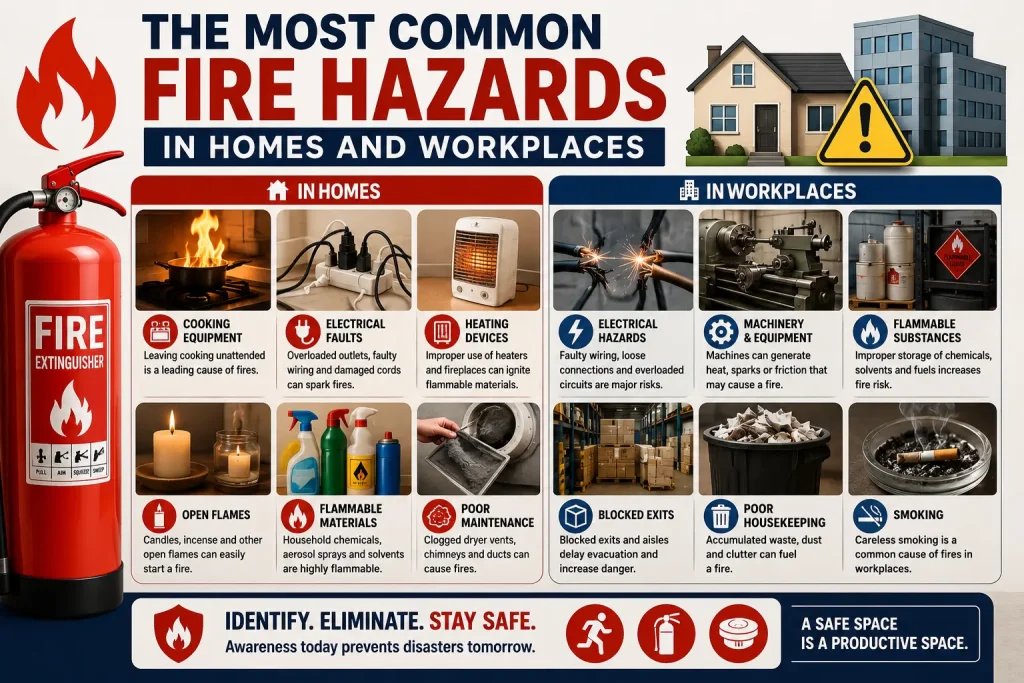
The hazards are different depending on the environment. Most fire safety guides pick one or the other. Here is how they actually compare:
| Hazard Category | In the Home | In the Workplace |
|---|---|---|
| Electrical | Overloaded sockets, faulty appliances | Faulty wiring, improper extension cord use |
| Cooking/Heat | Unattended cooking, grease buildup | Commercial kitchen equipment, industrial heaters |
| Flammable materials | Storage near heat sources | Improper chemical storage, no SDS compliance |
| Human behavior | Smoking indoors, candle misuse | Hot work (welding, cutting) without permits |
| Structural | Blocked exits, no smoke detectors | No fire doors, poorly maintained suppression systems |
Electrical faults are the leading cause of workplace fires according to OSHA data. At home, cooking is the number one cause, responsible for nearly half of all residential fires in the US.
One often-missed hazard: dust accumulation. In manufacturing and woodworking environments, fine dust particles suspended in air are explosive. This is a category that almost every general fire safety article skips entirely.
The Core Pillars of a Solid Fire Safety Strategy
Good fire safety does not rely on one thing. It is a layered system where each component backs up the others.
1. Detection Early warning is everything. Smoke detectors save lives by giving people time to act. They should be installed on every level of a building, inside sleeping areas, and tested monthly. Heat detectors are better suited to kitchens and garages where smoke alarms would trigger false alerts.
2. Suppression This is the equipment that slows or stops a fire. Sprinkler systems are the most effective passive suppression tool available. Studies show they reduce fire deaths by 80% when properly maintained. Fire extinguishers must match the fire class: Class A for ordinary combustibles, Class B for flammable liquids, Class C for electrical fires, Class K for kitchen fires involving cooking oils.
3. Compartmentalization Passive fire protection uses the physical structure of a building to contain fire. Fire-rated walls, ceilings, and floors slow the spread of flame and smoke, buying time for evacuation and emergency response. Fire doors are a critical and chronically undervalued part of this system. Propping them open defeats their entire purpose.
4. Evacuation Having an exit route is not enough. People need to know it, practice it, and be able to navigate it in zero-visibility smoke conditions. Means of egress must always be clear, lit, and signed. Regular fire drills are not a bureaucratic box-tick. They are the reason evacuation works under pressure.
5. Training Equipment is useless without knowledge. Every person in a building should know where the nearest extinguisher is, how to pull a fire alarm, and the evacuation assembly point. Fire wardens in workplace settings carry additional responsibility for sweeping areas and accounting for personnel.
Fire Safety Laws and Standards You Need to Know
Fire safety is not just best practice. In most jurisdictions, it is a legal requirement.
In the United States:
- OSHA (Occupational Safety and Health Administration) sets mandatory fire safety standards for workplaces under 29 CFR 1910 Subpart E. This includes requirements for fire prevention plans, emergency action plans, exit routes, and extinguisher maintenance.
- NFPA 101 (the Life Safety Code) is the most widely adopted fire safety standard globally. It governs occupancy requirements, means of egress, sprinkler systems, and alarm systems.
- Local fire codes vary by state and municipality. They are typically enforced through building permits, certificates of occupancy, and annual inspections.
Internationally:
- The UK uses the Regulatory Reform (Fire Safety) Order 2005, which requires all non-domestic premises to conduct fire risk assessments.
- Australia operates under AS 1851 for maintenance of fire protection systems.
- ISO 23932 provides an international framework for fire safety engineering principles.
Non-compliance is not just a fine risk. It is a criminal liability risk in cases where negligence leads to injury or death.
Fire Safety Myths That Are Genuinely Dangerous
This is where most fire safety articles stop short. Myths about fire are not harmless misconceptions. Some of them get people killed.
Myth 1: You will smell smoke and wake up. Smoke from a house fire at night will render you unconscious before it wakes you up. CO and other combustion gases work that quickly. This is the single most important reason to have working smoke detectors in sleeping areas.
Myth 2: Opening a window helps during a fire. It feeds the fire more oxygen. Keep windows and doors closed during evacuation to slow fire spread.
Myth 3: All fire extinguishers work on all fires. Using a water extinguisher on an electrical or grease fire makes things dramatically worse. The class ratings on extinguishers exist for a reason.
Myth 4: Sprinklers activate all at once like in the movies. Each sprinkler head activates independently in response to heat. In most fires, only one or two heads open. This limits water damage and protects unaffected areas.
Myth 5: A closed door does nothing against fire. A standard interior door can hold back flames and toxic gases for 10-20 minutes. That time window has saved thousands of lives. Sleeping with your bedroom door closed is a legitimate fire survival strategy.
How Modern Technology Is Reshaping Fire Safety
This is an area almost no competitor covers, yet it is changing fire safety significantly right now.
Smart smoke detectors like those using photoelectric and ionization dual sensors reduce false alarms while catching more fire types earlier. Some models now connect to your phone, alert you remotely, and integrate with smart home platforms to automatically unlock doors and disable HVAC systems.
IoT-enabled fire suppression is being deployed in data centers and industrial facilities. Sensors monitor temperature and air composition in real time, triggering suppression before flames are even visible.
Thermal imaging cameras are now standard in fire department equipment, allowing firefighters to locate people through smoke and identify hidden hotspots in walls or ceilings after a fire appears to be out.
AI-powered fire detection systems analyze video feeds to identify smoke and flame patterns faster than traditional detectors, reducing response time in large open spaces like warehouses and airports.
These advances do not replace the fundamentals. They reinforce them.
How to Build a Fire Safety Plan That Actually Works
A fire safety plan is not a document you create and forget. It is a living protocol.
Here is what a functional plan includes:
- Risk assessment: Walk through the space and identify ignition sources, fuel sources, and people at risk. Document what you find.
- Prevention measures: Actions to eliminate or reduce identified hazards. Assign responsibility to specific people, not just “everyone.”
- Detection and warning: Confirm working smoke and heat detectors. Establish how an alarm is raised, especially outside normal working hours.
- Evacuation routes and assembly points: Map primary and secondary routes. Ensure exits are never blocked. Designate an assembly point away from the building.
- Roles and responsibilities: Name fire wardens, assign floor sweeps, identify who contacts emergency services.
- Emergency procedures for people with disabilities: Do not leave this as an afterthought. Refuges, evacuation chairs, and buddy systems need to be part of the plan.
- Review schedule: Test alarms monthly. Run drills at least annually. Review the plan any time the building layout or occupancy changes.
The plan lives on paper, but it only works if people know it. Training is the bridge between the document and reality.
FAQ: Fire Safety Meaning and Common Questions
Q1: What is the simple meaning of fire safety?
Fire safety means taking deliberate steps to prevent fires from starting and to protect people and property if a fire does occur. It combines hazard removal, early warning systems, suppression tools, and clear evacuation procedures into one coordinated approach.
Q2: What is the difference between fire safety and fire protection?
Fire safety is the broad concept covering all measures related to fire risk. Fire protection specifically refers to the systems and structures that limit fire damage once it has already started, such as sprinklers, fire doors, and fire-rated construction.
Q3: What are the 3 main objectives of fire safety?
The three core objectives are: prevent fire from starting, detect and warn people quickly if it does, and ensure safe evacuation and suppression with minimal harm.
Q4: Is fire safety a legal requirement?
Yes, in most countries. In the US, OSHA mandates fire safety standards for workplaces. The UK requires fire risk assessments under the Regulatory Reform (Fire Safety) Order 2005. Local building codes add further requirements for residential and commercial properties.
Q5: How often should fire safety equipment be checked?
Smoke detectors should be tested monthly and have batteries replaced annually. Fire extinguishers need an annual professional inspection. Sprinkler systems should be maintained according to NFPA 25 standards, which includes quarterly, annual, and five-year inspection cycles depending on the component.
Q6: What is the fire triangle and why does it matter for fire safety?
The fire triangle describes the three things every fire needs: fuel, heat, and oxygen. Fire safety strategies work by removing at least one of these three elements. Extinguishers remove heat or oxygen. Fire prevention removes fuel sources. Understanding this principle helps you choose the right response to different fire types.
Q7: Can a closed bedroom door really protect you during a house fire?
Yes, research by the UL Firefighter Safety Research Institute shows a closed door can hold back flames and toxic gases for 10 to 20 minutes. It is not a permanent barrier, but in a house fire, that time window is often the difference between survival and tragedy.
Q8: What is a fire warden and what do they do?
A fire warden is a designated person responsible for managing fire safety in a specific area of a workplace or building. Their duties include conducting fire drills, sweeping their area during evacuations, assisting occupants to exits, and reporting to a central assembly point to account for everyone present.
Sources: NFPA Fire Statistics 2023, OSHA 29 CFR 1910 Subpart E, UL FSRI Door Study, NFPA 101 Life Safety Code, UK Regulatory Reform (Fire Safety) Order 2005