Fire safety is not an optional checkbox. Whether you manage a block of flats, run a business from a commercial premises, or oversee a hospital, you have a legal duty to keep the people inside your building safe from fire.
A fire safety consultant is the specialist who helps you meet that duty. But not all consultants are equal, and choosing the wrong one can leave you exposed both legally and financially.
This guide covers everything you need to know: what fire safety consultants actually do, the qualifications that matter, what a proper assessment involves, and how to avoid the most common mistakes building owners make.
What Is a Fire Safety Consultant?
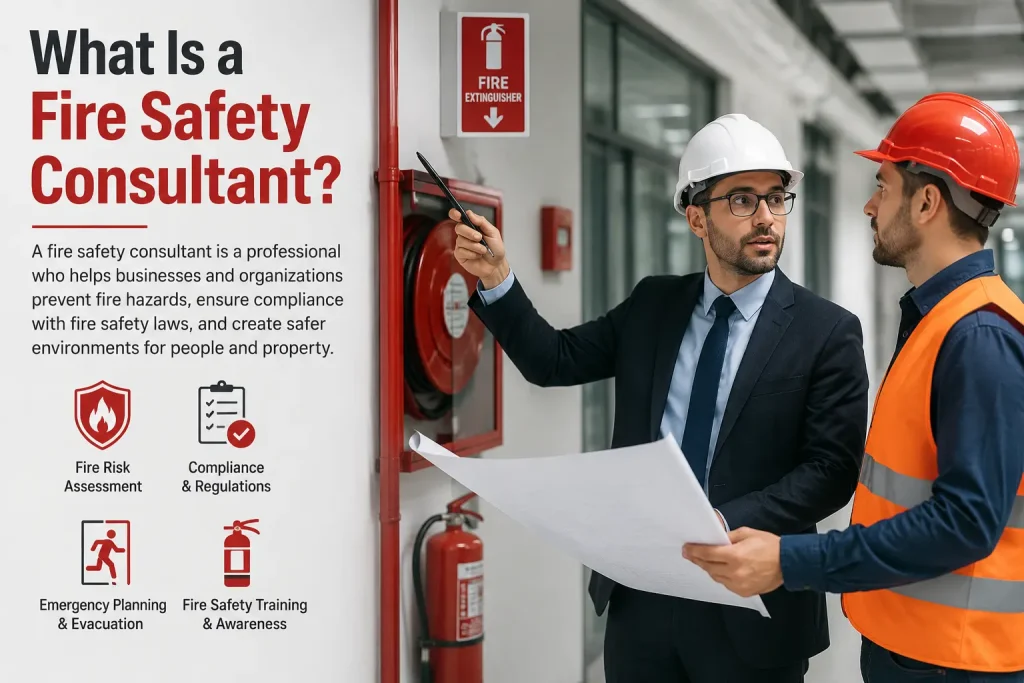
A fire safety consultant is an independent professional who assesses fire risk in buildings and advises on how to reduce it. They are distinct from firefighters or fire alarm engineers. Their role is strategic and compliance-focused: they review your building, identify hazards, and produce recommendations grounded in current UK legislation.
Their work typically spans:
- Fire risk assessments
- Fire strategy development
- Compartmentation surveys
- Fire door inspections
- Staff training programmes
- Ongoing compliance monitoring
Think of them as your building’s fire safety conscience. They see what daily familiarity causes you to overlook, and they document it in a way that holds up to legal scrutiny.
Who Legally Needs a Fire Safety Consultant?
Under the Regulatory Reform (Fire Safety) Order 2005 (FSO), the responsible person for any non-domestic premises must ensure a suitable and sufficient fire risk assessment is carried out. That duty falls on:
- Business owners and employers
- Landlords of houses in multiple occupation (HMOs) and purpose-built flats
- Managing agents and freeholders of residential blocks
- Schools, universities, hospitals, and care homes
- Hotel and hospitality operators
- Building owners undergoing construction or major refurbishment
The Building Safety Act 2022 added further responsibilities for higher-risk buildings, particularly blocks of flats over 18 metres (seven storeys or more). If your building falls into this category, the regulatory expectations are considerably higher.
In short: if you own, manage, or operate a building where people live, work, or visit, you almost certainly need a fire risk assessment, and engaging a qualified fire safety consultant is the most defensible way to get one done properly.
What Does a Fire Safety Consultant Actually Do?
1. Conduct a Fire Risk Assessment
This is the foundation of everything. A fire risk assessment is a structured, documented evaluation of:
- Potential ignition sources (electrical equipment, heating systems, combustible materials)
- People at risk, including vulnerable occupants who may need assistance evacuating
- Existing fire protection measures (detection systems, suppression, signage, escape routes)
- The likelihood of a fire starting and spreading
- Actions needed to reduce risk to an acceptable level
Residential fire risk assessments are classified by type, from Type 1 (common parts only, non-destructive) through to Type 4 (all areas, including flats, with destructive investigation). A qualified consultant will advise which type is appropriate for your building.
2. Develop a Fire Strategy
For new builds, significant refurbishments, or complex premises, a fire strategy document sets out how the building will be designed and managed to contain and control fire. This document supports planning applications, guides architects and engineers, and forms the long-term reference point for fire safety management.
3. Carry Out Compartmentation Surveys
Fire compartmentation divides a building into protected zones so fire and smoke cannot spread freely. Hidden defects such as breaches in fire-stopping around pipes, cables, or ductwork are among the most common and dangerous findings in older buildings.
A compartmentation survey, which can be non-destructive or intrusive depending on the level of investigation required, identifies these breaches and specifies remediation.
4. Inspect Fire Doors
Fire doors are safety-critical components. A door that fails to close properly, has missing intumescent strips, or has been propped open with a wedge offers no protection. Fire safety consultants carry out formal door surveys, produce detailed reports on each door’s condition, and recommend replacement or repair where needed.
5. Deliver Fire Safety Training
Your emergency plan is only as good as the people who need to follow it. A consultant can deliver staff fire awareness training, fire marshal training, and tailored sessions for roles with specific responsibilities such as building managers or wardens.
6. Provide Ongoing Compliance Monitoring
Legislation changes. Buildings change. Occupants change. A fire risk assessment must be reviewed regularly and updated whenever there is a significant change to the premises or the people using them. Many consultants offer ongoing monitoring retainers, providing continuous support and helping you demonstrate a proactive approach to compliance.
The Qualifications That Actually Matter

Fire safety consultancy is not a protected title in the UK. Anyone can call themselves a fire safety consultant without any formal qualification. This makes checking credentials essential.
Here is what to look for:
BAFE SP205 Accreditation
BAFE (British Approvals for Fire Equipment) operates the SP205 scheme specifically for fire risk assessors. Third-party certification under SP205 demonstrates that the assessor and their organisation have been independently audited against a nationally recognised standard. Choosing a BAFE SP205-registered company is one of the strongest indicators of genuine competence.
Institute of Fire Safety Managers (IFSM)
Membership of the IFSM, particularly at Affiliate, Associate, Member, or Fellow level, shows a commitment to professional standards and ongoing development.
Institution of Fire Engineers (IFE)
For those in the fire engineering space, IFE membership (especially at Chartered Engineer level) signifies a high level of technical expertise.
NEBOSH National Certificate in Fire Safety
A widely recognised qualification that confirms foundational competence in fire safety management.
First-Party vs. Third-Party Certification: Why It Matters
Many companies self-certify their work or rely on internal checks. Third-party certification, where an independent body audits the assessor’s processes and outputs, provides a much higher level of assurance. Always ask whether the consultant or their firm holds third-party certification, not just internal accreditations.
What a Quality Fire Risk Assessment Report Should Include
A professionally produced fire risk assessment report is not a generic template filled in on-site. It should contain:
- A description of the premises and its occupancy
- Identification of all significant hazards
- The population at risk and any specific vulnerabilities
- An evaluation of existing fire protection measures
- A risk rating (often expressed as significant, moderate, or low)
- A clear action plan with prioritised recommendations
- The recommended review date
The report should follow PAS 79, the Publicly Available Specification that sets out best practice for fire risk assessments in non-domestic and residential premises. Ask any prospective consultant whether they work to PAS 79 methodology. If they do not know what it is, look elsewhere.
How Much Does a Fire Safety Consultant Cost?
This is the question competitors rarely answer honestly, so here is a realistic guide. Pricing varies depending on the size of the premises, the complexity of the building, the type of assessment required, and the level of reporting needed.
As a general guide:
- Small commercial premises (up to 500 sqm): £300 to £600 for a basic fire risk assessment
- Medium commercial or residential block: £600 to £1,500
- Large or complex premises: £1,500 to £5,000 or more
- Higher-risk buildings (post-Building Safety Act): Bespoke pricing based on scope
- Fire engineering strategy: Typically £3,000 to £15,000 for complex new builds
- Fire door surveys: Often priced per door, typically £10 to £25 per door depending on volume
Be cautious of very low prices. A fire risk assessment that costs £99 will almost certainly be a generic document with limited value. If a fire incident occurs and your assessment is found to be inadequate, the cost in enforcement action, remediation, or worse, is far greater.
What Happens After the Assessment? The Part Nobody Talks About
Most articles stop at ‘get an assessment.’ Here is what happens next, and why it matters just as much.
Review the Action Plan Seriously
Your report will contain recommendations at varying levels of urgency. Some actions are immediate (a propped open fire door must be fixed today). Others are medium-term (upgrade your detection system within three months). Others are longer-term improvements. Treat the action plan as a project, not a filing exercise.
Implement Remediation Work
Your consultant can advise on contractors to carry out physical works such as fire-stopping, door replacement, or alarm upgrades. They should be able to specify what is needed without having a financial interest in who delivers it. This is why independence from equipment suppliers and contractors matters.
Update Your Records
Document what you have done and when. If a fire occurs or an enforcement officer visits, a clear record of your actions demonstrates you have taken your responsibilities seriously.
Set a Review Date and Keep It
A fire risk assessment should be reviewed at least annually in most premises. It must also be reviewed after any significant change to the building, its use, or its occupants. A consultant who sets a review date and contacts you when it approaches is worth retaining.
Train Your People Regularly
A new fire marshal training session every year, or whenever staff changes occur, keeps your team prepared. Knowledge fades quickly. Do not assume that training from three years ago is still effective.
Common Mistakes Building Owners Make (and How to Avoid Them)
- Treating the assessment as a tick-box exercise. An assessment filed and forgotten is not compliance. It is a liability. Act on the recommendations.
- Choosing the cheapest option. In fire safety, price often reflects quality. A thorough assessment takes time. If it is completed in 30 minutes for a large building, something is wrong.
- Failing to reassess after changes. Refurbishments, change of use, new occupants, or even new fire suppression equipment can all require a reassessment. Do not assume your existing report covers changes made after it was written.
- Using an unaccredited assessor. Without BAFE SP205 or equivalent accreditation, you have no independent verification that the assessor is competent. In the event of enforcement action, this matters enormously.
- Not asking about independence. A consultant who sells fire alarm systems and carries out fire risk assessments has an inherent conflict of interest. Choose someone with no financial link to equipment suppliers or contractors.
How to Choose the Right Fire Safety Consultant
Use this checklist when evaluating any fire safety consultant:
- Do they hold BAFE SP205 third-party certification?
- Are they a member of a recognised professional body such as the IFE or IFSM?
- Do they work to PAS 79 methodology?
- Do they have specific experience with your building type and sector?
- Are they independent of fire equipment suppliers and contractors?
- Can they provide references or case studies from similar projects?
- Do they offer ongoing support after the assessment, or just a one-off report?
- Are they willing to explain their findings in plain language, not just hand over a document?
A good consultant will welcome these questions. If they seem defensive or evasive, that tells you something important.
Fire Safety Consultants and the Building Safety Act 2022
The Building Safety Act 2022 introduced significant new obligations, particularly for higher-risk buildings, defined as residential buildings with at least two dwellings and a height of 18 metres or more (or at least seven storeys).
If you own or manage such a building, you need a fire safety consultant who understands the new dutyholder regime, the role of the Building Safety Regulator, and the requirements for safety case reports. This is a specialist area, and not every generalist consultant will have the necessary depth of knowledge.
Post-Grenfell reforms have changed the landscape of UK fire safety permanently. Engaging a consultant who is up to date with this legislation is not optional: it is a legal necessity.
Final Thoughts: Fire Safety Is an Investment, Not a Cost
The consequences of poor fire safety are severe. Lives can be lost. Buildings can be destroyed. Businesses can be closed by enforcement action. Landlords can face unlimited fines and criminal prosecution.
A qualified, independent fire safety consultant protects against all of these outcomes. More than that, they give you the clarity and confidence to manage your building responsibly, with a clear understanding of the risks and a documented plan to address them.
Choose someone with the right credentials. Ask the right questions. And treat their recommendations as the serious, professional guidance they are.
You May Also Like It: