
Every year, the UK Health and Safety Executive (HSE) records hundreds of fatal injuries and thousands of non-fatal accidents in the construction industry. Behind each statistic is a person, a family, and a workplace that could have been safer.
The good news is that most construction accidents are preventable. With the right construction safety solutions in place, sites can dramatically cut injury rates, stay on the right side of the law, and build a culture where every worker goes home safe.
This guide goes beyond surface-level advice. Whether you are a principal contractor, site manager, safety officer, or subcontractor, you will find practical, regulation-backed guidance that makes a real difference on the ground.
What Are Construction Safety Solutions?
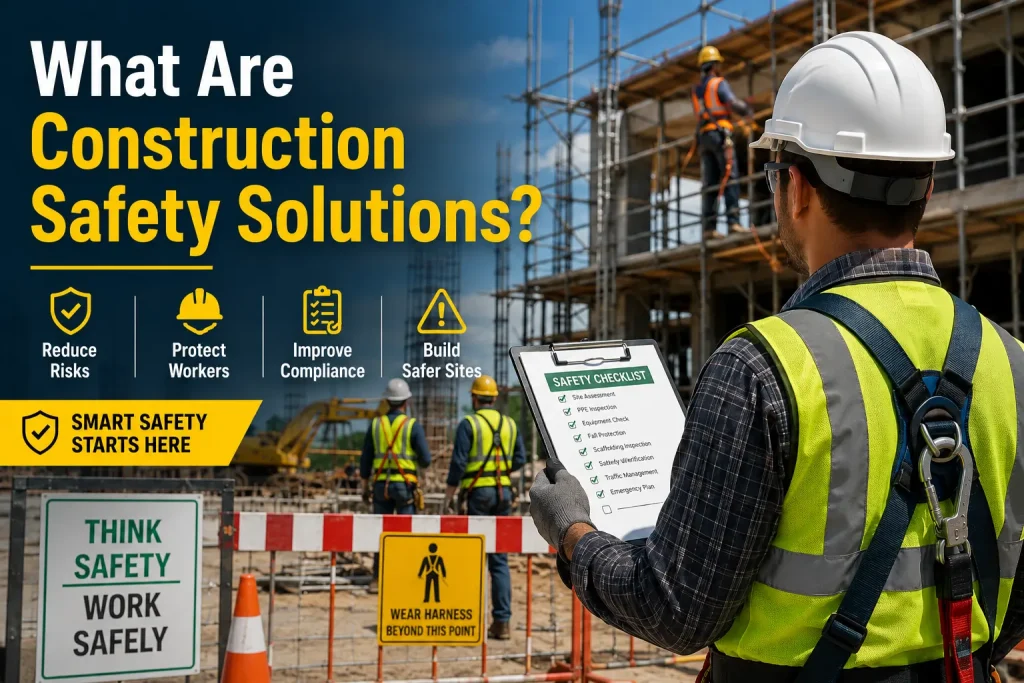
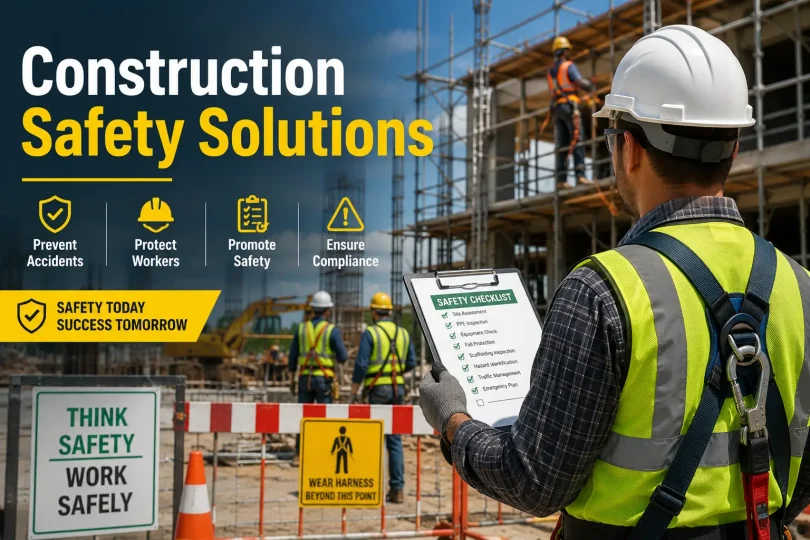
Construction safety solutions are the systems, processes, equipment, and behaviours that work together to eliminate or reduce the risk of harm on a building or civil engineering site. They cover everything from legal compliance to daily site routines.
A complete safety solution includes:
• Legal compliance with CDM 2015 and HSE regulations
• Risk assessments and method statements (RAMS)
• Personal Protective Equipment (PPE) management
• Site inductions and ongoing worker training
• Toolbox talks and daily briefings
• Emergency response planning
• Digital tools for inspections, audits, and incident reporting
• A strong safety culture led from the top down
The UK Legal Framework: What Every Contractor Must Know
Most safety guides skip the legal context. That is a mistake. Understanding your legal duties is the foundation of every effective safety solution.
CDM 2015: The Core Regulation
The Construction (Design and Management) Regulations 2015 (CDM 2015) is the primary legislation governing construction health and safety in the UK. It places specific duties on three key dutyholders:
• Principal Designer: Responsible for planning, managing, and monitoring pre-construction phase health and safety.
• Principal Contractor: Responsible for planning, managing, and monitoring construction phase health and safety.
• Contractors and Workers: Responsible for cooperating with the principal contractor and following site rules.
If your project has more than one contractor, you must notify the HSE and appoint both a Principal Designer and Principal Contractor before work begins. Failure to do so is not just a safety risk; it is a criminal offence.
Other Key Regulations to Know
• Work at Height Regulations 2005: Requires planning, supervision, and correct equipment for any work above ground level.
• COSHH Regulations 2002: Controls exposure to hazardous substances such as silica dust, asbestos, and chemical solvents.
• PUWER 1998: Ensures all plant and equipment is safe, maintained, and only used by trained operators.
• Management of Health and Safety at Work Regulations 1999: Requires suitable risk assessments for all significant workplace risks.
• Personal Protective Equipment at Work Regulations 2022: Strengthens PPE requirements and extends protections to limb workers.
The 6 Biggest Construction Hazards and How to Control Them

Understanding the most common hazards is the starting point for building effective construction safety solutions. The HSE consistently identifies these six categories as the leading causes of construction fatalities and serious injuries in the UK.
1. Falls from Height
Falls from height account for around 50% of all fatal injuries in UK construction. The hierarchy of control requires you to:
• Eliminate the need to work at height wherever possible.
• Use collective protection first (scaffolding, edge protection, safety nets) before individual protection such as harnesses.
• Never allow work at height without a completed and signed risk assessment.
• Inspect all working platforms, ladders, and access equipment before each shift.
2. Struck-By Incidents
Flying or falling objects and moving plant are consistent killers on construction sites. Controls include:
• Clearly defined exclusion zones around cranes, excavators, and lifting operations.
• Mandatory high-visibility clothing in all vehicle movement areas.
• Toe boards and debris nets on all elevated platforms.
• Strict segregation of pedestrian and vehicle routes.
3. Collapse and Structural Failure
Trench collapses, scaffold failures, and demolition incidents cause fatalities that are almost entirely preventable. Key controls:
• All excavations deeper than 1.2 metres must be supported, battered, or shored.
• Scaffolding must be erected, inspected, and modified only by CISRS-certified competent persons.
• All demolition works require a documented sequence of operations reviewed by a structural engineer.
4. Hazardous Substances (COSHH)
Respiratory diseases, occupational cancers, and dermatitis are long-term killers in construction. The most dangerous substances include:
• Respirable crystalline silica (RCS): Released by cutting, drilling, or grinding concrete, brick, and stone. Dust suppression and FFP3 masks are mandatory.
• Asbestos: Found in buildings constructed before 2000. A licensed contractor must remove all confirmed asbestos-containing materials. No exceptions.
• Wood dust: A known carcinogen. Dust extraction systems and RPE are required on all woodworking operations.
• Cement and epoxy resins: Cause occupational dermatitis. Chemical-resistant gloves and barrier creams are essential.
5. Manual Handling and Musculoskeletal Disorders
Musculoskeletal disorders (MSDs) account for over 40% of work-related ill health in UK construction. Prevention strategies:
• Mechanise lifting and carrying wherever possible (pallet trucks, boom lifts, mechanical aids).
• Break repetitive tasks into shorter shifts with rest breaks.
• Train workers in correct manual handling techniques, including team lifts.
• Involve workers in designing tasks to reduce unnecessary physical strain.
6. Electrical Hazards
Contact with overhead or underground cables causes serious burns, cardiac arrest, and instant fatalities. Always:
• Obtain a utility search before any ground-breaking work.
• Use a CAT and genny to locate buried services before digging by hand.
• Maintain safe distances from overhead lines (consult the line operator for exact clearance distances).
• Use 110V reduced low voltage (RLV) tools on all construction sites, not standard 230V.
Risk Assessments and Method Statements (RAMS): Your Paper Safety Net
RAMS are not box-ticking exercises. A well-written RAMS document is the operational backbone of safe working on site. It tells workers exactly how a task will be carried out safely, step by step.
What Makes a Good Risk Assessment?
• Identifies all significant hazards, not just the obvious ones.
• Evaluates the likelihood and severity of harm for each hazard.
• Lists specific control measures, not vague statements like “wear PPE.”
• Names the person responsible for implementing each control.
• Is reviewed and updated when site conditions change.
• Is communicated to every worker it affects, not just filed in an office.
What Makes a Good Method Statement?
• Written in plain English that any worker can follow.
• Describes the sequence of operations in logical, numbered steps.
• Specifies which tools, plant, and materials are required.
• States the exact PPE required at each stage.
• Includes emergency procedures relevant to the specific task.
• Signed off by a competent person before work begins.
PPE on Construction Sites: Beyond the Basics
PPE is the last line of defence, not the first. It should only be used after all other controls have been applied. That said, on construction sites, some level of PPE is almost always necessary.
Mandatory Site PPE
• Hard hat: EN 397-compliant. Replace after any impact, even if no visible damage is present.
• Safety footwear: Steel toe cap and midsole protection (EN ISO 20345). Ankle support is recommended for uneven ground.
• High-visibility vest or jacket: Class 2 minimum on most sites, Class 3 near live traffic.
• Safety gloves: Matched to the specific risk (cut-resistant, chemical-resistant, or vibration-damping).
• Safety glasses or goggles: Required where there is a risk of flying debris, chemical splashes, or UV from welding.
• Hearing protection: Required in any area where noise exceeds 85 dB(A).
Task-Specific PPE
• Respiratory Protective Equipment (RPE): FFP2 minimum for dust, FFP3 or powered-air for silica and asbestos. Fit-test all tight-fitting facepieces before first use.
• Fall arrest harness: Full-body harness (EN 361) for work at height when collective protection is not reasonably practicable. Inspect before every use.
• Cut-resistant trousers: Mandatory for all chainsaw work.
• Welding PPE: Auto-darkening welding helmet, flame-retardant clothing, and leather gauntlets.
• Chemical-resistant overalls: Required for asbestos removal, spray painting, and epoxy application.
Toolbox Talks: The Daily Safety Habit That Actually Works

A toolbox talk is a short, focused safety briefing delivered to workers at the start of a shift or before a specific task. When done well, they are one of the most cost-effective construction safety tools available.
How to Run an Effective Toolbox Talk
• Keep it short: 5 to 10 minutes maximum. Workers disengage after that.
• Make it specific: Focus on one hazard or one task. “Today we are cutting concrete near the drainage trench” beats a generic safety lecture.
• Make it two-way: Ask questions and wait for answers. Passive listening does not change behaviour.
• Record it: Log the topic, date, and names of attendees. This is your evidence of compliance.
• Follow up: If a worker raises a concern during the talk, resolve it before work starts. Never dismiss a concern as too minor.
Mental Health and Wellbeing on Site: The Gap Most Guides Miss
Suicide is the leading cause of death for men aged 20 to 49 in the UK, and construction workers are three times more likely to take their own life than to die in a workplace accident. This is a construction safety crisis that most guides completely ignore.
Physical safety cannot be separated from mental health. A worker who is struggling, sleep-deprived, or under financial pressure is more likely to take risks, miss hazards, and have accidents.
What Sites Can Do Right Now
• Train site managers as Mental Health First Aiders (MHFA England accredited).
• Display the Samaritans, Mates in Mind, and Lighthouse Construction Industry Charity helpline numbers in welfare facilities.
• Create a culture where it is safe to say “I am not okay.” That starts with site leadership being open and honest.
• Tackle practical stressors: late pay, poor welfare facilities, and zero-hours uncertainty. These are workplace hazards too.
• Conduct anonymous wellbeing surveys to identify issues before they escalate.
• Never ignore visible signs of distress. Check in directly, privately, and without judgment.
Digital Construction Safety Solutions: Working Smarter
Paper-based safety management is slow, error-prone, and difficult to audit. Digital tools are now affordable, accessible, and genuinely transformative for site safety management.
Key Digital Tools for Construction Safety
• Digital inspection apps: Conduct and log site inspections, snag lists, and safety audits from a smartphone. Instant reporting means faster fixes.
• RAMS management software: Create, issue, and track method statements and risk assessments. Workers sign off digitally, giving you a complete audit trail.
• Incident and near-miss reporting tools: Low-friction reporting (a 30-second app submission) increases near-miss reports, which are your earliest warning system.
• Permit to work systems: Digital permits for hot work, confined space entry, and excavation prevent unauthorised dangerous work.
• Wearable safety technology: Smart hard hats with sensors that detect fatigue, falls, and environmental hazards are increasingly cost-effective for larger sites.
• Drone surveys: Drones can inspect rooftops, tall structures, and hard-to-reach areas, removing the need to send workers into hazardous positions.
Building a Strong Safety Culture: Compliance Versus Commitment
Rules and equipment alone do not keep people safe. Culture does. A site where workers feel empowered to stop unsafe work, report near misses, and challenge poor practices without fear of blame is measurably safer than one that only ticks compliance boxes.
Signs of a Strong Safety Culture
• Leadership is visible on site and takes safety seriously at every level.
• Workers stop unsafe work without fear of reprisal.
• Near misses are reported freely and treated as learning opportunities, not blame events.
• Safety is discussed in the same breath as quality and programme.
• New workers receive genuine inductions, not just a signature on a form.
• Subcontractors are held to the same standards as the principal contractor’s own workforce.
Signs of a Weak Safety Culture
• Safety briefings are rushed formalities with no real engagement.
• Incidents are hidden or minimised to protect the site’s safety record.
• PPE is only worn when management walks around.
• Workers feel pressure to work through pain, exhaustion, or risk to hit deadlines.
• Subcontractors are treated as an afterthought in the site’s safety plan.
Subcontractor Safety Management: Your Responsibility, Their Workforce
Under CDM 2015, the principal contractor is responsible for coordinating and managing the health and safety of all contractors and subcontractors on site. You cannot delegate this responsibility, only the work.
• Pre-qualify all subcontractors: Check their safety record, insurance, RAMS, and accreditations (SSIP, CHAS, Constructionline) before they arrive on site.
• Brief every subcontractor on site rules before they start. Do not assume they know your site’s specific hazards.
• Include subcontractor activities in your Construction Phase Plan.
• Monitor subcontractor safety performance on the same basis as your own workforce.
• Stop any subcontractor work that poses an imminent risk. Under CDM 2015, you have both the right and the duty to do so.
Emergency Response Planning: Be Ready Before You Need It
An emergency on a construction site can unfold in seconds. The time to plan your response is not when the alarm sounds.
Your Emergency Plan Must Cover
• Evacuation routes and muster points, clearly communicated and physically marked on site.
• Named Emergency Coordinator and deputies, with contact details visible in welfare areas.
• Procedures for common site emergencies: fire, structural collapse, COSHH incident, medical emergency, and severe weather.
• Location of first aid kits, defibrillators, and eyewash stations.
• How to communicate with emergency services, including the site address and access routes for large vehicles.
• Procedures for accounting for all workers after an evacuation.
• Regular drills, at least once per phase of the project.
Construction Safety Accreditations: Proving Your Competence
For many clients and principal contractors, safety accreditations are a minimum requirement to tender. They are also a genuine mark of commitment to safe working.
• SSIP (Safety Schemes in Procurement): The umbrella body for safety pre-qualification schemes in the UK. Achieve one SSIP member scheme (such as CHAS or Acclaim) and it is recognised across all others.
• CHAS (Contractors Health and Safety Assessment Scheme): One of the most widely recognised safety accreditations for UK contractors.
• Constructionline: A pre-qualification service that includes health and safety assessment alongside financial and insurance checks.
• ISO 45001: The international standard for occupational health and safety management systems. Demonstrates a systematic, documented approach to safety.
• CITB (Construction Industry Training Board): Industry training body. CITB levy-registered employers can access funded training for workers and managers.
Key Takeaways: Your Construction Safety Solutions Checklist
Effective construction safety is not a single action. It is a system of interlocking practices that must all work together. Here is a quick summary:
1. Know your legal duties under CDM 2015 and the relevant regulations for your work type.
2. Identify every significant hazard and implement controls in the correct order: eliminate, substitute, engineer, administrate, then PPE.
3. Write clear, specific RAMS for every high-risk activity. Make sure every worker reads and understands them before starting.
4. Run daily toolbox talks and make them two-way conversations, not one-way monologues.
5. Manage PPE properly: the right equipment, properly fitted, inspected regularly, and replaced when needed.
6. Address mental health with the same seriousness as physical hazards.
7. Use digital tools to make reporting, inspections, and compliance faster and more reliable.
8. Pre-qualify and continuously monitor subcontractors. They are your responsibility on site.
9. Have a tested, communicated emergency response plan that every worker knows.
10. Build a safety culture where every worker feels responsible, empowered, and heard.
Final Thoughts
Construction is one of the most hazardous industries in the world. But it does not have to be the most dangerous place to work. The construction sites with the best safety records share one thing in common: they treat safety as a core value, not a compliance obligation.
Investing in robust construction safety solutions protects your workers, your business, your reputation, and your future. It reduces costs from accidents, avoids enforcement action, and helps you win work from clients who take safety seriously.
Start with the hazards most likely to cause serious harm. Build your systems around them. Then create the culture that makes those systems stick.
Safe sites are not lucky. They are planned, led, and maintained by people who refuse to accept that accidents are inevitable.
You May Also Like It: