
Falls are the leading cause of death in construction and one of the top killers across general industry. According to OSHA, falls account for more than one in three construction fatalities every year. Most employers know they need fall protection. The harder problem is: what do you do when there is no fixed structure to anchor to?
That’s exactly where portable fall protection systems come in.
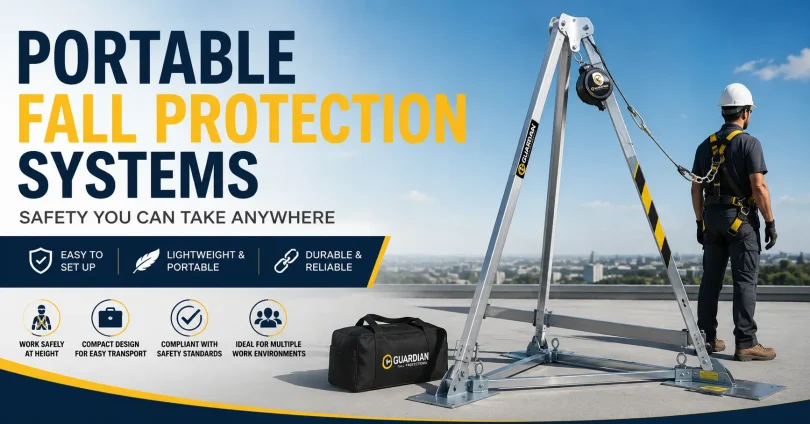
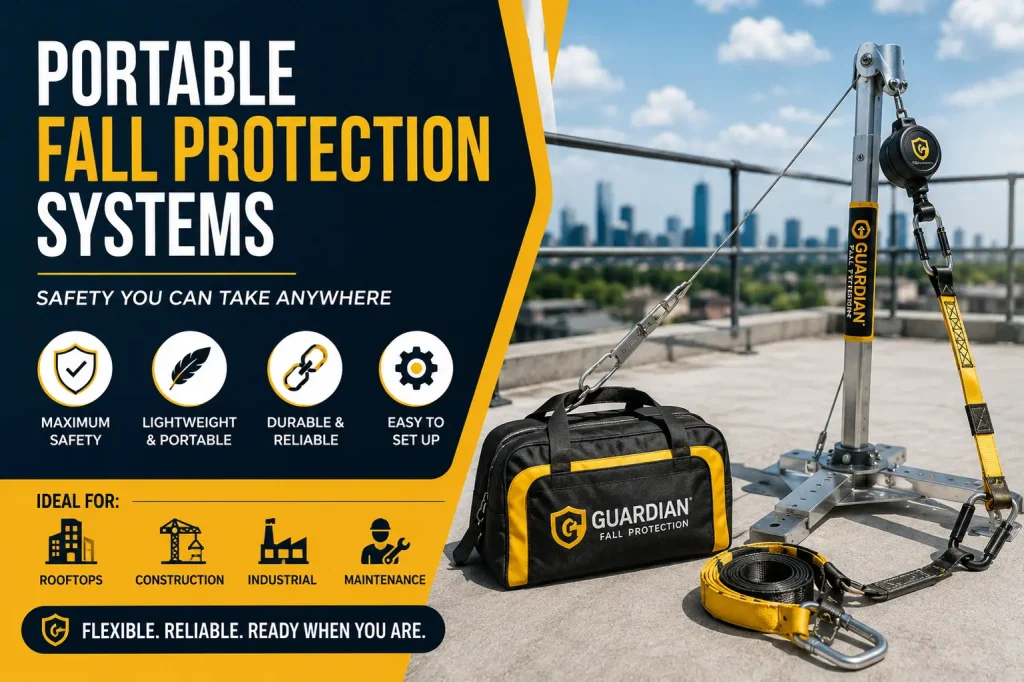
Portable fall protection lets you bring the anchor point to the job. You don’t need an overhead beam, a structural column, or a permanent roof anchor. Whether you’re maintaining a fleet of aircraft, inspecting rooftops, working at a loading dock, or servicing industrial equipment in the middle of a warehouse floor, portable systems give you a compliant, engineered fall protection solution that moves with your work.
This guide covers every major system type, how to choose the right one, what OSHA requires, and how to keep your equipment safe and inspection-ready. It’s written for safety managers, site supervisors, and anyone responsible for protecting workers at height.
What Is a Portable Fall Protection System?

A portable fall protection system is a freestanding or mobile unit that creates a certified anchor point without being permanently attached to a building’s structure. The system supports one or more workers through a combination of ballast weight, structural engineering, or vacuum suction, rather than bolts or welds into a wall or roof.
These systems do the same job as a fixed anchor, but they go where you go.
Key characteristics of portable systems:
- No drilling, welding, or structural modification required
- Can be repositioned as the work area changes
- Engineered to meet OSHA and ANSI anchor force requirements
- Available for single users or multiple simultaneous workers
- Suited for indoor and outdoor applications
Portable systems are not a shortcut. They are a legitimate, fully engineered solution for situations where permanent anchoring is impractical, impossible, or cost-prohibitive.
Types of Portable Fall Protection Systems
Understanding the different system types helps you match the right solution to your specific work environment.
1. Counterweight Anchor Systems
Counterweight systems use heavy ballast weights (typically steel or concrete plates) to offset the forces generated during a fall. The weight of the ballast creates stability without any structural connection to the building.
Best for:
- Flat rooftops where penetration is not allowed
- Loading docks and warehouse interiors
- Applications where the work area shifts regularly
Important note: The counterweight must be calculated by a qualified engineer. The required ballast weight depends on the fall arrest forces your system will experience, the height of the anchor point, and the number of workers. Never guess at counterweight sizing.
2. Freestanding Frame Systems (A-Frame, C-Frame, Box Frame)
Frame systems use a wide base footprint to distribute load and resist tipping without the need for ballast weights. Common configurations include:
- A-Frame: Two legs form an A-shape for a stable, narrow profile
- C-Frame: Extends over the edge of a platform or truck, ideal for vehicle maintenance
- Box Frame (Quad Frame): Four-legged design for maximum stability and multi-user capability
Best for:
- Vehicle maintenance (aircraft, buses, semi-trucks, heavy equipment)
- Outdoor applications with no overhead obstructions
- Elevated platforms and work stands
Frame systems are popular in aviation and fleet maintenance facilities because they can be rolled directly into position alongside the aircraft or vehicle without any ceiling attachment.
3. Rigid Rail Portable Systems
Rigid rail systems mount a horizontal or angled beam onto a portable base. Workers connect to a trolley that travels along the rail, giving them a continuous overhead anchor as they move along the work area.
Unlike flexible lifelines, rigid rails eliminate deflection and sag. This matters because sag increases fall distance. In tight spaces where fall clearance is limited, a rigid rail can be the difference between a compliant system and an unusable one.
Best for:
- Applications with limited fall clearance
- Multi-user work along a linear path
- Aircraft fuselage maintenance
- Truck and trailer inspection
4. Freestanding Portable Anchors and Jib Arms
These systems provide a single overhead anchor point on a telescoping or fixed vertical mast. Many models extend from 14 feet to 38 feet or more in height. The base is weighted or designed to be secured to the floor without permanent fasteners.
Some jib arm systems offer 360-degree rotation, giving the worker a full circular work zone from a single anchor.
Best for:
- Single-worker tasks requiring a high anchor point
- Painting, welding, or assembly at varying heights
- Applications where the exact work zone changes shift to shift
5. Vacuum Anchor Systems
Vacuum anchors attach to non-porous surfaces (glass, smooth concrete, metal decking) using suction. They require no ballast and no penetration. Most systems include a built-in low-pressure alarm that warns the user if suction is lost.
Best for:
- Skylights and glass roof structures
- Metal standing-seam roofs
- Curved or sloped surfaces unsuitable for frame systems
Key limitation: Vacuum anchors only work on smooth, non-porous surfaces. They cannot be used on gravel rooftops, rough concrete, or wet or frost-covered surfaces. Always follow the manufacturer’s surface suitability requirements.
6. Portable Horizontal Lifeline Systems
A horizontal lifeline connects two anchor points and creates a travel line along which a worker’s lanyard or self-retracting lifeline (SRL) can slide. A portable horizontal lifeline pairs end anchors (which can be freestanding or counterweighted) with a tensioned cable or synthetic rope between them.
Best for:
- Rooftop work requiring movement across a long span
- Workers who need to travel the full length of a roof or platform
- Multiple workers working along a shared path (when the system is rated for more than one user)
Caution: Never use a horizontal lifeline for more workers than it is rated to support simultaneously. The shock loads in a multi-user arrest can exceed safe limits quickly.
7. Portable Guardrail Systems
Guardrail systems are a passive fall prevention approach. They do not arrest a fall after it starts. Instead, they prevent the fall from happening by creating a physical barrier. Portable guardrails use counterweighted bases or parapet clamps, and they require no drilling.
Under OSHA standards, guardrails must have a top rail at 42 inches (plus or minus 3 inches), withstand a 200-pound force applied in any direction, and include a mid-rail and toeboard.
Best for:
- Rooftop work near edges
- Temporary work areas with consistent edge locations
- Situations where passive protection is preferred over active fall arrest
OSHA Requirements for Portable Fall Protection
Understanding the regulations protects both your workers and your organization. Here are the key OSHA rules that apply to portable fall protection systems.
When Fall Protection Is Required
- Construction industry (29 CFR 1926 Subpart M): required at 6 feet above a lower level
- General industry (29 CFR 1910 Subpart D): required at 4 feet above a lower level
- Longshoring operations: required at 8 feet
- Any height when working over dangerous machinery or equipment, regardless of fall distance
Anchor Point Requirements
Under 29 CFR 1926.502(d)(15), anchor points used in personal fall arrest systems must support at least 5,000 pounds per attached worker. This is the minimum for a non-engineered anchor.
However, if the anchor is designed by a qualified person and used with a personal fall arrest system that limits maximum arrest force to 1,800 pounds, the required anchor strength drops to twice the maximum arrest force. This is why engineered portable systems can often be rated for lower counterweights than a simple 5,000-pound calculation might suggest.
Always request load ratings and engineering certifications when purchasing or renting a portable system.
Maximum Arrest Force
During a fall, the forces on the body can spike dramatically. OSHA limits the maximum arrest force to 1,800 pounds for construction workers under 29 CFR 1926.502(d). This is why your lanyard or SRL must be rated to decelerate you within a controlled distance.
Free Fall Distance
OSHA limits free fall to no more than 6 feet, and the total fall distance (including deceleration) must not result in contact with a lower level. This is where portable systems with limited height can create compliance challenges. Always calculate your fall clearance before selecting a portable anchor height.
Fall clearance calculation:
- Free fall distance (up to 6 feet)
- Plus deceleration distance (up to 3.5 feet for a 6-foot lanyard with energy absorber)
- Plus worker height (measured from feet to dorsal D-ring, approximately 5 to 6 feet)
- Plus safety margin (2 feet minimum)
Total required clearance for a worker using a 6-foot lanyard: approximately 18 to 20 feet below the anchor point.
If you do not have that clearance, choose a shorter lanyard, an SRL, or a rigid rail system.
Inspection and Certification
OSHA requires that all fall protection equipment be inspected before each use by the worker and formally inspected at regular intervals by a competent person. Engineered portable systems should also undergo periodic load testing and recertification by a qualified engineer per the manufacturer’s schedule.
How to Choose the Right Portable Fall Protection System
With so many system types available, the selection process can feel overwhelming. Use this framework to narrow your choices.
Step 1: Identify Your Anchor Surface
Ask yourself: What can the system rest on or attach to?
- Flat roof with no penetration allowed: counterweight system or portable guardrail
- Smooth metal or glass surface: vacuum anchor
- Open floor or pavement: frame system, jib arm, or freestanding anchor
- Two fixed points at opposite ends of a work area: horizontal lifeline system
Step 2: Calculate Your Fall Clearance
Measure the distance from the work surface to the nearest lower level. Then run the clearance calculation above. If clearance is tight, lean toward a rigid rail system or a short-rated SRL rather than a traditional lanyard.
Step 3: Count Your Workers
Single-user systems cannot protect multiple simultaneous workers. If you have a crew working from the same anchor zone at the same time, you need a system rated for multiple users, or you need multiple independent systems deployed side by side.
Step 4: Consider Mobility
How often will the system be repositioned? If you’re setting up once a week in the same spot, a heavier counterweight system is manageable. If you’re moving the system multiple times per shift, prioritize systems with casters, quick-release ballast, or lighter frame designs.
Step 5: Check the Environment
- Outdoor use in wind: heavier base systems are more stable
- Wet or sloped surfaces: avoid vacuum anchors, use frame or counterweight systems
- Confined or low-clearance indoor areas: rigid rail systems reduce vertical fall distance
- High-temperature environments (near kilns, furnaces): check component heat ratings
Step 6: Verify OSHA Compliance and Certifications
Any system you purchase or rent should include:
- An engineer’s stamp or third-party certification
- A rated capacity (users and maximum load)
- Documentation of the anchor force rating
- Compatibility with your other PPE (harness, lanyard, SRL)
If the vendor cannot provide these documents, do not buy the system.
Industry Applications: Where Portable Fall Protection Is Used
Aviation Maintenance
Aircraft maintenance is one of the most common use cases for portable fall protection. Aircraft fuselages are curved, engines are at varying heights, and maintenance bays are not always equipped with overhead cranes. Frame systems and rigid rail systems on wheeled bases are commonly rolled into position around wings, tails, and fuselages.
Fleet and Vehicle Maintenance
Buses, semi-trucks, and heavy construction equipment all require maintenance at heights above 6 feet. C-frame and A-frame portable systems provide overhead anchor points while workers inspect roofs, clean trailers, or service elevated components.
Roofing and Construction
Flat roofs present one of the most common portable fall protection needs. Counterweight anchors and portable guardrail systems protect workers without requiring any penetration of the roofing membrane, which is critical for warranty compliance on TPO, EPDM, and other membrane roof systems.
Industrial and Manufacturing
Manufacturing facilities often have elevated platforms, mezzanines, and process equipment that require occasional maintenance at height. Portable systems allow safety teams to deploy compliant fall protection to these locations without the cost of permanent installations at every point.
Warehousing and Logistics
Loading docks, mezzanine levels, and pallet rack inspection create fall hazards at heights above 4 feet. Portable guardrails and freestanding anchors provide rapid deployment without structural modification to the facility.
Telecommunications and Utilities
Tower and utility work sometimes requires portable systems when workers must transition from a permanent structure to a location without fixed anchors. Vacuum anchors and jib arms fill this gap on smooth tower sections and equipment housings.
Inspection and Maintenance: What Most Guides Leave Out
Most competitors list the product types and stop there. But a portable fall protection system is only as reliable as its maintenance program. Here’s what a proper inspection schedule looks like.
Pre-Use Inspection (Every Use, by the Worker)
Before each use, the worker should visually inspect:
- Frame members and base for cracks, bends, deformation, or corrosion
- All bolted or pinned connections for tightness and wear
- Ballast weights for completeness (all required weights present and secured)
- Wheels and casters for smooth operation and locking function
- Overhead rail or anchor hardware for damage, play, or corrosion
- Any locking mechanisms for full engagement
- Labels and load rating plates for legibility
If any component shows damage, remove the system from service immediately.
Periodic Formal Inspection (by a Competent Person)
Schedule a formal inspection at least every 6 months, or more frequently if the system is used daily or exposed to harsh conditions. The competent person should:
- Check all structural welds for cracks using visual or dye-penetrant inspection
- Verify counterweight mass against the engineered specification
- Test wheel brake systems under load
- Inspect all harness connection hardware (hooks, carabiners, trolleys) for gate function, corrosion, and wear
- Review any fall event history (see below)
Post-Fall Inspection (After Any Arrest Event)
If the system arrested a fall, remove it from service immediately. A fall arrest event generates forces that may have stressed or deformed structural components in ways that aren’t visible to the naked eye. The system must be returned to the manufacturer or a qualified engineer for full inspection before being returned to service.
Never re-deploy a system after a fall arrest event without formal engineering review.
Documentation
Keep written inspection records for every system. Records should include: the date of inspection, name of the competent person, components inspected, any deficiencies found, corrective actions taken, and the date the system was returned to or removed from service. OSHA inspectors may ask to see these records.
Training Requirements: A Step People Skip
A portable fall protection system protects nobody if workers don’t know how to set it up correctly. OSHA requires that employers train all workers who use fall protection equipment under 29 CFR 1926.503 (construction) and applicable general industry standards.
Training must cover:
- The nature of fall hazards at the specific work site
- Correct procedures for erecting, maintaining, disassembling, and inspecting the system
- Limitations of the specific equipment being used
- Maximum rated load capacity
- Proper harness donning and fit verification
- Rescue procedures in the event of a suspended fall arrest
Training must be provided before the worker uses the system for the first time, and retraining is required when there are changes in equipment, changes in the workplace, or evidence that a worker does not understand proper use.
Tip: Include a hands-on setup exercise in every training session. Reading a manual and actually assembling a counterweight system in the field are two different skill sets.
Common Mistakes to Avoid
These are the errors that get workers hurt and companies cited.
Using the Wrong System for the Surface
A counterweight system designed for a flat, level concrete floor may tip on a sloped or uneven surface. Always verify that the system is approved for the specific surface condition where it will be deployed.
Insufficient Counterweight
Shortcutting on ballast is one of the most dangerous mistakes in portable fall protection. If the required counterweight is 2,400 pounds, running the system with 2,000 pounds is not “close enough.” The counterweight was calculated to resist a specific arrest force. Any shortfall puts the system at risk of tipping.
Not Accounting for Swing Fall
A swing fall occurs when a worker falls while positioned to the side of the anchor point. In a swing fall, the worker swings like a pendulum and can strike a wall, column, or piece of equipment before the fall arrests. Position workers directly below the anchor point whenever possible, and select systems with horizontal travel (rail or lifeline systems) when the work area is wide.
Ignoring Fall Clearance
Setting up a portable anchor at 10 feet and connecting a 6-foot lanyard is not compliant if the nearest lower level is 14 feet down. Always run the full clearance calculation before committing to a system height.
Skipping Post-Fall Inspection
No post-fall inspection is a common audit finding. Make it a non-negotiable policy: any arrested fall triggers immediate removal from service and formal engineer review.
Renting vs. Buying: What Makes Financial Sense
Portable fall protection systems range from a few hundred dollars for a simple freestanding anchor to $30,000 or more for a fully engineered multi-user rigid rail system on a motorized base. The right buy-vs-rent decision depends on your use frequency.
Consider buying when:
- The system will be used more than once per month
- Your work sites are consistent in layout
- You need the system immediately available without lead time
- Your team has trained personnel to inspect and maintain the equipment
Consider renting when:
- You need the system for a one-time or short-term project
- The required system is highly specialized and rarely needed
- You lack internal capacity for maintenance and formal inspections
- Renting includes certified inspection, setup support, and post-use service
Whether you rent or buy, always confirm the system comes with current engineering certification and load documentation.
Key Standards and References
When selecting, using, or auditing portable fall protection systems, the following standards apply:
- OSHA 29 CFR 1926 Subpart M: Fall protection in construction
- OSHA 29 CFR 1910 Subpart D: Walking-working surfaces in general industry
- ANSI/ASSP Z359.1: Safety requirements for personal fall arrest systems
- ANSI/ASSP Z359.6: Specifications and design requirements for active fall protection systems
- ANSI/ASSP Z359.7: Qualification and verification testing of fall protection products
- ANSI/ASSP Z359.14: Safety requirements for self-retracting devices
Always verify that the portable system you select has been designed and certified to the relevant ANSI Z359 series standard for your application.
Frequently Asked Questions
Do portable fall protection systems meet OSHA requirements?
Yes, if they are properly engineered and certified. A portable system must provide an anchor capable of supporting the required load (either 5,000 pounds per worker or twice the maximum arrest force when engineered by a qualified person). The key word is engineered: a system without a certified load rating does not comply, portable or not.
Can one portable system protect multiple workers at the same time?
Some systems are engineered for multiple simultaneous users. The load rating must explicitly cover the number of workers you plan to connect. Never connect more workers than the system is rated for.
How often do portable fall protection systems need to be inspected?
Before each use by the operator, and at formal intervals of at least every 6 months by a competent person. After any fall arrest event, remove from service immediately until a qualified engineer completes a formal review.
What’s the difference between fall arrest and fall restraint?
Fall restraint prevents a worker from reaching a fall hazard at all. Fall arrest catches a worker after a fall has begun. Portable systems can provide either. Restraint systems are generally simpler but require careful lanyard length management to be effective.
Can I use any harness with a portable fall protection system?
The harness, lanyard (or SRL), and the portable anchor system must all be compatible and rated for the same application. A Class II body harness intended for positioning is not a substitute for a full Class III fall arrest harness. Check compatibility before use.
Summary: The Bottom Line on Portable Fall Protection
Portable fall protection systems solve a real problem: how do you protect workers at height when there’s no fixed structure to anchor to? The answer is an engineered, certified portable system matched to your specific environment, worker count, fall clearance, and surface conditions.
No single system works everywhere. Counterweight anchors, frame systems, rigid rails, jib arms, vacuum anchors, horizontal lifelines, and portable guardrails each have strengths and limitations. The right system is the one that fits your work, meets the regulatory requirements, and can be properly maintained and inspected by your team.
Before purchasing or deploying any system:
- Calculate your fall clearance
- Verify the load rating and engineer’s certification
- Train your workers on correct setup and use
- Establish a written inspection and maintenance program
- Know your post-fall protocol before you ever need it
Fall protection is not just about compliance. It’s about making sure everyone goes home at the end of the shift.
You May Also Like It: