
Introduction
A construction crew starts work at seven in the morning. A lab technician opens a container of solvent. A machine operator switches on a press that has run the same way for ten years. None of these people expect anything to go wrong, and most days, nothing does. But workplaces are unpredictable by nature, and the moment something does go wrong, the equipment a worker is wearing or has access to often decides the difference between a close call and a life-changing injury.
Safety equipment exists because hazards cannot always be removed. Employers can redesign a process, install a guard, or retrain a team, yet some risk usually remains. That remaining risk is where personal protective equipment (PPE) and collective safety systems step in.
This guide covers what safety equipment actually is, why it matters, how the professional Hierarchy of Controls fits into the picture, every major category of protective gear, the official standards that govern them, realistic costs, how to choose and maintain equipment, common mistakes, and where the field is heading next. Whether you manage a warehouse, run a safety program for a manufacturing plant, or simply want to understand what your employer should be providing, you will find a complete and practical reference here.
What Is Safety Equipment?
You May Also Like It:
Roofer Safety Equipment: The Complete Guide to Working Safely at Height
What Is PPE? A Complete Guide to Personal Protective Equipment
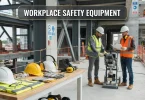
Safety equipment refers to any device, clothing item, or system designed to reduce the risk of injury, illness, or death in the workplace. It protects people against physical, chemical, biological, electrical, ergonomic, and environmental hazards, and it applies to nearly every industry, not just construction. Hospitals, food processing plants, laboratories, warehouses, mines, offices, and transportation companies all depend on it daily.
Safety equipment splits into two broad categories, and a third supporting category that is often overlooked.
Personal Protective Equipment (PPE)
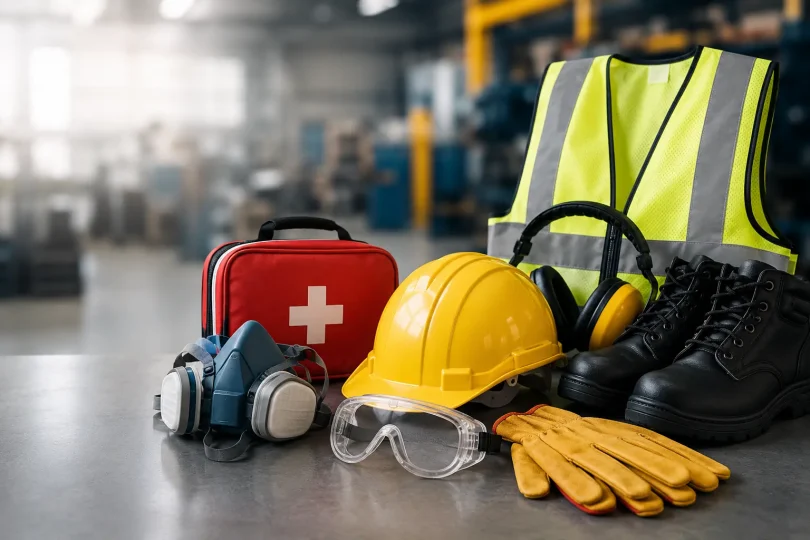
PPE covers wearable items that protect one individual worker. Common examples include:
- Safety helmets
- Safety glasses and goggles
- Protective gloves
- Respirators
- Hearing protection
- High-visibility clothing
- Protective footwear
- Fall protection harnesses
The right PPE is determined by a hazard assessment, not by job title or habit. Two workers doing similar tasks in different environments may need entirely different gear.
Collective Safety Equipment
Collective equipment protects everyone in a work area rather than a single person. Examples include:
- Fire extinguishers
- Guardrails and safety barriers
- Emergency eyewash stations and safety showers
- Fire alarm and detection systems
- Gas detection systems
- Warning signage
- Emergency lighting
Collective systems reduce risk before anyone even needs to rely on personal gear, which is exactly why they sit higher in the safety hierarchy discussed below.
Ergonomic and Support Equipment
Not every hazard is sudden. Repetitive strain, poor posture, and manual handling injuries build up over months or years, and they are just as much a safety concern as a falling object. This category includes back support belts, anti-fatigue mats, adjustable workstations, lifting aids, and vibration-dampening gloves. Many safety programs still treat this as optional, but it is quietly one of the biggest sources of long-term workers’ compensation claims in warehousing, logistics, and manufacturing.
Why Safety Equipment Matters
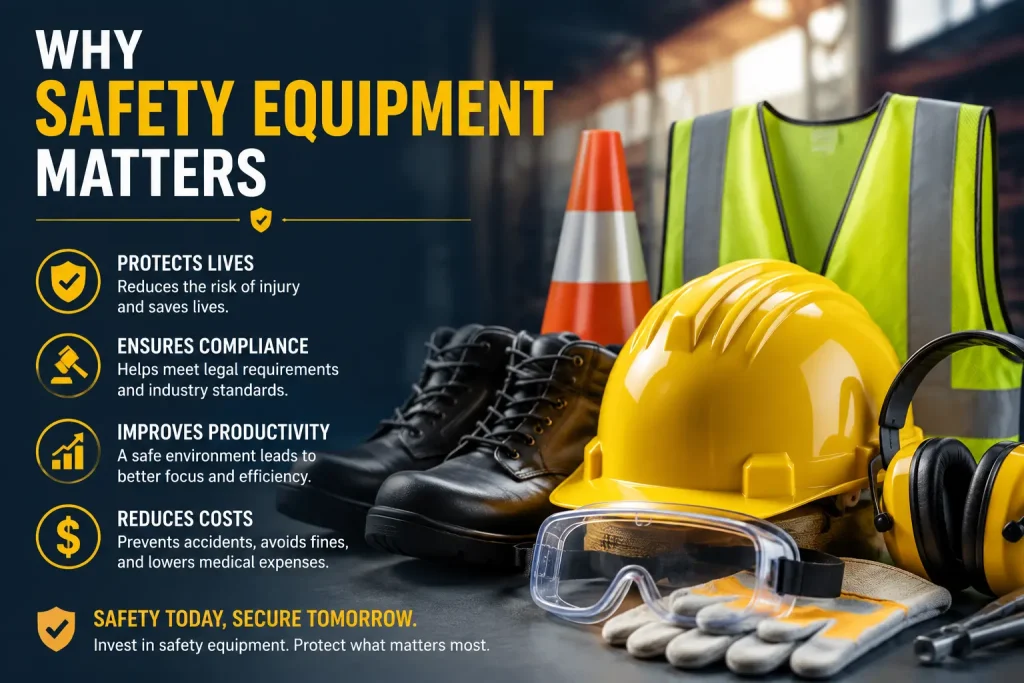
According to the U.S. Bureau of Labor Statistics, thousands of workers are killed on the job every year in the United States alone, and millions more sustain injuries that could often have been prevented with the correct equipment and training. The reasons safety equipment matters go beyond avoiding a fine.
It Reduces Injuries at the Point of Contact
Protective equipment is the last line of defense against falling objects, flying debris, chemical splashes, toxic gases, loud noise, electrical shock, heat, slips, and sharp materials. A hard hat cannot prevent an object from falling, but it can prevent that fall from becoming fatal.
It Builds Employee Trust
Workers who see their employer invest in real protection tend to stay more engaged and follow procedures more consistently. Safety, in that sense, is also a retention tool.
It Keeps Employers Compliant
In the United States, OSHA requires employers to assess workplace hazards and provide suitable PPE at no cost to the employee under 29 CFR 1910 Subpart I. Similar obligations exist under the UK’s PPE at Work Regulations and the EU’s Directive 89/656/EEC. Non-compliance can mean fines, project shutdowns, lawsuits, and reputational damage that lingers long after the incident itself.
It Protects the Bottom Line
Medical bills, workers’ compensation claims, equipment damage, lost productivity, and legal fees routinely cost far more than the equipment that would have prevented the incident in the first place. Prevention is almost always cheaper than the alternative.
It Shapes Safety Culture
When wearing the right gear becomes second nature rather than an afterthought, accident rates drop and morale tends to rise along with it.
Understanding the Hierarchy of Controls
A common misconception is that PPE should be the first response to a hazard. Professional safety programs actually treat PPE as the last resort, following a framework known as the Hierarchy of Controls, recognized by NIOSH and OSHA alike.
1. Elimination
Remove the hazard entirely. Retiring a dangerous machine or discontinuing a risky process removes the need for any additional protection.
2. Substitution
Replace the hazard with something less dangerous, such as switching to a less toxic solvent or installing quieter equipment.
3. Engineering Controls
Physically separate people from the hazard using machine guards, ventilation systems, noise enclosures, or dust extraction. These controls work independently of human behavior, which makes them more reliable than a rule someone has to remember to follow.
4. Administrative Controls
Change how work gets done through training, signage, job rotation, permits, and standard procedures. These reduce exposure but do not remove the hazard itself.
5. Personal Protective Equipment
PPE is the final barrier, used when hazards cannot be fully eliminated or controlled upstream. It should always support the other four controls, never replace them.
Types of Safety Equipment
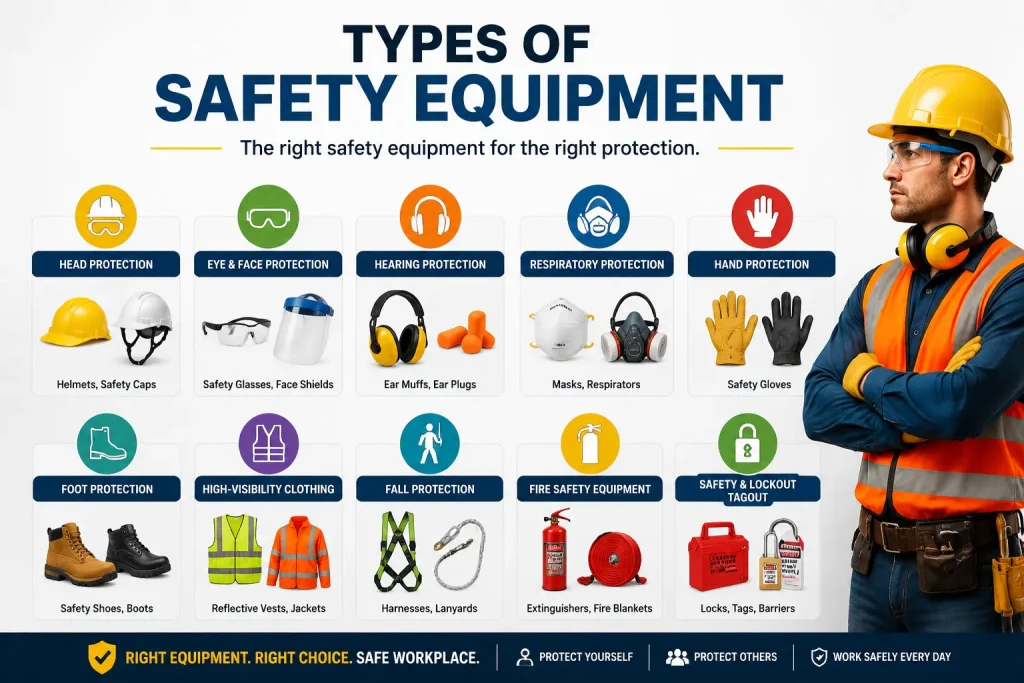
Every category below exists to answer a specific hazard. Understanding what each one protects against is the first step toward choosing correctly.
Head Protection
Head injuries remain among the most common and most preventable workplace injuries, particularly in construction, mining, manufacturing, and warehousing.
Common types:
- Hard hats (Type I protects against top impact, Type II adds lateral impact protection)
- Industrial safety helmets
- Bump caps for low-clearance areas
- Welding helmets
Where it’s required: construction sites, warehouses, manufacturing plants, mining operations, oil and gas facilities, and utility work.
Class ratings to know:
- Class G (General): protects against low-voltage conductors, tested to 2,200 volts
- Class E (Electrical): tested to 20,000 volts, used near high-voltage lines
- Class C (Conductive): offers impact protection only, no electrical rating
What to check before buying: impact class, electrical rating, ventilation, chin strap security, and certification to ANSI/ISEA Z89.1. Inspect helmets regularly and replace them immediately after any significant impact, visible cracking, or once they pass the manufacturer’s service life, usually five years from the date of manufacture.
Typical cost range: $15 to $40 for a standard hard hat, $80 to $200 for helmets with integrated hearing and eye protection.
Eye and Face Protection
Eye injuries often happen in a fraction of a second and can cause permanent vision loss. Flying particles, chemical splashes, sparks, and molten metal are the most frequent causes.
Common equipment:
- Safety glasses
- Safety goggles
- Face shields
- Welding helmets
- Laser safety eyewear
Safety glasses vs. safety goggles: glasses guard against impact and suit general tasks, while goggles form a sealed barrier around the eyes, which makes them the better choice around chemicals, dust, or liquid splashes.
Face shields add coverage for the whole face but are meant to be worn alongside glasses or goggles, not instead of them.
Best practices:
- Keep lenses clean and free of scratches
- Replace scratched or pitted lenses immediately
- Store eyewear in a hard case, not a pocket or toolbox
- Choose anti-fog coatings for humid or fast-changing environments
Look for eyewear certified to ANSI/ISEA Z87.1. In the European Union, the equivalent standard is EN 166.
Typical cost range: $5 to $15 for basic safety glasses, $20 to $60 for chemical splash goggles, $150 and up for prescription safety eyewear.
Hearing Protection
Noise-induced hearing loss develops slowly and painlessly, which is what makes it so easy to ignore until the damage is permanent. OSHA’s Permissible Exposure Limit sits at 90 decibels averaged over an eight-hour shift, and hearing protection becomes mandatory above that threshold under 29 CFR 1910.95.
Common equipment:
- Disposable and reusable earplugs
- Earmuffs
- Electronic hearing protectors that allow ambient sound through while blocking harmful peaks
Industries most affected: manufacturing, construction, aviation, mining, heavy engineering, and metal fabrication.
Choosing the right protection: select a Noise Reduction Rating (NRR) suited to the actual measured noise level, not the highest number on the shelf. In extremely loud environments, combining earplugs with earmuffs can add meaningful protection where recommended by a safety professional. Overprotecting can be counterproductive too, since it can isolate workers from warning alarms and verbal instructions.
Typical cost range: under $1 per pair for disposable foam earplugs, $15 to $40 for earmuffs, $100 to $300 for electronic or communication-enabled hearing protection.
Respiratory Protection
Airborne hazards are often invisible, which makes respiratory protection one of the most misunderstood categories of PPE. Dust, smoke, chemical vapors, and biological contaminants can cause damage long before symptoms appear.
Common equipment:
- N95 respirators
- Disposable dust masks
- Half-face and full-face respirators
- Powered Air Purifying Respirators (PAPRs)
- Self-Contained Breathing Apparatus (SCBA)
Selection tips:
- Identify the specific airborne hazard and its exposure level
- Choose the correct filter or cartridge type for that hazard
- Complete a proper fit test before first use
- Retrain and refit periodically, and after any significant weight change
Selection depends entirely on the hazard present. NIOSH certifies respirators under 42 CFR Part 84, and OSHA’s Respiratory Protection Standard (29 CFR 1910.134) requires fit testing, medical evaluation, and training before a worker relies on one. A respirator that has not been fit-tested can leak around the seal and offer far less protection than its rating suggests, even if it is the correct model for the job.
Typical cost range: under $1 for a basic disposable mask, $20 to $60 for a reusable half-face respirator, $300 to $1,000+ for a PAPR system, several thousand dollars for SCBA units used in confined space or firefighting work.
Hand and Arm Protection
Hands do most of the physical work in almost every job, which also makes them one of the most frequently injured body parts. Comfort should never be the deciding factor in glove selection; the hazard should be.
Common types:
- Cut-resistant gloves (rated under ANSI/ISEA 105, cut levels A1 through A9)
- Chemical-resistant gloves
- Heat- and cold-resistant gloves
- Electrical insulating gloves (rated by voltage class under ASTM D120)
- Impact-resistant gloves
- Disposable nitrile gloves
- Leather work gloves
How to choose:
- Match the glove to the specific hazard, not just the task name
- Check chemical compatibility charts before working with solvents or acids
- Confirm the dexterity level needed for fine work
- Verify the voltage rating for any electrical task
Nitrile gloves handle many chemicals well, leather suits rough materials, and electrical work always requires gloves rated for the specific voltage involved, tested regularly for insulation integrity.
Best practices: inspect gloves before every use, discard damaged disposables, never reuse single-use gloves, and wash reusable gloves according to the manufacturer’s instructions.
Typical cost range: $0.10 to $0.50 per pair for disposable nitrile gloves, $5 to $20 for cut-resistant work gloves, $50 to $150 per pair for rated electrical insulating gloves.
Protective Clothing and Body Protection
Clothing protects the areas gloves and helmets cannot reach, shielding against chemicals, flame, heat, electricity, or contamination.
Common types:
- Flame-resistant (FR) clothing rated under NFPA 2112
- Arc-rated clothing rated under NFPA 70E for electrical work
- Chemical-resistant coveralls
- High-visibility vests meeting ANSI/ISEA 107
- Cold-weather and rain gear
- Laboratory coats and chemical aprons
High-visibility clothing uses fluorescent fabric and reflective tape to keep workers visible near moving vehicles, and it is standard in road construction, warehousing, transportation, and airport operations. ANSI/ISEA 107 defines three classes based on the level of risk and visibility distance required.
Flame-resistant clothing, common in oil and gas, welding, and utilities, reduces burn severity by resisting ignition and limiting how fast flames spread across the fabric.
Typical cost range: $15 to $40 for a high-visibility vest, $80 to $250 for a set of FR coveralls, $150 to $500+ for arc-rated clothing depending on the arc rating (cal/cm²) required.
Foot and Leg Protection
Falling objects, punctures, slippery floors, and electrical hazards account for most foot injuries, and the right footwear addresses several of these risks at once.
Common types:
- Steel-toe, composite-toe, and alloy-toe boots
- Slip-resistant shoes
- Electrical hazard boots rated under ASTM F2413
- Puncture-resistant and metatarsal protection boots
- Waterproof safety boots
Selecting footwear, consider:
- Workplace hazards (impact, puncture, electrical, chemical)
- Sole traction on the specific floor surfaces used
- Comfort for full-shift wear
- Weight, since heavier boots increase fatigue over long days
Fit matters as much as the safety rating. Boots that are too loose reduce stability, and boots that are too tight cause fatigue over a full shift, which itself becomes a safety issue.
Typical cost range: $50 to $120 for standard steel-toe boots, $120 to $250 for specialized electrical hazard or waterproof safety boots.
Fall Protection Equipment
Falls are consistently one of the leading causes of workplace fatalities, particularly in construction and industrial maintenance, and OSHA requires fall protection for most work performed at four feet or higher in general industry and six feet in construction.
A complete system includes:
- A full-body harness
- A lanyard or self-retracting lifeline
- An anchorage point rated to the required strength, typically 5,000 lbs per worker under OSHA
- Connectors
- Guardrails or safety nets where applicable
Systems are governed under ANSI Z359 in the United States. Systems are only as strong as their weakest component, so every part should be inspected before each shift, and any equipment involved in an actual fall must be removed from service immediately, no exceptions.
Typical cost range: $50 to $150 for a basic full-body harness, $100 to $300 for a self-retracting lifeline, $200 to $600+ for engineered anchorage systems.
Fire Safety Equipment
Fire spreads fast, which is why prevention, detection, suppression, and response all need to work together rather than relying on any single tool.
Essential equipment includes fire extinguishers, smoke and heat detectors, alarm systems, fire blankets, sprinkler systems, emergency lighting, and exit signage, all governed in the U.S. by NFPA codes, most notably NFPA 10 for portable extinguishers.
Fire Class and Suitable Use:
| Fire Class | Suitable For |
|---|---|
| Class A | Wood, paper, cloth |
| Class B | Flammable liquids |
| Class C | Electrical fires |
| Class D | Combustible metals |
| Class K | Cooking oils and fats |
Using the wrong extinguisher on the wrong fire class can make the situation worse, which is exactly why hands-on extinguisher training matters more than simply mounting one on a wall.
Typical cost range: $30 to $80 for a standard ABC dry chemical extinguisher, $150 to $400 for specialized Class D or Class K units.
Electrical Safety Equipment
Electrical incidents can cause severe burns, cardiac arrest, or death within seconds, and arc flash events in particular generate temperatures hotter than the surface of the sun in a fraction of that time.
Common equipment: insulated gloves, arc-rated clothing, voltage detectors, insulated tools, face shields, arc flash suits, and lockout/tagout kits, all tied to the requirements of NFPA 70E.
Best practice: de-energize equipment whenever possible, verify isolation before starting work, never use a damaged insulated tool, and follow lockout/tagout procedures without shortcuts, even when the job feels routine.
Typical cost range: $50 to $200 for insulated gloves per pair, $300 to $1,500+ for a full arc flash suit depending on the incident energy rating required.
Gas Detection Equipment
Many of the most dangerous gases, including carbon monoxide and hydrogen sulfide, have no smell or color at all, which makes detection equipment the only reliable warning system in confined spaces.
Types include:
- Single-gas detectors
- Multi-gas detectors
- Fixed monitoring systems
- Portable units
Common gases monitored: carbon monoxide, hydrogen sulfide, oxygen levels, methane, carbon dioxide, and ammonia.
Calibration on a defined schedule is non-negotiable. An uncalibrated detector can give a false sense of safety that is worse than having no detector at all.
Typical cost range: $150 to $400 for a single-gas detector, $400 to $1,200 for a multi-gas portable unit, several thousand dollars for fixed facility-wide monitoring systems.
First Aid and Emergency Equipment
Even the best prevention program cannot eliminate every emergency, which is why every workplace needs equipment that lets trained personnel respond within the first critical minutes.
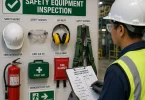
Essential equipment includes ANSI Z308.1-compliant first aid kits, Automated External Defibrillators (AEDs), stretchers, emergency eyewash stations, safety showers, burn kits, and blood spill cleanup kits. All of it should be clearly marked, unobstructed, and checked on a set schedule, not just after someone notices it is missing.
Typical cost range: $30 to $100 for a compliant workplace first aid kit, $1,200 to $2,500 for an AED unit.
Safety Equipment by Industry

| Industry | Typical Equipment |
|---|---|
| Construction | Hard hats, high-visibility vests, safety boots, safety glasses, fall protection, hearing protection, dust respirators |
| Manufacturing | Cut-resistant gloves, hearing protection, safety glasses, steel-toe footwear, respirators, protective clothing |
| Healthcare | Medical gloves, surgical masks, respirators, face shields, protective gowns, safety goggles |
| Oil and Gas | Flame-resistant clothing, gas detectors, respirators, fall protection, safety helmets, arc-rated PPE |
| Warehousing and Logistics | Safety footwear, high-visibility clothing, gloves, safety helmets, hearing protection in high-noise zones, back support equipment |
| Laboratories | Lab coats, chemical-resistant gloves, safety goggles, face shields, respirators, emergency eyewash stations |
| Food Processing | Cut-resistant gloves, slip-resistant footwear, hairnets and beard covers, waterproof aprons, hearing protection |
| Agriculture | Respirators for pesticide handling, hearing protection, eye protection, cut-resistant gloves, sun and heat protection |
Workplace Safety Standards
Certification is not a formality. It means a product has been independently tested against a defined performance benchmark.
| Organization | Purpose |
|---|---|
| OSHA | Workplace safety regulations (United States) |
| ANSI | Voluntary performance standards for PPE |
| ASTM | Product testing and material standards |
| NFPA | Fire and electrical safety codes |
| NIOSH | Respiratory equipment approval and safety research |
| ISEA | PPE performance and design standards |
| EN (European Norms) | Equivalent PPE standards used across the European Union |
Always check certification markings on the product itself, not just on the packaging, before you buy.
Inspection and Maintenance
Even well-made equipment loses effectiveness without a consistent maintenance routine.
Daily Checks
- Look for cracks, tears, or damaged straps and buckles
- Test moving parts
- Confirm cleanliness
- Check fit before each use
Monthly Maintenance
- Replace worn components
- Test emergency systems
- Calibrate gas detectors
- Inspect fire extinguishers
- Review expiration dates
Storage Tips
- Keep equipment dry
- Store away from direct sunlight
- Avoid excessive heat
- Store chemicals separately from other gear
- Follow the manufacturer’s specific guidance
A five-minute inspection habit is, in almost every case, cheaper than the alternative.
How to Choose the Right Safety Equipment
Expensive equipment is not automatically better equipment. What matters is whether it matches the actual hazard a worker faces.
Step 1: Identify the Hazard
Conduct a formal hazard assessment covering falling objects, flying particles, chemicals, noise, electrical risk, fire risk, slippery surfaces, and work at height. Skipping this step is the single most common reason equipment ends up mismatched to the job.
Step 2: Select Certified Equipment
Never buy on price alone. Verify OSHA compliance and relevant ANSI, ASTM, NFPA, or NIOSH certification, since certified products have already been tested against a known standard.
Step 3: Confirm Proper Fit
Certified equipment that does not fit correctly is only marginally better than no equipment at all. Loose glasses leave gaps, oversized gloves reduce grip and control, and a poorly fitted respirator can let contaminated air in around the seal.
Step 4: Train Employees
Provide training on when to use each item, how to wear it correctly, how to inspect it, and when to replace it. Equipment without training is only half a safety program.
Step 5: Replace on Time
Cracked, torn, expired, or contaminated equipment goes out of service immediately, not at the end of the shift and not once a replacement happens to arrive.
Safety Equipment Buying Guide
Before purchasing, ask:
- Does it match the actual hazard?
- Is it certified to a recognized standard?
- Is it comfortable enough for daily, full-shift use?
- Are replacement parts easy to source?
- Does the manufacturer provide inspection and care guidance?
- Is training available for this specific item?
- Is it suited to your industry’s conditions?
- What is the realistic total cost including replacements over a year, not just the sticker price?
Reliable products from established manufacturers usually cost less over time, since quality gear lasts longer and needs replacing less often.
Workplace Safety Equipment Checklist
- General Workplace: safety helmets, safety glasses, protective gloves, hearing protection, safety footwear, high-visibility clothing, first aid kit, fire extinguishers, emergency exit signs, emergency lighting.
- Construction Site: hard hats, fall protection harnesses, safety boots, high-visibility clothing, hearing protection, dust respirators, guardrails, safety barriers.
- Manufacturing Facility: cut-resistant gloves, safety glasses, hearing protection, respirators, steel-toe footwear, machine guards, lockout/tagout equipment.
- Laboratory: chemical-resistant gloves, lab coat, safety goggles, face shield, respirator where required, emergency eyewash station, safety shower.
- Warehouse: high-visibility vest, safety boots, work gloves, safety helmet, fire extinguisher, first aid kit.
Common Mistakes to Avoid
- Skipping the hazard assessment: equipment chosen without one rarely matches the actual risk.
- Buying on price alone: cheap equipment tends to fail exactly when it is needed most.
- Ignoring inspections: a surprising number of workplace injuries involve equipment that was already visibly damaged before the incident.
- Under-training workers: even correct equipment fails if nobody understands how to wear or maintain it.
- Using the wrong PPE for the task: no single glove or respirator handles every hazard, so matching gear to task matters more than convenience.
- Delaying replacement: expired helmets, worn harnesses, and scratched glasses should never stay in circulation “just a little longer.”
Expert Tips for Improving Workplace Safety
Run hazard assessments on a schedule, not just after an incident, since conditions change as equipment, processes, and staff turn over.
Ask employees directly what feels unsafe. The people doing the work usually spot problems before anyone in an office does.
Keep emergency equipment genuinely reachable, not stored behind boxes or locked cabinets nobody has the key to.
Keep inspection and maintenance records. Good documentation both improves compliance and demonstrates due diligence if an incident is ever investigated.
Revisit safety procedures regularly rather than treating the employee handbook as a document written once and never touched again.
The Future of Workplace Safety Equipment
Safety equipment is not standing still. Connected PPE now includes smart helmets that detect impacts and alert supervisors automatically, wearable sensors that track heat stress and fatigue in real time, and gas detectors that upload readings to the cloud instead of a paper logbook. AI-assisted video monitoring is also being used in some industries to flag missing PPE on a job site before an incident occurs, not after. None of this replaces the fundamentals covered in this guide, but it is worth watching if you are planning a safety budget for the next several years.
Glossary of Key Terms
PPE: Personal Protective Equipment, gear worn by an individual to reduce exposure to a hazard.
Hierarchy of Controls: a ranked framework for reducing workplace risk, from elimination down to PPE.
NRR (Noise Reduction Rating): a lab-tested rating showing how much a hearing protector reduces sound exposure.
Arc Rating (cal/cm²): a measure of how much heat energy a fabric can withstand before it would cause a second-degree burn, used for arc-rated clothing.
Fit Testing: a required process confirming a respirator forms a proper seal on an individual’s face.
Lockout/Tagout (LOTO): a safety procedure that ensures machinery is fully de-energized and cannot restart during maintenance.
Hazard Assessment: a documented review of a workplace to identify risks before selecting controls or PPE.
Frequently Asked Questions
What is safety equipment?
Safety equipment includes protective devices, clothing, and systems designed to reduce workplace injuries and occupational hazards.
What is the difference between PPE and safety equipment?
PPE protects one individual worker, while safety equipment also covers collective protection such as fire extinguishers, guardrails, emergency showers, and gas detection systems.
Who is responsible for providing PPE?
In the United States and most other countries, employers are legally responsible for providing appropriate PPE at no cost to the employee whenever a workplace hazard requires it.
How often should safety equipment be inspected?
Most PPE needs a visual check before every use, while emergency equipment such as extinguishers and eyewash stations should follow a scheduled inspection program, often monthly or quarterly.
Can damaged PPE still be used?
No. Damaged or defective equipment should be removed from service immediately and replaced before the task continues.
Why does proper PPE fit matter?
Properly fitted PPE protects better, feels more comfortable, and makes workers far more likely to wear it consistently instead of avoiding it.
Which industries require safety equipment?
Nearly every industry does, including construction, manufacturing, healthcare, mining, warehousing, transportation, utilities, laboratories, agriculture, and oil and gas.
What standards should safety equipment meet?
Depending on the item, common standards include OSHA regulations, ANSI/ISEA design standards, ASTM test methods, NFPA fire and electrical codes, and NIOSH respiratory approval.
How should safety equipment be stored?
Store it in a clean, dry space away from direct sunlight, moisture, chemicals, and excessive heat, following the manufacturer’s specific storage instructions.
Why is employee safety training important?
Training teaches workers how to use, inspect, maintain, and replace equipment correctly, which reduces accidents and keeps a safety program compliant in practice, not just on paper.
How much should a business budget for PPE per employee?
This varies widely by industry, but a general industrial worker’s basic PPE kit, including boots, gloves, glasses, and hearing protection, typically runs between $150 and $400 per year once replacements are factored in. High-hazard roles involving respiratory or fall protection can run considerably higher.
Final Thoughts
Safety equipment is not a box to check before an inspection. It is an ongoing investment in the people who make a business run. A hard hat, a pair of cut-resistant gloves, or a complete fall protection system only works if it is chosen for the right hazard, certified to a real standard, fitted correctly, and replaced before it fails.
The strongest safety programs treat this as a continuous cycle: assess the hazard, choose certified equipment, train the people using it, and inspect everything on a schedule that never quietly slips. Businesses that build this cycle into daily operations tend to see fewer accidents, steadier productivity, and a workforce that trusts its employer to look out for it.
Whatever industry you work in, from a construction site to a hospital ward, the equipment covered in this guide is what stands between routine hazards and serious harm. Choosing it carefully is one of the most direct ways to protect your most valuable resource: the people doing the work.