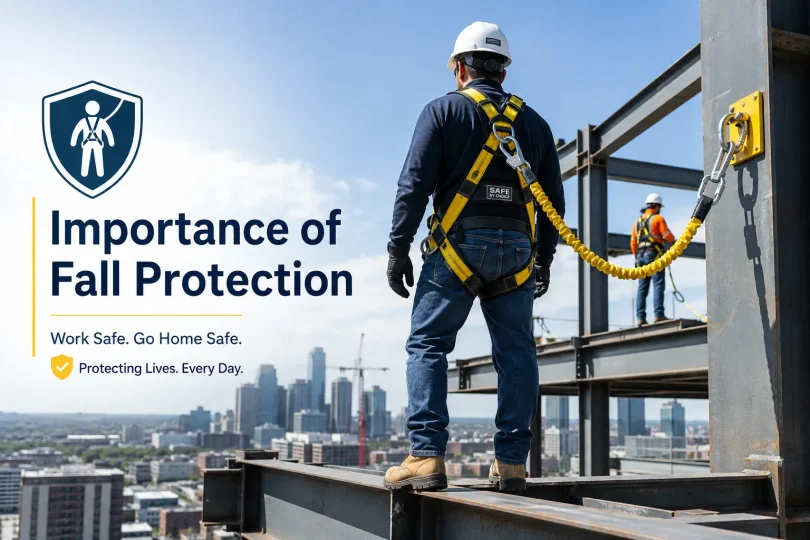

Importance of Fall Protection:
Fall protection is critical because falls are the leading cause of workplace fatalities in construction and a top killer across all industries, accounting for hundreds of deaths and tens of thousands of injuries every year in the US alone. Beyond the human toll, a single fall incident can cost an employer over $41,000 in direct expenses, not counting fines, lawsuits, or lost productivity. Proper fall protection – equipment, training, written plans, and rescue procedures — prevents these outcomes and is legally required by OSHA for workers at heights as low as four feet.
Falls Kill More Workers Than Almost Anything Else
You May Also Like It:
Guardian Fall Protection: The Complete Guide to Staying Safe at Heights
Portable Fall Protection Systems: The Complete Safety Guide
Skylight Fall Protection: A Complete Guide to OSHA Compliance and Keeping Workers Safe
Fall Protection Meaning: What It Is, Why It Matters, and How It Actually Works
The numbers are hard to ignore. In 2022, falls, slips, and trips accounted for 865 worker fatalities in the United States, according to the Bureau of Labor Statistics. In construction alone, falls consistently represent roughly 36–38% of all industry deaths year after year.
That’s not bad luck. It’s a pattern.
For every worker who dies, thousands more are seriously injured. The National Safety Council reports that falls are among the top three causes of disabling workplace injuries across all industries. These aren’t near-misses — they’re broken bones, spinal injuries, traumatic brain injuries, and long-term disabilities.
In the UK, the Health and Safety Executive recorded 50 deaths from falls at height in 2023/2024, making it the single leading cause of worker fatalities there. The problem is global, persistent, and preventable.
Why “We Have Harnesses” Isn’t a Fall Protection Program
This is where most employers go wrong. Owning fall protection equipment is not the same as having a fall protection program. It’s a bit like keeping a fire extinguisher in a locked closet without training anyone to use it.
OSHA and safety professionals use a Hierarchy of Controls to prioritize how hazards get addressed:
- Elimination — Remove the hazard entirely (redesign the task so no one works at height)
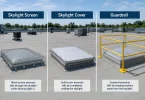
- Engineering controls — Install guardrails, hole covers, or safety net systems (passive protection that doesn’t rely on worker behavior)
- Administrative controls — Restrict access, use permit systems, rotate workers
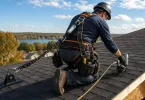
- Personal protective equipment (PPE) — Harnesses, lanyards, and personal fall arrest systems
Most employers jump straight to PPE. That’s backwards.
OSHA’s own standards prioritize passive systems — guardrails, covers, nets — over equipment workers wear. A guardrail protects everyone passing by, regardless of training, fatigue, or forgetfulness. A harness only works if it’s worn correctly, connected to a rated anchor, and has enough clearance to arrest a fall before the worker hits something.
When passive controls aren’t feasible, personal fall arrest systems (PFAS) are the right call. But they’re the last line of defense, not the first.
What OSHA Actually Requires (And Most Employers Don’t Know About)
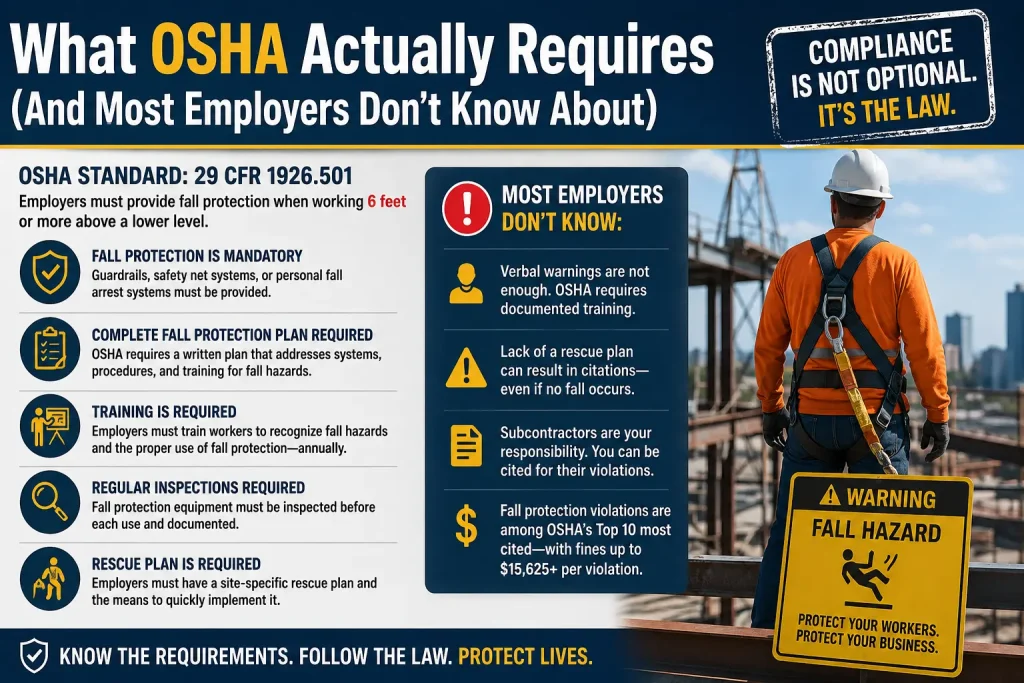
The height thresholds are the part everyone knows:
| Industry | Required fall protection height |
|---|---|
| General industry | 4 feet |
| Shipyards | 5 feet |
| Construction | 6 feet |
| Longshoring operations | 8 feet |
| Over dangerous equipment | Any height |
What fewer employers know is that OSHA also requires a written fall protection plan for construction sites under 29 CFR 1926.502. This isn’t a form you fill out once. It’s a living document that must cover:
- Specific fall hazards identified at the site
- The fall protection systems selected and why
- Equipment inspection and maintenance procedures
- Rescue procedures in the event of a fall
- A designated competent person responsible for implementation
A competent person under OSHA is someone capable of identifying existing and predictable fall hazards, authorized to take corrective action, and trained in the applicable standards. This person must be on-site, not just named on paper.
Beyond OSHA, many safety professionals also reference ANSI Z359, a series of standards from the American National Standards Institute that cover fall protection equipment performance, rescue, and training in more technical detail than OSHA alone.
Understanding Your Equipment Options — And When to Use Each
You May Also Like It:
New Balance Safety Shoes: The Complete Buying Guide
Safety Shoes Meaning: What They Are, How They Work, and Why They Matter
What Are Safety Shoes? Types, Standards, and How to Pick the Right Pair
Caterpillar Safety Shoes: The Complete Buyer’s Guide
Most Comfortable Safety Shoes: What Actually Makes a Difference (And What to Buy)
Safety Shoes UK: Everything You Need to Know Before You Buy (2026 Guide)
The five recognized fall protection systems each serve a specific purpose:
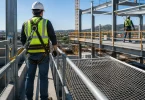
- Guardrail systems: Passive barriers along open sides and edges. The first choice wherever they’re structurally feasible. No training required to “use” them correctly.
- Safety net systems: Installed below work areas at heights to catch falling workers or objects. Common on bridges, high-rise construction, and large scaffolding projects.
- Personal fall arrest systems (PFAS): A full-body harness connected via lanyard or self-retracting lifeline (SRL) to an anchor point. Stops a fall after it begins.
- Positioning systems: Keep workers in a hands-free position (e.g., ironworkers leaning against a structure). Not designed to arrest a free fall.
- Restraint systems: Prevent workers from reaching the fall hazard in the first place. The lanyard length is calculated so the worker physically cannot get to the edge.
Choosing the wrong system is a real risk. A restraint system used incorrectly in a fall arrest scenario won’t stop anything. A PFAS used without enough clearance below the worker is equally dangerous.
The Fall Clearance Calculation Most Sites Skip
This is the most overlooked piece of fall protection math. A PFAS doesn’t stop a fall instantly. Before you deploy any personal fall arrest system, calculate the total fall clearance required:
- Free fall distance: Up to 6 feet (OSHA maximum for PFAS)
- Deceleration distance: Typically 3.5 feet for shock-absorbing lanyards
- Worker height (D-ring to feet): Approximately 5–6 feet
- Safety factor: Minimum 2 feet
Total minimum clearance: approximately 16–18 feet below the anchor point.
If that clearance doesn’t exist, a PFAS isn’t the right choice. Self-retracting lifelines (SRLs) have shorter arrest distances and are often better in tight spaces, but they still require clearance calculations. Do this before someone clips in, not after.
The Real Cost of One Fall – Making the Business Case
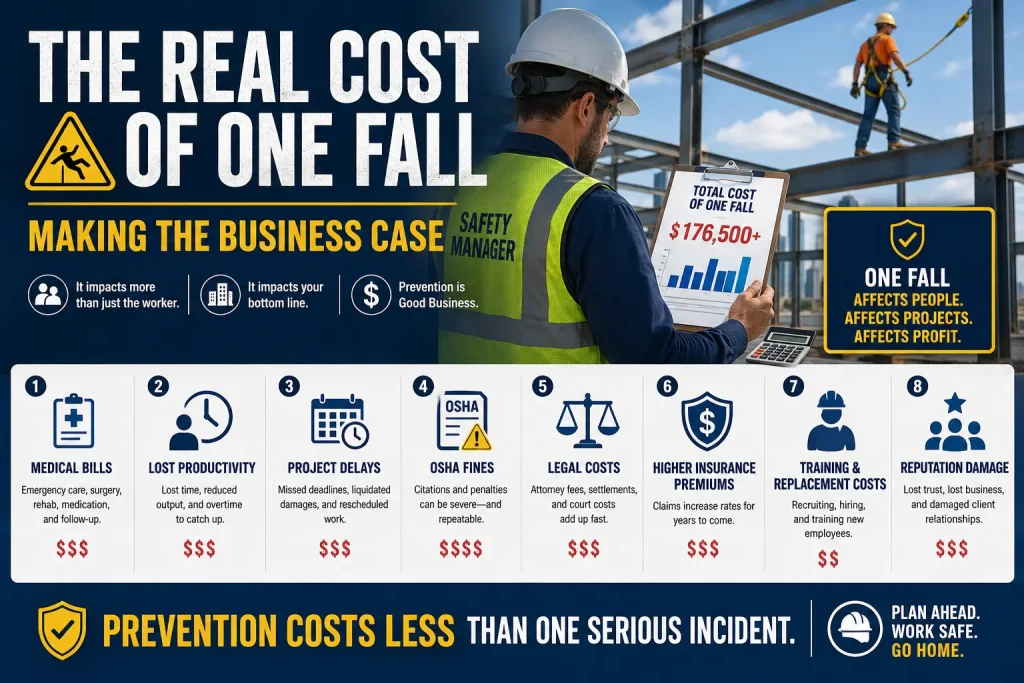
Workplace safety decisions often come down to budget conversations. Here’s the data that changes those conversations.
The average direct cost of a fall from height is approximately $41,000 (OSHA). That includes medical treatment, workers’ compensation, and immediate response costs. But direct costs are only part of the picture.
Indirect costs run 4 to 10 times higher than direct costs, according to research by the Liberty Mutual Research Institute for Safety. Indirect costs include:
- Lost productivity from the injured worker and their team
- Overtime for replacement workers
- Retraining and onboarding costs
- Project delays and contract penalties
- Increased insurance premiums for years following a claim
- Management time spent on incident investigation and reporting
- Damage to equipment or materials
OSHA civil penalties add another layer. A serious violation can cost up to $16,131 per incident as of 2024. A willful or repeated violation runs up to $161,323 per violation. If an inspector walks a site and finds multiple fall protection failures, each unprotected worker can represent a separate citation.
For context, a quality guardrail system runs a few hundred to a few thousand dollars. A personal fall arrest kit costs $150 to $500. The math is not close.
Every $1 invested in workplace safety yields $2–$6 in reduced costs, according to the National Institute for Occupational Safety and Health (NIOSH). That’s not a soft benefit — it shows up in insurance premiums, workers’ comp experience ratings, and project bid competitiveness.
The Step Almost Every Company Skips: Rescue Plans and Suspension Trauma
You May Also Like It:
What Is Construction Safety? Full Guide
Construction Safety: A Complete Guide to Staying Safe on Every Job Site
Construction Safety Products: A Complete Guide to Protecting Your Crew
Temporary Construction Safety Railing: The Complete Guide for Job Site Safety
Construction Safety Solutions: A Complete Guide for Modern Construction Sites
Here’s something none of your competitors are telling you.
OSHA requires that whenever a PFAS is used, a prompt rescue plan must be in place before work begins. Not “we’ll call 911.” An actual plan — who does the rescue, with what equipment, by what method, within what timeframe.
The reason this matters so urgently is suspension trauma, also called orthostatic intolerance.
When a worker is suspended motionless in a harness after a fall arrest, blood pools in the legs. Blood flow to the brain decreases. Without rescue, a suspended worker can lose consciousness, suffer cardiac arrest, or die — sometimes within 3 to 30 minutes of hanging in a harness.
This is not a theoretical risk. It’s documented in OSHA safety bulletins and incident reports. And yet the majority of companies that own harnesses have no rescue plan — and no one on-site trained to execute one.
A compliant rescue plan includes:
- Designated rescuers trained and equipped for suspended worker recovery
- Equipment on-site: rescue SRL, retrieval system, or aerial lift access
- A defined response time (emergency services alone are rarely fast enough)
- Post-rescue first aid protocol, including how to correctly lay a rescued worker down (never immediately upright — this can trigger cardiac arrest from sudden blood pressure changes)
If your company uses PFAS on any job, stop and ask: “If someone fell and arrested right now, how would we get them down in under 10 minutes?” If there’s no clear answer, the rescue plan is the most urgent thing to fix.
What Effective Fall Protection Training Actually Looks Like
OSHA requires employers to train any worker who might be exposed to fall hazards. That training must cover:
- The nature of fall hazards at their specific worksite
- How to use the fall protection systems provided
- How to inspect equipment before use
- Procedures for erecting, maintaining, and dismantling fall protection systems
But legally compliant training and effective training aren’t always the same thing.
Research consistently shows that workers who understand why a system works — not just how to clip in — use it more consistently. Training that includes hands-on equipment practice, real-site walkthrough, and a discussion of suspension trauma and rescue produces measurably better compliance than a one-hour video.
There’s also a documented psychological benefit. Workers who receive thorough fall protection training report lower on-the-job anxiety and higher focus at height. That confidence reduces the “rushing” behavior that causes many falls in the first place.
Retraining is required when: a worker is observed using equipment incorrectly, site conditions change, new equipment is introduced, or there is reason to believe a worker doesn’t understand the hazards.
Employer Responsibilities: A Practical Checklist
This is what a compliant, effective fall protection approach actually looks like in practice:
Before work begins:
- Conduct a site-specific hazard assessment and document it
- Identify all surfaces where a fall of 4+ feet (general industry) or 6+ feet (construction) is possible
- Select the appropriate fall protection system using the hierarchy of controls
- Designate a competent person for fall protection oversight
Equipment:
- Provide all required fall protection equipment at no cost to workers
- Ensure all equipment meets OSHA and ANSI Z359 standards
- Inspect all equipment before each use and document periodic formal inspections
- Remove and destroy any equipment that has arrested a fall (it cannot be reused)
Program documentation:
- Maintain a written fall protection plan (required for construction under 1926.502)
- Document all training with worker names, dates, and topics covered
- Write and post a site rescue plan before PFAS use begins
Ongoing:
- Conduct regular audits of fall protection practices, not just equipment
- Investigate all near-misses, not just incidents
- Retrain workers when hazards change or compliance gaps are observed
- Review and update the fall protection plan when site conditions evolve
Frequently Asked Questions
What is the most common OSHA violation related to falls?
Fall protection in construction (1926.501) has been the single most-cited OSHA standard for over a decade, consistently appearing as the number-one violation in OSHA’s annual Top 10 list. It’s not a coincidence — it’s a sign that fall hazards are both widespread and undermanaged.
Does fall protection apply to workers on ladders?
Yes. OSHA’s ladder standards (1926.1053 for construction, 1910.23 for general industry) require fall protection on fixed ladders above specific heights, and portable ladder safety rules are strict. Ladders account for a significant share of fall injuries and deaths, including on-site fatalities at heights below 10 feet.
How often should fall protection equipment be inspected?
At minimum, equipment must be inspected before each use by the worker using it. A formal documented inspection by a competent person should happen at regular intervals, typically annually, or per manufacturer guidelines. Any equipment that has been involved in a fall arrest must be immediately removed from service, regardless of visible condition.
What is the difference between a fall arrest system and a fall restraint system?
A fall arrest system (PFAS) is designed to stop a fall after it begins. A fall restraint system is designed to prevent the worker from reaching the fall hazard entirely — the lanyard length is calculated so the worker can’t physically get to the edge. Restraint systems are preferable where feasible because they prevent the fall rather than managing it.
Can a worker refuse to work without fall protection?
Yes. Under Section 11(c) of the OSH Act, workers have the right to refuse work they reasonably believe poses imminent danger, including work at height without adequate fall protection. Employers cannot retaliate against a worker for exercising this right.
What is suspension trauma and how quickly does it become dangerous?
Suspension trauma (orthostatic intolerance) occurs when a worker hangs motionless in a harness after a fall arrest. Blood pools in the legs, reducing circulation to the brain and heart. Symptoms — dizziness, nausea, loss of consciousness — can develop within 3 to 30 minutes. This is why every PFAS deployment requires a documented rescue plan capable of recovering the worker within minutes, not the response time of local emergency services.
What is a “competent person” for fall protection?
Under OSHA, a competent person is someone who can identify fall hazards in the surroundings or working conditions that are unsanitary, hazardous, or dangerous to employees, and who has the authority to take prompt corrective measures to eliminate them. This person must be trained in applicable OSHA fall protection standards and be physically present at the worksite — not just named in a document.
Do OSHA fall protection rules apply to small businesses?
Yes. OSHA standards apply to all employers regardless of company size. Small contractors are actually disproportionately cited for fall protection violations, partly because they may lack a dedicated safety officer. If your operation has even one worker, OSHA’s general duty clause requires you to provide a workplace free of recognized hazards — and falls qualify.
Sources: Bureau of Labor Statistics (2022 Census of Fatal Occupational Injuries), OSHA Fall Protection Standards (29 CFR 1926.501, 29 CFR 1910 Subpart D), NIOSH, Liberty Mutual Research Institute for Safety, Health and Safety Executive (UK) 2023/2024 Annual Statistics, ANSI/ASSP Z359 Fall Protection Standards.
You May Also Like It:
Workplace Safety Equipment: A Complete Guide to Protecting Your Team
What Is PPE? A Complete Guide to Personal Protective Equipment
Personal Protective Equipment: The Complete Guide to Staying Safe at Work
Types of Safety Equipment: A Complete Guide to Workplace Protection
Safety Equipment: The Complete Guide to Workplace Protection and PPE
Welding Safety Equipment: The Complete Guide
Roofer Safety Equipment: The Complete Guide to Working Safely at Height