
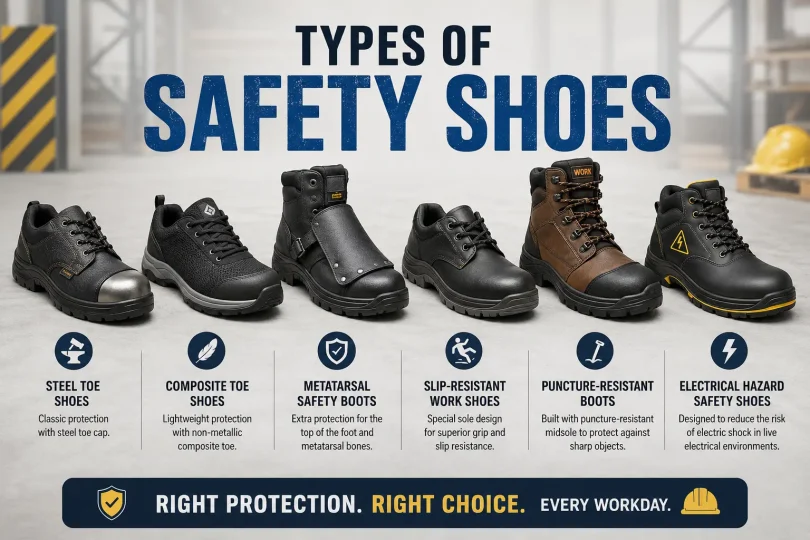

Safety shoes are protective footwear designed to shield workers from specific job-site hazards, including falling objects, electric shock, punctures, and chemical spills. There are over 15 distinct types, each certified to meet ASTM F2413 performance standards. Choosing the wrong type doesn’t just fail an OSHA audit. It can put you in the ER.
What Classifies a Shoe as a “Safety Shoe”?
Not every work boot earns that label. To count as a genuine safety shoe in the U.S., footwear must meet ASTM F2413, the national standard covering impact resistance, compression resistance, and any additional protective features the shoe claims to offer.
The label inside the shoe is your proof. It lists a series of codes that tell you exactly what the shoe protects against. We’ll decode those later in this guide because, honestly, no one talks about them enough.
One stat worth keeping in mind: the Bureau of Labor Statistics recorded over 93,000 foot injuries that caused workers to miss days on the job in a recent two-year span. Most of those injuries happened to people who either wore the wrong type of shoe or no protective footwear at all.
15 Types of Safety Shoes (and Exactly Who Needs Each One)
You May Also Like It:
Types of Safety Equipment: A Complete Guide to Workplace Protection
Safety Equipment: The Complete Guide to Workplace Protection and PPE
Roofer Safety Equipment: The Complete Guide to Working Safely at Height
Welding Safety Equipment: The Complete Guide
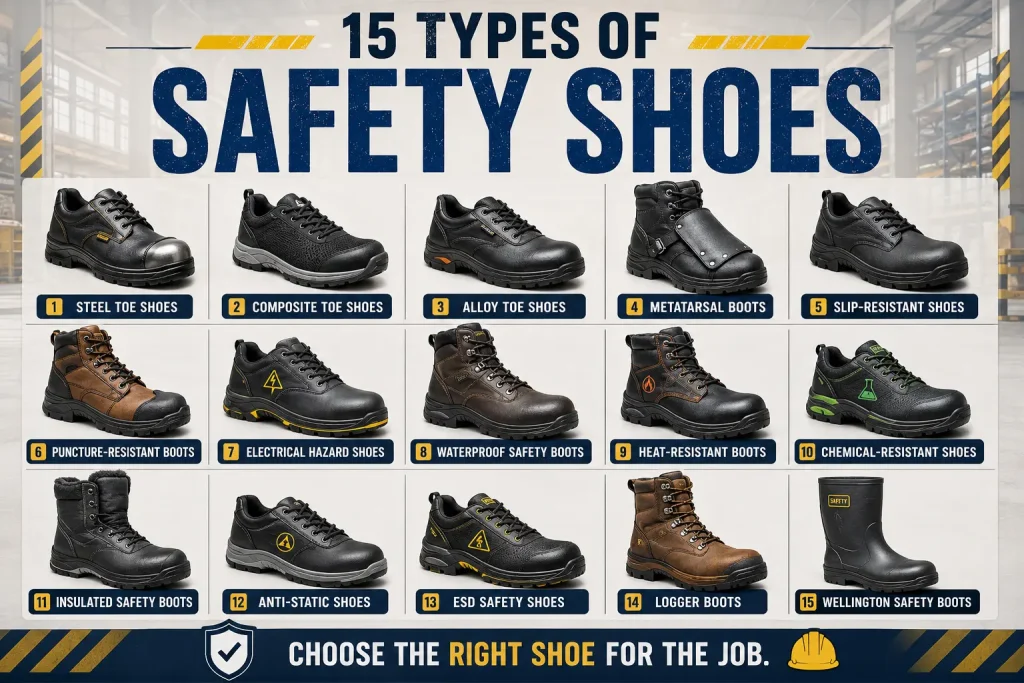
1. Steel Toe Shoes
Steel toe shoes put a steel cap over your toes to absorb the impact of falling or rolling objects. They’re the most widely used type across construction, warehousing, and manufacturing.
A study published in the National Library of Medicine found steel toe shoes reduce the risk of a foot fracture by 67 percent. That number alone justifies the cost.
The catch: Steel conducts both electricity and temperature. If you work near live electrical circuits or outdoors in extreme cold, steel toe is the wrong choice. It can get painfully cold in winter and poses a shock risk in electrical environments.
Best for: General construction, warehousing, heavy manufacturing, loading docks.
2. Composite Toe Shoes
Composite toe shoes offer the same level of impact and compression protection as steel, but the cap is made from non-metallic materials like carbon fiber, Kevlar, or fiberglass.
They’re lighter than steel. They won’t trigger metal detectors. They don’t conduct heat or cold. For electricians, airport security workers, or anyone working outdoors in winter, composite toe is the smarter call.
Best for: Electrical work, cold environments, security screening areas, light construction.
3. Alloy (Aluminum) Toe Shoes
Alloy toe shoes sit between steel and composite. They’re made from lightweight metals like aluminum or titanium, so they’re thinner and lighter than steel while still meeting ASTM impact standards.
If you’re on your feet for a 10-hour shift and every ounce matters, alloy toe gives you real protection without the fatigue that comes from heavier footwear.
Best for: Long-shift industrial work, assembly lines, workers prioritizing comfort without sacrificing protection.
4. Nano Toe Shoes
This is the newest generation of toe protection. Nano toe caps use advanced non-metallic composites like carbon fiber in a profile that’s roughly 50 percent lighter than steel and 40 percent thinner than standard composite toes.
They pass the same ASTM F2413 impact and compression tests. The difference is pure engineering. If you’ve ever been frustrated that safety shoes feel bulky and slow, nano toe changes that experience.
Best for: Workers who need protection but spend their day moving fast, like logistics workers or mobile technicians.
5. Metatarsal Guard Shoes
Most people focus on toe protection and forget about the rest of the foot. The metatarsals are the five long bones running from your toes to your ankle. A falling pipe or marble slab can crush them just as easily as it can crush your toes.
Metatarsal guard shoes extend the protective shell from the toe cap over the entire top of the foot. One safety manager at a stone yard told the story of a worker whose foot was saved by met-guard shoes after a marble slab fell. He walked out of that incident with ruined shoes, not broken bones.
OSHA specifically requires metatarsal protection in certain environments, including foundries and some mining operations.
Best for: Mining, foundries, stone and tile work, heavy equipment operation, steel mills.
6. Electrical Hazard (EH) Shoes
Electrical hazard shoes are built to stop electricity from flowing through your body to the ground. The soles and heels are made from non-conductive materials that break the electrical circuit.
Under ASTM F2413, EH-rated shoes must withstand 18,000 volts at 60 Hz for one full minute with no current leakage above one milliamp. These are tested under dry conditions, which is important. Wet conditions change the risk profile significantly.
Best for: Electricians, utility workers, anyone working near live circuits or high-voltage equipment.
Important note: EH shoes are not the same as static dissipative or conductive shoes. See the dedicated section below.
7. Static Dissipative (SD) Shoes
Static dissipative shoes do the opposite of EH shoes. Instead of blocking electricity, they slowly channel static electricity from your body to the ground.
Why does that matter? The human body builds up static charge just by walking. If that charge discharges suddenly onto sensitive electronics, like computer chips, circuit boards, or medical devices, it destroys them instantly. One ungrounded technician can ruin thousands of dollars in components in a single touch.
SD shoes conduct static slowly and in a controlled way, protecting the equipment around you. They’re not designed to protect the wearer from live electrical sources.
Best for: Electronics manufacturing, semiconductor plants, hospital operating rooms, data centers.
8. Conductive Shoes
Conductive shoes move static charge to the ground much faster than SD shoes. The difference in speed matters when you’re working with flammable or explosive materials.
In environments where grain dust, natural gas, or explosive compounds are present, even a tiny spark from static buildup can trigger a catastrophe. Conductive shoes bleed that charge away instantly, before a spark can form.
Critical rule: Never wear conductive shoes near open electrical circuits. The same conductivity that protects you from explosions will channel electrical current straight through you in a live electrical environment. These two scenarios require opposite types of footwear.
Best for: Ammunition and explosive storage, grain handling facilities, oil and gas environments with explosive atmospheres.
9. Slip-Resistant Shoes
Slips, trips, and falls account for a massive share of workplace injuries in the U.S. every year. Slip-resistant shoes use specialized outsole compounds and tread patterns designed to grip on wet, oily, or greasy surfaces.
The ASTM F3445 standard specifically tests slip resistance in occupational footwear. Look for this certification when buying, especially if you work in a kitchen, hospital, or any wet-floor environment. Most safety shoe labels won’t automatically include it, so you have to check.
The outsole material matters as much as the tread pattern. Rubber and certain polyurethane blends grip better on oil and grease than harder materials.
Best for: Restaurant and food service workers, healthcare workers, cleaning crews, anyone working near wet floors or liquid spills.
10. Puncture-Resistant Shoes
Stepping on a nail through a regular boot is one of the most common construction injuries there is. Puncture-resistant shoes include a steel or composite plate built into the midsole, between the insole and outsole.
This plate stops nails, screws, glass, rebar ends, and other sharp debris from penetrating through to your foot. It doesn’t affect flexibility much because the plate is positioned to bend slightly with the natural walking motion.
Best for: Roofing, demolition, construction, waste management, any site with debris on the ground.
11. Chemical-Resistant Shoes
Chemical-resistant safety shoes are built from materials that physically block hazardous substances from reaching your skin. Common materials include nitrile rubber, neoprene, PVC, and polyurethane, each resistant to different chemical families.
This is one of the trickier shoe types to buy because “chemical-resistant” isn’t a blanket statement. A shoe resistant to acids may not hold up against petroleum solvents. Always match the shoe’s chemical resistance rating to the specific substances at your worksite.
Best for: Chemical plants, laboratories, agriculture (pesticide handling), pharmaceutical manufacturing, industrial cleaning.
12. Waterproof Safety Shoes
Waterproof shoes use a sealed membrane, usually Gore-Tex or a proprietary equivalent, to keep moisture out entirely. They’re different from water-resistant shoes, which slow moisture penetration but don’t stop it.
Beyond comfort, waterproofing matters in cold environments because wet feet lose heat much faster than dry feet. It also matters in environments where standing water may carry contaminants or bacteria.
Look for waterproof models that also offer breathability. A shoe that traps sweat inside is uncomfortable and can cause skin issues during long shifts.
Best for: Outdoor construction, agriculture, utility work, food processing, any role requiring long hours in wet conditions.
13. Insulated Safety Shoes
Insulation is rated in grams. A 200-gram insulation rating handles mild cold. Work in freezing temperatures or cold storage facilities and you need 400 grams or more.
Composite toe insulated boots are the better choice for cold environments because, unlike steel, composite materials don’t transfer cold to your toes. Working in a -10°F freezer in steel toe boots is genuinely dangerous.
Best for: Cold storage workers, outdoor crews in northern states, winter construction, utility workers.
14. Chainsaw Safety Boots
Chainsaw boots are in a category of their own. They’re not just cut-resistant. They contain multiple layers of loosely woven fibers, usually Kevlar or similar aramid materials, packed between the outer boot and the inner lining.
When a chainsaw blade contacts the boot, those fibers are instantly pulled into the saw’s drive sprocket and clog it, stopping the chain. The boot takes the damage so your leg doesn’t.
Chainsaw boots carry protection class ratings: Class 1 (up to 20 m/s chain speed), Class 2 (up to 24 m/s), and Class 3 (up to 28 m/s). Match the class to the chainsaw you actually operate.
Best for: Arborists, loggers, landscaping crews, forestry workers, land-clearing operations.
15. Safety Trainers (Safety Sneakers)
Safety trainers look like athletic shoes. They carry real safety toe protection and meet ASTM F2413, but they’re built on a lightweight, low-profile sneaker platform.
They’re one of the fastest-growing categories in workplace PPE right now, and it makes sense why. Workers in logistics, tech manufacturing, or light assembly don’t always need the bulk of a traditional boot. Safety trainers give them protection without sacrificing agility or comfort during long shifts.
They typically offer less ankle support than safety boots, so they’re not the right call for uneven terrain or heavy outdoor work.
Best for: Warehouse workers, light manufacturing, IT and facilities roles, any environment with hard floors and lighter hazards.
EH vs. SD vs. Conductive: The Difference That Could Save Your Life
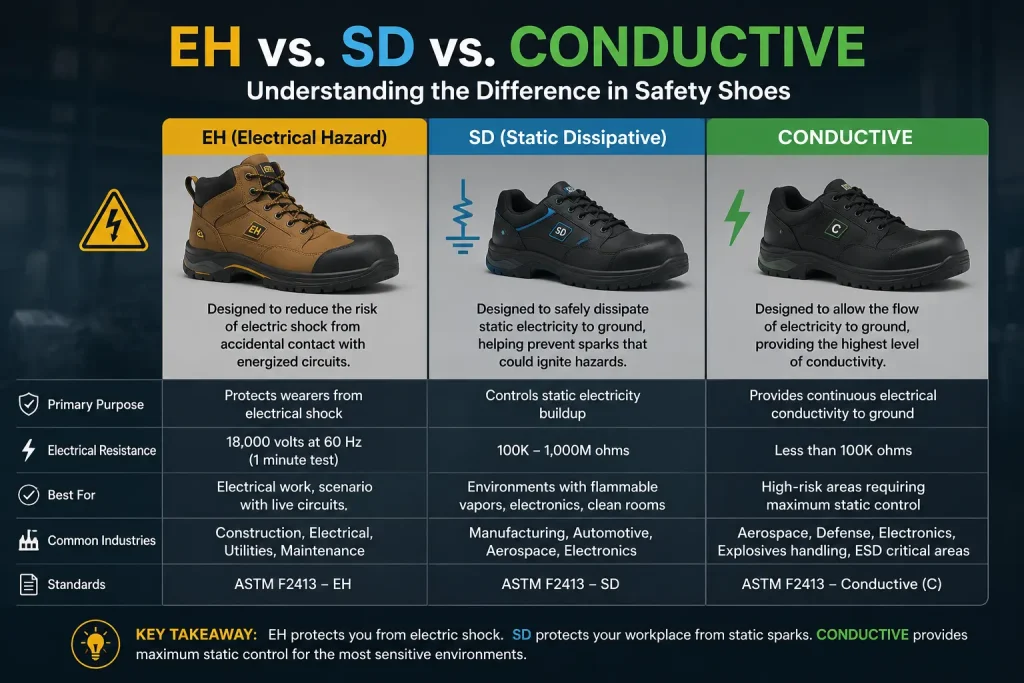
This is the most misunderstood area in safety footwear. All three types involve electricity. They work in opposite ways, and wearing the wrong one in the wrong environment can be fatal.
Here’s the breakdown:
| Type | What It Does | Protects | Risk If Wrong Choice |
|---|---|---|---|
| EH (Electrical Hazard) | Blocks electricity from flowing through the wearer | The worker from electric shock | No static dissipation. Static can build up and discharge |
| SD (Static Dissipative) | Slowly bleeds static from body to ground | Sensitive electronics from static damage | Won’t protect from live electrical sources |
| Conductive | Rapidly channels static to ground | Explosive environments from static sparks | Extremely dangerous near live circuits |
Think of it this way. EH shoes are a wall. SD shoes are a slow drain. Conductive shoes are a fast drain. You pick based on what the hazard actually is, not what sounds safest.
An electrician needs the wall. A microchip technician needs the slow drain. A munitions worker needs the fast drain. Wrong shoe, wrong outcome.
You May Also Like It:
Industrial Safety Equipment: The Complete Guide
New Balance Safety Shoes: The Complete Buying Guide
Safety Shoes Meaning: What They Are, How They Work, and Why They Matter
What Are Safety Shoes? Types, Standards, and How to Pick the Right Pair
Most Comfortable Safety Shoes: What Actually Makes a Difference (And What to Buy)
How to Decode the Safety Label Inside Your Shoe
Every ASTM F2413-compliant shoe has a label. Most workers never look at it. Here’s what the codes mean:
ASTM F2413-[year] confirms the shoe passed the current standard.
After that, a series of letter codes tells you the exact protections:
- I/75 and C/75 — Impact and Compression resistance. I/75 means the toe cap survives a 75 ft-lb impact. This is the baseline for any safety toe shoe.
- Mt/75 — Metatarsal protection at the same 75 ft-lb standard
- PR — Puncture Resistance in the midsole
- EH — Electrical Hazard protection
- SD — Static Dissipative
- CD — Conductive
- CR — Chain saw resistance
So a label reading ASTM F2413-18 I/75 C/75 EH means: the shoe was certified in 2018, protects your toes from 75 ft-lb impacts and compression, and is rated for electrical hazard work.
If a shoe doesn’t carry an ASTM F2413 label, it’s not a certified safety shoe, regardless of what the marketing says.
Safety Shoes by Industry: What Workers Actually Wear
Construction: Steel or composite toe boots with puncture-resistant midsoles. S3-equivalent protection. Slip-resistant outsoles. Metatarsal guards if handling very heavy materials.
Healthcare: Slip-resistant shoes or clogs. ESD protection for operating room staff near sensitive equipment. Waterproof upper for environments where fluid exposure is possible. Comfort and support matter enormously given 10-to-12-hour standing shifts.
Food Processing and Restaurants: Slip-resistant, waterproof shoes. Chemical-resistant soles for cleaning chemicals. Safety clogs are common here because they’re easy to clean and provide the clog design’s natural drainage.
Oil and Gas: Conductive or SD shoes depending on the specific location, chemical-resistant uppers, steel or composite toe, puncture resistance. This industry has some of the most complex footwear requirements because the hazard profile is layered.
Cold Storage and Freezer Work: Insulated composite toe boots. The composite toe is critical here because steel toe in extreme cold can transfer temperature and cause real discomfort and injury over time.
Warehousing and Logistics: Safety trainers or lightweight composite toe boots with slip-resistant outsoles. Comfort and fatigue reduction matter most given constant movement.
Women’s Safety Shoes: What the Industry Often Skips
Almost every article about safety shoes ignores women entirely. That’s a problem because women make up a significant portion of the construction, healthcare, food service, and manufacturing workforce.
Women’s safety shoes aren’t just smaller versions of men’s boots. Women’s feet have a different shape: narrower heel, wider forefoot, higher arch. A boot sized down from a men’s last fits poorly, causes blisters, and creates fatigue faster.
Look specifically for women’s-last safety footwear from brands like Timberland PRO, Wolverine, Caterpillar, and Keen Utility. These are built on lasts shaped for women’s anatomy, not just scaled down.
The same ASTM F2413 certifications apply. Women’s shoes can and do meet the same protective standards. Don’t let anyone convince you that protection requires a bulkier or heavier boot.
How Long Do Safety Shoes Last? When to Replace Them
General lifespan: 6 to 12 months for workers on their feet all day in demanding environments. Up to 2 years for lighter-duty use.
Signs the protection is gone, even if the shoe looks okay:
- The sole has worn smooth. Tread depth below 2mm on slip-resistant outsoles defeats the grip entirely.
- The toe cap is visibly dented. Once a toe cap has absorbed a significant impact, it’s structurally compromised. ASTM testing is a one-time test. A dented cap may not pass a second impact.
- The upper is cracked or separating. Waterproofing fails when the upper cracks. Chemical resistance fails when the material degrades.
- The midsole feels flat. Energy absorption, arch support, and puncture resistance all degrade as the midsole compresses over time.
- EH or SD certification date. Some manufacturers date-stamp EH and SD ratings. Confirm yours haven’t expired.
Replace safety shoes on a schedule, not when they look obviously worn out. By the time a safety shoe looks done, it’s been unprotective for months.
Match Your Hazard to Your Shoe: A Quick Reference
| Workplace Hazard | Shoe Type to Choose |
|---|---|
| Falling or rolling heavy objects | Steel Toe, Composite Toe, or Metatarsal Guard |
| Live electrical circuits | EH (Electrical Hazard) |
| Sensitive electronics or medical devices | Static Dissipative (SD) |
| Explosive or flammable atmospheres | Conductive |
| Wet or greasy floors | Slip-Resistant (ASTM F3445 rated) |
| Nails, screws, sharp debris on ground | Puncture-Resistant (PR rated) |
| Chemicals, acids, solvents | Chemical-Resistant (match to specific chemicals) |
| Chainsaw operation | Chainsaw Boots (Class 1, 2, or 3) |
| Cold storage or extreme cold | Insulated Composite Toe |
| Light indoor work, long shifts | Safety Trainers |
| Outdoor wet conditions | Waterproof Safety Boots |
FAQ
Q: Can a single safety shoe protect against multiple hazards at once?
Yes. Many safety shoes are built with combined protections, such as a composite toe shoe that’s also waterproof, EH-rated, and slip-resistant. Always check the ASTM label codes to confirm exactly which protections are actually certified, not just marketed.
Q: Are safety shoes required by law in the U.S.?
OSHA’s general industry standard (29 CFR 1910.136) requires employers to ensure workers use protective footwear when there are hazards like falling objects, rolling objects, sharp objects on the floor, or electrical hazards. The employer is responsible for identifying those hazards. The employee is responsible for wearing the prescribed footwear.
Q: What’s the difference between S1, S2, and S3 safety shoe ratings?
These are European EN ISO 20345 ratings, not U.S. ASTM designations. You may see them on imported boots. S1 offers basic toe protection and anti-static and energy-absorbing heel features. S2 adds water resistance. S3 adds a puncture-resistant midsole and cleated outsole. The U.S. uses ASTM F2413 and separate letter codes instead.
Q: Can I wear my safety shoes outside of work?
You can, but most safety shoes wear out faster with constant use. More importantly, once a toe cap has absorbed a significant impact, even if the shoe looks fine, it may no longer meet its rated protection level. Keep your work shoes for work.
Q: Do I need different safety shoes for different tasks in the same job?
Sometimes, yes. An electrician doing rough-in work on a construction site may need EH boots with puncture resistance. The same electrician testing energized panels indoors may still need EH shoes but not puncture resistance. Review the hazard profile of each specific task rather than assuming one shoe covers everything on the job.
Q: Are slip-resistant shoes really necessary in kitchens and restaurants?
Absolutely. The National Floor Safety Institute identifies slips and falls as the leading cause of accidents in the food service industry. Slip-resistant outsoles, especially those meeting ASTM F3445, significantly reduce that risk. This is also one of the areas where cheap “non-slip” marketing can be deceptive. Look for ASTM-tested slip resistance, not just the label claim.
Q: What’s the best safety shoe for a job with multiple hazards, like oil and gas?
Look for a shoe that carries multiple certifications: steel or composite toe (I/75 C/75), EH or SD rating depending on the specific zone, slip-resistant outsole, chemical-resistant upper, and waterproofing if outdoor work is involved. Many industrial safety boot brands offer multi-rated footwear specifically engineered for complex hazard environments. Consult your site’s PPE requirements document and match each code on the label.
Q: How should safety shoes fit?
Safety shoes should have about a thumb’s width of space between your longest toe and the front of the toe cap. They should feel snug through the heel and midfoot without pressure points. Try them on at the end of the day when feet are at their largest. A break-in period for leather boots is normal, but a boot that causes pain on day one will only get worse.
Information in this article is based on ASTM F2413, OSHA 29 CFR 1910.136, and BLS workplace injury data. Always consult your employer’s specific PPE requirements and a safety professional for compliance guidance.
You May Also Like It:
Guardian Fall Protection: The Complete Guide to Staying Safe at Heights
Portable Fall Protection Systems: The Complete Safety Guide
Skylight Fall Protection: A Complete Guide to OSHA Compliance and Keeping Workers Safe



[…] write these through committees of industry experts. Nobody forces you to follow ASTM F2412 for protective footwear testing, until your client’s procurement contract says you must, or your insurer ties your […]