Fire kills more people worldwide than floods, earthquakes, and hurricanes combined. Yet most fires in workplaces and buildings are entirely preventable with the right knowledge, preparation, and training.
Whether you are a safety officer, a facility manager, a construction supervisor, or simply someone who wants to protect their workplace, enrolling in a fire safety training course is one of the smartest decisions you can make.
This guide breaks down everything you need to know about fire safety training courses in 2026. From what you will actually learn, to who needs it, to how to pick the right course for your goals.
What Is a Fire Safety Training Course?
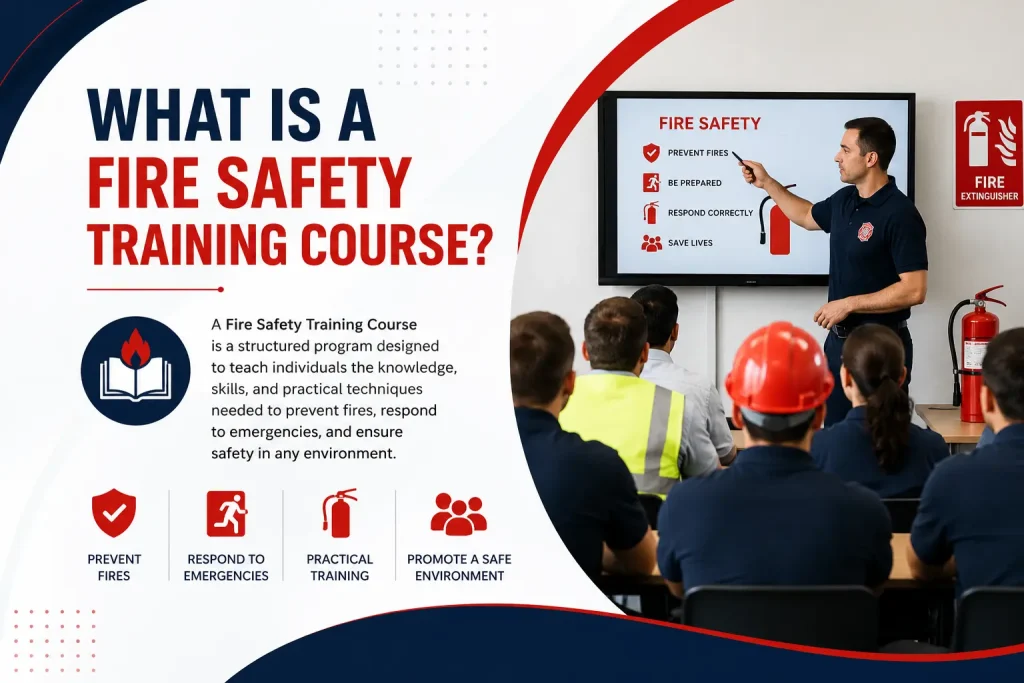
A fire safety training course is a structured program that teaches individuals how to prevent, detect, respond to, and manage fire emergencies. These courses cover everything from understanding how fires start and spread, to conducting professional fire risk assessments, to leading safe evacuations under pressure.
Good training does not stop at theory. The best fire safety courses combine practical exercises, real-world case studies, simulation-based drills, and compliance with national and international safety standards.
Fire safety training is relevant across industries including:
- Manufacturing and heavy industry
- Construction and infrastructure
- Commercial offices and high-rise buildings
- Hospitals, schools, and public buildings
- Oil and gas, petrochemicals, and power plants
- Hospitality, retail, and logistics
Why Fire Safety Training Matters More Than Ever
Here are the facts that put this in perspective:
- According to the National Crime Records Bureau (NCRB), India records over 25,000 fire-related deaths annually.
- The United States Fire Administration reports that workplace fires cause roughly 200 deaths and $2.4 billion in property losses each year in the US alone.
- Research consistently shows that fire fatalities drop dramatically when buildings have trained staff, proper evacuation plans, and functioning fire suppression systems.
Most of these tragedies share a common cause: people did not know what to do when fire broke out. Training closes that gap.
Beyond safety, there is a legal and regulatory angle. In India, the National Building Code (NBC 2016), the Factories Act, and state fire service acts all mandate fire safety measures and trained personnel for certain premises. In the UK, the Regulatory Reform (Fire Safety) Order 2005 requires a competent person to carry out a fire risk assessment. In the US, OSHA standards under 29 CFR 1910 outline employer obligations for fire safety.
Ignoring these requirements does not just put lives at risk. It exposes businesses to heavy fines, criminal liability, and business closure.
What You Will Learn in a Fire Safety Training Course
Course content varies by level and provider, but a well-rounded fire safety training program should cover the following:
Fire Science Fundamentals
- The fire triangle and fire tetrahedron
- Classes of fire (A, B, C, D, K) and how each behaves differently
- How fire spreads through conduction, convection, and radiation
- Common causes of workplace fires
Fire Prevention and Hazard Control
- Identifying and eliminating fire hazards
- Safe storage of flammable and combustible materials
- Electrical fire prevention
- Hot work permits and procedures
- Housekeeping standards that reduce fire risk
Firefighting Equipment
- Types of fire extinguishers and when to use each
- Correct operation of fire hose reels and hydrant systems
- Fixed suppression systems including sprinklers, CO2, and foam systems
- When to fight a fire and when to evacuate instead
Fire Risk Assessment
- How to carry out a systematic fire risk assessment
- Identifying who is at risk and where
- Evaluating existing control measures
- Documenting and reviewing the assessment
- Legal requirements for risk assessment records
Emergency Evacuation Planning
- Designing and testing effective evacuation plans
- Roles and responsibilities of fire wardens and marshals
- Handling people with disabilities or mobility limitations during evacuation
- Mustering procedures and headcount protocols
- Drills: how to run them and what to look for
Emergency Action and First Response
- How to raise the alarm correctly
- Calling emergency services and communicating clearly
- Basic first aid for fire injuries including burns and smoke inhalation
- Coordination with fire brigades on arrival
Types of Fire Safety Training Courses
Not every course is designed for the same person. Here is a breakdown of the main types available:
1. Fire Safety Awareness Training
Best for: All employees, office staff, general workers
This is a foundational course that ensures every person in a workplace understands basic fire hazards, evacuation routes, and what to do in an emergency. Usually completed in a few hours and ideal as part of onboarding or annual refresher programs.
Key Topics Covered
- Fire hazard identification
- Evacuation routes and assembly points
- How to use a fire extinguisher
- When and how to raise the alarm
2. Fire Warden or Fire Marshal Training
Best for: Team leaders, floor wardens, designated fire officers
Fire wardens are the people responsible for coordinating evacuation during an emergency. This course builds on awareness training and adds leadership, decision-making under pressure, and first-response responsibilities.
Key Topics Covered
- Warden roles and legal duties
- Sweeping procedures and floor clearance
- Communication during emergencies
- Dealing with non-compliant evacuees
- Post-incident reporting
3. Fire Risk Assessment Training
Best for: Health and safety managers, facility managers, safety officers
This is a technical and analytical course. It teaches participants how to formally assess fire risk across a building or site, document findings, and implement corrective actions. This is a legal requirement in many jurisdictions.
Key Topics Covered
- Identifying ignition sources, fuel, and oxygen paths
- Evaluating people at risk
- Risk scoring and priority actions
- Documenting assessments to legal standards
- Periodic review and reassessment triggers
4. Fire Safety Management for Industries
Best for: Safety professionals in manufacturing, oil and gas, construction, warehousing
Industrial environments carry higher fire loads and more complex hazards. This specialized training covers industrial layouts, suppression strategy, and compliance with sector-specific codes such as NFPA 101, IS standards, and NBC 2016 in India.
Key Topics Covered
- Fire load calculations and hazardous processes
- Industrial suppression systems: foam, deluge, CO2
- Hot work safety and permit systems
- HAZMAT and chemical fire response
- NBC 2016, IS standards, and NFPA compliance
5. Fire Safety for Commercial and High-Rise Buildings
Best for: Property managers, building owners, facilities teams
High-rise buildings present unique evacuation and suppression challenges. Phased evacuation, refuge areas, stairwell pressurization, and coordination with fire departments are all covered in this specialized module.
Key Topics Covered
- Phased evacuation strategies
- Refuge areas and mobility-impaired occupants
- Stairwell pressurization and fire lifts
- Fire alarm and suppression system integration
- Coordination with fire brigade on arrival
6. Train-the-Trainer: Fire Safety
Best for: Internal trainers, safety team leads, HR professionals
If your organization needs to run regular in-house fire safety training, this program equips your people to design, deliver, and evaluate training sessions internally. It reduces long-term training costs while building internal capability.
Key Topics Covered
- Adult learning principles
- Designing practical fire safety exercises
- Facilitation and classroom management
- Assessment and evaluation techniques
- Keeping training current with regulation updates
Online vs. Onsite Fire Safety Training: Which Is Right for You?

Both formats have genuine strengths. The right choice depends on your goals, team size, and context.
Online Fire Safety Training
- Flexible: complete it at your own pace
- Lower cost, no travel required
- Ideal for awareness-level and theory-heavy content
- Easily scaled across large, dispersed teams
- Certificates issued digitally and quickly
Onsite Fire Safety Training
- Hands-on: practice with actual extinguishers, hoses, and equipment
- Tailored to your specific site, layout, and hazards
- More engaging and memorable for participants
- Allows real evacuation drills with your actual team
- Better for complex industrial or high-risk environments
Instructor-Led Online Training
Instructor-led online training is a growing middle ground. Delivered live via video conferencing with a certified trainer, it combines the flexibility of online with the interaction and Q and A of in-person. This format is increasingly popular for corporate teams with staff across multiple locations.
How to Choose the Right Fire Safety Training Course
With so many options available, here is a practical checklist to help you decide:
Check Accreditation
Look for courses accredited by recognized bodies such as NEBOSH, IOSH, NFPA, or local equivalents. Accreditation is your assurance that the content meets a tested standard.
Match the Course Level to Your Role
A fire warden course is not the same as a fire risk assessment course. Choose one that matches your actual responsibilities, not just the most impressive-sounding title.
Verify Regulatory Alignment
If you are in India, check that the course covers NBC 2016, the Factories Act, and relevant IS codes. If you operate globally, NFPA or NEBOSH certifications carry wider recognition.
Ask About Practical Components
Theory alone does not prepare someone for a real emergency. Ensure the course includes hands-on exercises or simulation-based scenarios.
Check for Post-Assessment Support
The best providers include pre-course and post-course evaluations to measure genuine learning, not just attendance.
Consider Language of Instruction
If your team is not entirely English-speaking, check whether training is available in Hindi or other regional languages. Training people in a language they are truly comfortable in improves retention dramatically.
Look at Trainer Credentials
Your trainer should have real-world fire safety experience, not just a teaching certificate. Industry exposure matters.
Who Needs Fire Safety Training?
The short answer: anyone who works in a building. But specific roles carry specific legal and operational obligations:
Training Requirements by Role
- General employee: Fire Safety Awareness
- Receptionist or security staff: Awareness plus warden basics
- Team leader or supervisor: Fire Warden or Marshal
- Facilities or property manager: Fire Warden plus Risk Assessment
- Health and Safety officer: Risk Assessment plus Management
- Industrial safety professional: Specialist industrial course
- Trainer or safety team lead: Train-the-Trainer
Legal Requirements in India
- The Factories Act requires factories above a certain size to appoint trained safety officers.
- State fire service acts mandate trained fire officers in hospitals, hotels, shopping malls, and high-rise buildings.
- Non-compliance can result in license cancellation and prosecution.
Career Opportunities After Fire Safety Training
Fire safety is a growing professional field. Completing a recognized course is a legitimate career step, not just a compliance checkbox.
Job Roles You Can Pursue
- Fire Safety Officer or Inspector
- Health, Safety, and Environment (HSE) Manager
- Fire Risk Assessor (independent or employed)
- Safety Consultant
- Fire Warden Trainer
- Site Safety Supervisor (construction, industrial)
- Emergency Response Coordinator
Salary and Market Demand
- In India, demand for certified fire safety professionals is accelerating as enforcement of NBC 2016 tightens and large infrastructure projects multiply.
- Salaries for experienced fire safety officers in India range from INR 4 lakh to INR 18 lakh annually, depending on industry, location, and certification level.
- Internationally recognized certifications such as NEBOSH or NFPA credentials open doors to roles in the Gulf, Southeast Asia, the UK, and beyond.
What Makes a Good Fire Safety Training Provider?
Use these signals to separate quality providers from those simply selling certificates:
Green Flags to Look For
- Certified trainers with field experience, not just academic backgrounds
- Accreditation from a recognized body such as NEBOSH, NFPA, IOSH, or a government body
- Practical, simulation-based content, not only slide presentations
- Updated curriculum aligned with current codes and standards (NBC 2016, NFPA 2024 editions)
- Pre and post-course assessments to validate learning
- Support after training: access to resources, toolkits, and follow-up Q and A
- Transparent pricing: reputable providers publish their fees clearly
- Case studies and real incident reviews from the relevant industry
Common Questions About Fire Safety Training
How long does fire safety training take?
It depends on the course type. Awareness training can take as little as 4 to 8 hours. Fire warden courses typically run 1 to 2 days. Fire risk assessment courses run 2 to 5 days. Advanced management programs can extend over several weeks.
How often should fire safety training be refreshed?
Most safety standards recommend annual refresher training for all staff, with fire drills conducted at least twice a year. Fire risk assessments should be reviewed annually or whenever a significant change occurs in the workplace.
Is online fire safety certification recognized by employers?
Yes, provided it is from an accredited provider. Certification from bodies like NEBOSH is recognized globally. Always check that the certificate explicitly states accreditation and the issuing body.
Can organizations arrange group or in-house training?
Yes. Most professional training providers offer customized in-house programs for teams, with content adapted to your site-specific layout, hazards, and industry. This is often more cost-effective for teams of 10 or more.
What is the difference between a fire warden and a fire marshal?
The terms are often used interchangeably, but in some organizations a fire marshal holds a higher authority than a warden. A marshal may coordinate multiple wardens across floors or zones. Both roles require formal training.
Key Takeaways
Fire safety training is not a box-ticking exercise. It is the knowledge and confidence that decides what happens in the first 60 seconds of a real emergency.
Here is what to remember:
- Fire safety training covers prevention, detection, equipment, evacuation, and first response.
- Different roles need different levels of training.
- Choose an accredited course aligned to your country’s regulatory requirements.
- Online training suits awareness and theory; onsite training is better for practical skills.
- Fire safety qualifications open genuine career paths locally and internationally.
- Refresher training matters as much as the initial course.
If you are responsible for people in a building, there is no reason to wait. The cost of good training is a fraction of the cost of getting it wrong.
You May Also Like It: