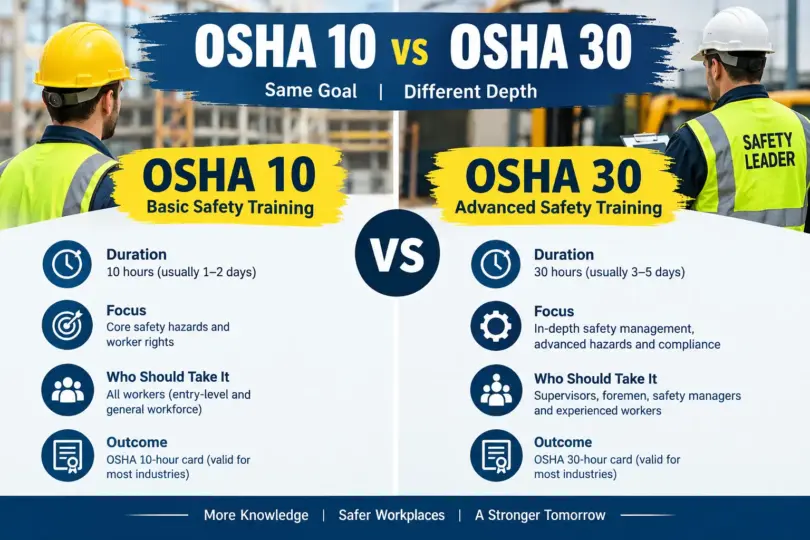

OSHA 10 is a 10-hour safety course built for entry-level workers who answer only for their own safety. OSHA 30 is a 30-hour course built for supervisors, foremen, and anyone responsible for other people’s safety on the job. Neither card expires under federal law, but the one your project actually requires often comes down to your state, your contract, or your job title, not just your gut feeling about which sounds more “official.”
Quick Comparison: OSHA 10 vs OSHA 30
| Factor | OSHA 10 | OSHA 30 |
|---|---|---|
| Minimum training days | 2 days (7.5 hrs/day max) | 4 days (7.5 hrs/day max) |
| Who it’s built for | Entry-level workers, no supervisory duties | Supervisors, foremen, safety leads, PMs |
| Prerequisite required | None | None (you can skip OSHA 10 entirely) |
| Federal expiration | Never expires | Never expires |
| Typical online completion window | Must finish within 180 days of starting | Must finish within 180 days of starting |
| Covers OSHA 10 content? | N/A | Yes, fully, plus expanded topics |
What’s Actually Inside the 10 Hours (Construction)
Most articles tell you OSHA 10 covers “the basics.” Here’s what that means in actual clock time, because the breakdown matters if you’re trying to figure out whether a provider’s course is legitimate:
- Introduction to OSHA: 2 hours, covering worker rights, employer duties, and how to file a complaint
- The Focus Four hazards: roughly 4 hours combined, split across falls, electrocution, struck-by, and caught-in/between incidents, which together cause the majority of construction fatalities
- PPE and health hazards: about 1 hour combined
- Elective topics: 2 hours minimum, chosen from things like scaffolds, excavation, or hand and power tools
OSHA 30 doesn’t just add more of the same. It adds an entire mandatory module called Managing Safety and Health, which walks supervisors through job site inspections, injury and illness prevention programs, and how to run a safety meeting that people actually pay attention to. That module alone is why you can’t shortcut OSHA 30 by “basically” knowing the OSHA 10 material already.
Where the Card Stops Being Optional
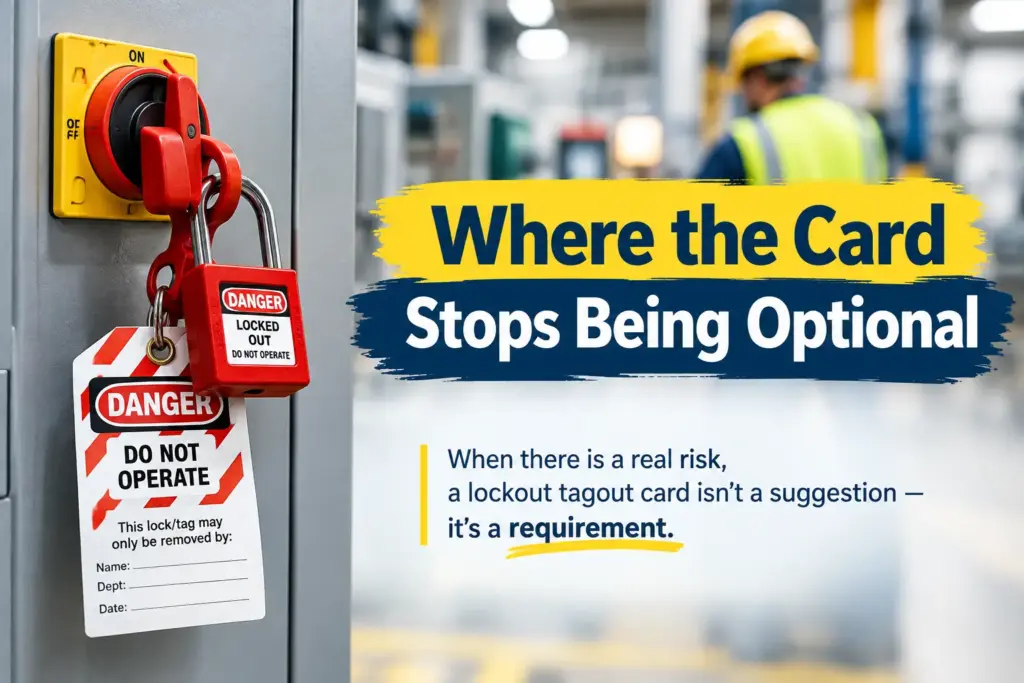
Every competitor piece I reviewed says some version of “a few states require this.” None of them name the states or the actual thresholds. Here’s the real list, and it changes what you should do next:
- Connecticut: OSHA 10 required for any public building project over $100,000 funded wholly or partly by the state. Contractors must submit proof within 30 days of contract award.
- Massachusetts: OSHA 10 required before setting foot on any public worksite. The law specifically says “at least 10 hours,” so an OSHA 30 card satisfies it too.
- Missouri: OSHA 10 required for any public works project, state or municipal. You get 60 days from your start date to complete it.
- New Hampshire: Required on public projects of $100,000 or more. Miss it by 15 days after starting and you’re removed from the site.
- New York, Rhode Island: OSHA 10 required on public construction work, though New York City layers on its own separate requirement (more on that below).
- Nevada: The broadest requirement I found. All construction workers need OSHA 10, all supervisors need OSHA 30, and the same 10/30 split applies to the entertainment, convention services, and cannabis industries.
Beyond state law, most federal construction contracts require at least an OSHA 10 card as a baseline, and general contractors on private jobs frequently require it by contract even where no law forces the issue. A contract requirement isn’t optional just because it isn’t a statute. Show up without the card and you get sent home the same as if a law required it.
The NYC Curveball Almost Nobody Mentions
If you’re working construction in New York City specifically, OSHA 10 or 30 alone won’t cut it. NYC’s Department of Buildings requires a separate 40-hour Site Safety Training (SST) card for most construction workers on sites that fall under its site safety program. The SST curriculum actually incorporates OSHA 10 or OSHA 30 hours as part of the 40, but it’s a distinct city credential with its own renewal cycle. I’ve seen crews arrive with valid OSHA 30 cards from another state and still get turned away because nobody checked the NYC-specific requirement first. Always confirm whether a job falls under SST rules before assuming your OSHA card alone gets you on site.
Picking Between Them When the Answer Isn’t Obvious
“Do you supervise anyone?” works for most people, but it breaks down in a few common situations:
- You’re new but you know you’ll move into a lead role within a year or two. Going straight to OSHA 30 saves you from paying for both courses. OSHA 30 has no prerequisite, so skipping OSHA 10 costs you nothing in terms of eligibility.
- You work across state lines. Check the strictest state you’ll be working in, not your home state. A card that satisfies Missouri won’t automatically satisfy Nevada’s supervisor rule if your role shifts.
- Your title says “worker” but you informally direct a two-person crew. Job titles lag behind actual responsibility all the time. If you’re the one telling someone else how to do a task safely, get OSHA 30. Insurance auditors and GCs care about function, not your pay stub’s job code.
- You already hold OSHA 10 and just got promoted. You don’t retake anything. Enroll directly in OSHA 30. It assumes no prior training and covers the OSHA 10 material inside it.
Mistakes I See on Job Sites Constantly
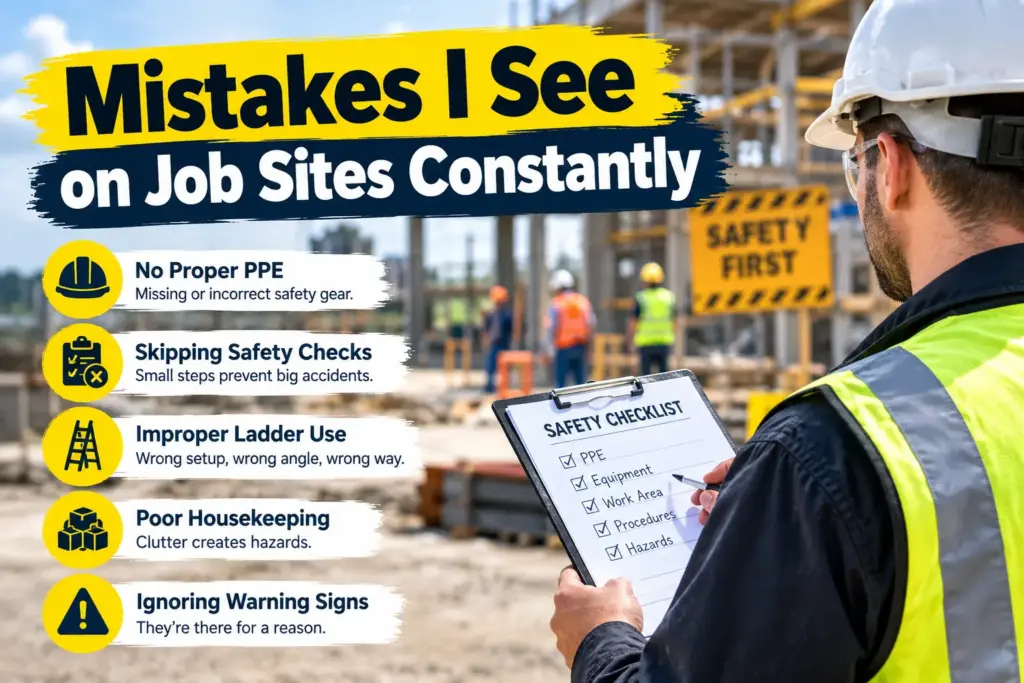
Field experience surfaces patterns that a course description never will:
- Assuming the card never needs replacing. The federal card doesn’t expire, but a lost card is a real headache. Photograph both sides the day it arrives. Providers can reissue records, but replacement processing routinely takes weeks, and a job start date doesn’t wait for that.
- Buying from a provider that isn’t OSHA-authorized. These sites look identical to legitimate ones. The tell is simple: search the provider’s name in OSHA’s Outreach Training Program database before paying. If they’re not listed, the card is worthless on a real job site regardless of how professional the certificate looks.
- Splitting the hours to “save time.” Some providers advertise compressed schedules that violate OSHA’s 7.5-hour daily cap. A 10-hour course finished in one day violates the minimum two-day rule and produces a non-compliant card, even if it says “10-hour” on it.
- Confusing “OSHA certified” with the actual card. There’s no such thing as being “OSHA certified.” You receive a Department of Labor course completion card, not a certification. Employers sometimes use the phrase loosely, but if you see a provider selling “OSHA certification,” that’s a wording red flag worth double-checking.
Frequently Asked Questions
Can I take OSHA 30 without ever taking OSHA 10?
Yes. OSHA 30 has no prerequisite. It’s built to stand on its own and fully includes the OSHA 10 material inside its expanded curriculum.
Does an OSHA 10 or 30 card expire?
Not under federal law. Some states, like New York, and some employers set their own 5-year practical renewal window even though the card technically stays valid forever.
Is OSHA 10 or 30 accepted if I completed it online?
Yes, as long as the provider is OSHA-authorized. The DOL card doesn’t note whether you trained online or in a classroom. The exception is some union agreements and specific federal specs that require classroom-only completion, so confirm that before enrolling if it applies to you.
What happens if I show up to a job site with the wrong card?
You’ll typically be sent home the same day. On public projects with statutory requirements, like those in Connecticut or Missouri, the contractor can also face penalties for letting you on site without proof.
Do OSHA 10 and OSHA 30 cover different industries differently?
Yes. Construction courses follow 29 CFR 1926, while General Industry courses follow 29 CFR 1910. The hour totals are the same, but the topic lists differ significantly. Warehousing, manufacturing, and healthcare workers typically need the General Industry version, not Construction.
If I already have OSHA 30, do I still need OSHA 10 in a state that requires it?
Almost never. Most state laws that mandate OSHA 10 explicitly accept OSHA 30 as satisfying the same requirement, since OSHA 30 covers everything in OSHA 10 and more.
Can my employer require OSHA 30 even if no state law does?
Yes. A contractual requirement from a general contractor or project owner is enforceable even where no statute exists. Many private commercial projects require it purely by contract.
How fast can I actually get a physical card after finishing the course?
Most authorized providers submit your completion record within about 10 business days, and the DOL mails the physical card within roughly 2 weeks after that. Budget 3 to 4 weeks total, and ask your provider for an interim completion certificate if your job starts sooner.
Written by Engineer Jack Henry, industrial safety consultant and site safety trainer.
You May Also Like It:
Skylight Fall Protection: What OSHA Actually Requires and How to Get It Right
Skylight Screen vs Cover vs Guardrail: What’s the Real Difference?
Best Fall Protection Harness for Roofers: A Field-Tested Comparison
Fall Protection Systems: A Practical Guide to Types, Selection, and Compliance
Fall Protection: The Complete Guide to Keeping Workers Safe at Heights