Skylight Fall Protection:
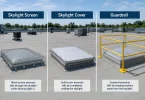
OSHA treats every skylight as a hole in the walking surface, no matter how sturdy it looks. Under 29 CFR 1926.501(b)(4) for construction and 1910.28(b)(3)(i) for general industry, workers must be protected from falling through a skylight using a personal fall arrest system, a load-rated cover, or a guardrail. There’s no size exception and no grandfather clause: if a person could fall through it, it needs protection.
That’s the rule in one paragraph. The rest of this guide covers the parts that actually trip people up on real jobsites: why factory skylights fail the load test, what a compliant cover looks like in practice, and where crews get hurt even when they think they’ve done everything right.
Why Most Factory-Installed Skylights Don’t Count as Protection

Here’s the part almost nobody reads on the spec sheet. A skylight manufacturer can call a unit “impact-rated” or “load-tested” and still have it fail OSHA’s cover requirement. The two standards are testing completely different things.
Manufacturers often test skylights for static load and weather resistance, meaning the dome or panel won’t crack under snow, hail, or foot traffic during normal building use. OSHA’s cover rule under 1926.502(i)(2) asks a different question entirely: can the surface support twice the weight of any employee, tool, or material that might land on it during work near that opening. Most skylight domes, especially older acrylic or polycarbonate ones, were never engineered against that specific benchmark, and UV exposure over the years makes brittle plastic even less reliable than it was on day one.
I’ve walked roofs where a client pointed to a skylight and said “that’s rated for 400 pounds, we’re fine.” What they had was a load rating from a structural engineer’s report for roof design purposes, not a documented cover certification for fall protection. Those are two different pieces of paper, and OSHA compliance officers know the difference even if the facility manager doesn’t.
The fix is simple but often skipped: get written documentation from the manufacturer stating the skylight meets the specific cover strength criteria in 1926.502(i) or 1910.29, dated for the period work will occur nearby. No documentation means no assumption of compliance, regardless of what the sales brochure claims.
You May Also Like It:
Wire Harness Manufacturers in the USA
The Three Compliant Options, and When Each One Actually Makes Sense
OSHA gives you three paths. Picking the wrong one for your situation is where most projects lose time and money.
Guardrail Systems
A perimeter guardrail set at 42 inches (plus or minus 3 inches) around the skylight keeps workers from ever reaching the opening. This is the option I recommend most often for facilities with recurring rooftop work like HVAC service or solar panel maintenance, because it needs zero action from the worker once it’s installed. No harness to clip, no cover to remember.
The trade-off: guardrails need enough clearance to avoid shading the skylight, which matters if the building relies on it for daylighting. Modular, non-penetrating rail systems solve the roof-warranty problem since they clamp or use ballast rather than drilling through the membrane.
Load-Rated Covers or Screens
A cover physically spans the opening so nobody can fall through, even if they step directly on it. This works well for skylights that see infrequent foot traffic, like on a warehouse roof that gets visited twice a year for maintenance.
The catch: covers have to be secured against displacement by wind or accidental kicks, and they need to be clearly marked so nobody mistakes them for a walking surface without checking the rating first. A cover that slides out of place under a worker’s boot is worse than no cover, because it creates false confidence.
Personal Fall Arrest Systems (PFAS)
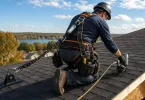
Harness, lanyard, and anchor point, engineered to stop a fall before the worker hits the lower level. This is the right call for one-off repair jobs where installing a guardrail or cover isn’t practical, like a single technician replacing a seal on one unit.
The catch here is training and inspection discipline. A PFAS only works if the anchor point is rated correctly, the lanyard length accounts for the actual fall distance to the level below, and the worker was trained on how to use it that day, not six months ago at orientation. I’ve seen crews with brand-new harnesses still get injured because the anchor was tied off to unrated rooftop equipment instead of an engineered anchor point.
| Fall Distance Trigger | Standard | Applies To |
|---|---|---|
| 6 feet or more | 29 CFR 1926.501(b)(4) | Construction work |
| 4 feet or more | 29 CFR 1910.28(b)(3)(i) | General industry / facility maintenance |
| No minimum size | 29 CFR 1910.21(b) | Defines “hole” as 2 inches or more in least dimension |
You May Also Like It:
Skylight Screen vs Cover vs Guardrail
Best Fall Protection Harness for Roofers
The Real-World Failure Pattern: Guardrails on the Edge, None on the Skylight
Field investigations keep turning up the same story. A roof gets guardrails installed around the perimeter edges, everyone assumes the roof is now “protected,” and the skylight in the middle of that same roof gets ignored because it doesn’t look like an edge hazard.
That gap has killed people. A roofer working on a Sam’s Club roof fell roughly 40 to 50 feet through an unprotected skylight while the perimeter guardrails sat fully compliant a dozen feet away. A seven-year NIOSH review of national fatality data found that 447 workers died from falling through roof or floor openings and surfaces, including skylights, over that period alone.
The lesson for anyone managing a roof: perimeter fall protection and opening protection are two separate compliance obligations. Passing one inspection doesn’t cover the other, and a competent person doing a walkthrough needs to physically check every skylight, not just the roof edges, before signing off on a job as safe.
What a Proper Hazard Assessment Actually Looks Like

Skip the generic checklist language. Here’s what a competent person should physically verify before anyone steps onto a roof with skylights:
- Locate every skylight, including smoke-vent domes that don’t look like traditional skylights and are easy to miss from a distance
- Pull manufacturer documentation confirming load rating meets the twice-maximum-intended-load standard, dated for current work
- Inspect existing screens or covers for UV degradation, cracking, or loose fasteners, especially on units older than 10 years
- Check anchor points if PFAS is the chosen method, confirming they’re rated for fall arrest and not just general equipment tie-off
- Walk the full roof surface, not just the areas listed on the work order, since adjacent skylights outside the immediate work zone still pose a hazard to anyone crossing the roof
This assessment needs to happen before work starts, not as a mental checklist while already up there. Once boots are on the roof, it’s too easy to rationalize skipping a step because the crew is already behind schedule.
California and State-Plan Differences Worth Knowing
If you’re working under Cal/OSHA rather than federal OSHA, the rules get more specific. California’s Construction Safety Orders allow the skylight itself to serve as its own cover only if the employer obtains documentation from the manufacturer confirming it meets the strength requirements, and that paperwork has to be secured before work starts and made available on request. Federal OSHA’s language is close but slightly less prescriptive about the documentation timing.
Other state-plan states (Washington, Oregon, Michigan, and a handful of others) sometimes layer on additional guardrail height or screen strength requirements. If your project crosses state lines, don’t assume the federal minimum travels with you. A five-minute check of the relevant state plan can save a costly stop-work order.
You May Also Like It:
Retrofitting Older Buildings: The Cost Question Nobody Likes to Answer
Facility managers ask this constantly: do we really need to retrofit skylights installed 20 years ago under older codes? The honest answer is yes, because OSHA’s fall protection duty applies to the work being performed today, not the installation date of the skylight. A skylight installed under 1990s code that never got a load-rating update is still a hole under current enforcement, regardless of when it went in.
The practical path most facilities take is a phased approach: prioritize skylights on roofs with recurring maintenance access (HVAC units, solar arrays, exhaust fans) first, since those get foot traffic multiple times a year, and schedule less-trafficked areas for the next budget cycle. A non-penetrating guardrail system is often the fastest retrofit since it doesn’t require re-engineering the skylight itself, just securing a rail perimeter around it.
Frequently Asked Questions
Does a small residential skylight need fall protection?
Size doesn’t exempt a skylight from OSHA’s hole definition, which starts at 2 inches in its smallest dimension. What matters is the fall distance to the level below. If that’s 4 feet or more under general industry rules, or 6 feet under construction rules, protection is required regardless of how small the unit looks.
Can a wire mesh screen alone meet the requirement?
Only if the screen meets the load capacity spelled out in the applicable standard, generally the greater of 400 pounds or twice the combined weight of workers, tools, and materials that could land on it. A decorative or bird-deterrent screen almost never meets this bar.
Who is qualified to sign off on skylight fall protection?
A Competent Person as defined by OSHA, someone capable of identifying hazards and authorized to take corrective action, should perform the hazard assessment. For complex load calculations or custom guardrail engineering, many facilities bring in a fall protection engineer to validate the system before it goes into service.
What happens if a skylight is discovered mid-job with no protection in place?
Work in that area stops until a compliant option, guardrail, cover, or PFAS, is put in place. Continuing work with a known unprotected opening is one of the clearest willful-violation scenarios OSHA cites, since the hazard was identified and ignored rather than missed.
Do smoke-vent skylights need the same protection as regular skylights?
Yes, and they’re actually one of the more commonly missed hazards. Smoke-vent domes look similar to standard skylights from a distance but are designed to open automatically during a fire, which means the surface underneath can be even less stable for foot traffic. Treat them with the same or greater caution.
How often should existing skylight covers or screens be inspected?
At minimum, before each work assignment near the skylight, and on a scheduled basis (commonly quarterly or annually depending on roof traffic and climate exposure). UV-degraded plastic and corroded fasteners are the two most common failure points found during inspections.
You May Also Like It: