

By Jack Henry, Safety Engineer | Last reviewed: 2026
Lockout tagout (LOTO) is the practice of physically locking a machine’s energy source in the off position and tagging it with the worker’s name before anyone services or repairs it. It stops equipment from starting up or releasing stored energy while a person’s hands are inside it. In the US, it’s governed by OSHA standard 29 CFR 1910.147, and it’s one of the most cited standards on OSHA’s annual violation list.
I’ve walked into plants where the LOTO binder looked perfect on paper and still watched a maintenance tech get a hydraulic ram drop on him because nobody bled the accumulator. The procedure existed. Nobody followed the part that mattered. That gap between having a program and doing the isolation right is what this guide actually covers.
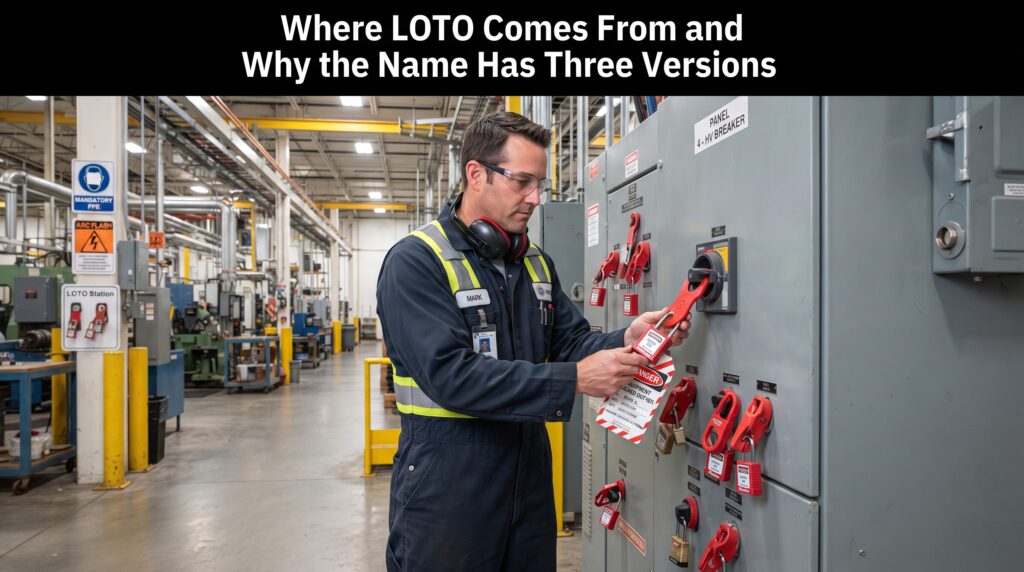
Where “LOTO” Comes From and Why the Name Has Three Versions
You May Also Like It:
Physical Hazards in the Workplace: What They Are and How to Actually Control Them
Industrial Fire Safety Checklist: The Complete 2026 Inspection Guide
LOTO is short for lock out, tag out. You’ll also see it written as “lockout/tagout” or “lock, tag, and try,” and that third version isn’t just wordier for no reason. It reflects a real addition to the practice: the “try” step, where a worker attempts to start the equipment after locking it to prove the isolation actually worked.
The federal standard behind it, 29 CFR 1910.147, was written in 1982 and became enforceable in 1989. Before that, plants relied on verbal warnings and “don’t touch” signs, which is exactly as unreliable as it sounds. The rule exists because tags alone don’t stop a machine from restarting. Only a physical lock does.
The Energy Types Your Procedure Has to Account For (Not Just Electrical)
Most people think LOTO and picture a breaker panel. Electrical is the one everyone remembers. It’s also the one that gets people hurt least often in my experience, because it’s the most obvious. The energy that catches techs off guard is the kind that’s invisible after the main switch is already off.
- Electrical: Isolate at the disconnect, verify with a meter, and don’t forget capacitors. A capacitor can hold a lethal charge for minutes or hours after the breaker is open.
- Hydraulic: Closing the valve isn’t enough. The line downstream still holds pressure until you bleed it through a relief valve or crack a fitting slowly.
- Pneumatic: Same logic as hydraulic, but the giveaway is sound. A hissing line after you’ve “isolated” it means you haven’t isolated it.
- Mechanical (springs, flywheels): A flywheel can keep spinning for a surprising amount of time after power cuts. Wait for it to fully stop, don’t estimate.
- Gravitational: Anything suspended, a raised forklift fork, an elevated press platen, needs a physical block or pin, not just a “park brake” mentality.
- Chemical: Close and lock supply valves, then cap or bleed the line. Residual chemical in a line is still a live hazard even with the source isolated.
- Thermal: Steam lines and hot surfaces need time to cool as part of the procedure, not an afterthought after the lock goes on.
A machine can have four or five of these stacked on top of each other. I’ve seen a single stamping press need electrical, pneumatic, and gravitational isolation all in the same procedure. Miss one and the other two locks don’t save you.
The Six-Step Procedure, and the Two Steps People Actually Skip
Every LOTO program breaks down into six steps: preparation, shutdown, isolation, lockout/tagout application, stored energy release, and verification. On paper, that’s clean. On the floor, two of these get rushed constantly.
- Stored energy release gets skipped because it feels redundant after the switch is already off. It isn’t. This is where springs, capacitors, and pressurized lines still carry a charge.
- Verification (the “try”) gets skipped because techs are confident the lock worked. Confidence isn’t verification. Hit the start button. If nothing happens, you’re verified. If it does anything at all, even a twitch, you’re not done.
Every serious LOTO injury I’ve reviewed traces back to one of these two steps being treated as optional. Not the lock itself. The stuff around it.
When You Don’t Need a Full Lockout: The Exemption Test
You May Also Like It:
Types of Safety Shoes: The Complete Guide for Every American Worker
New Balance Safety Shoes: The Complete Buying Guide
Safety Shoes Meaning: What They Are, How They Work, and Why They Matter
What Are Safety Shoes? Types, Standards, and How to Pick the Right Pair
Not every task needs the full six-step treatment, and knowing the difference matters because over-applying LOTO where it isn’t required slows production and trains workers to see the procedure as bureaucratic overkill. That mindset is dangerous when it bleeds into the tasks that do need it.
OSHA allows an exemption only when all eight of these are true, per 1910.147(c)(4)(i):
- No stored or residual energy remains after shutdown
- There’s a single, readily identifiable energy source
- That single point brings the equipment to a full zero-energy state
- Lockout is performed at that one point
- A single lockout device secures it
- The device is under the exclusive control of the authorized employee doing the work
- The servicing creates no hazard to other employees
- There’s no history of accidents involving that equipment
There’s also a separate minor servicing exception: routine, repetitive tasks that are integral to normal production, like clearing a jam or swapping a tool, can skip full lockout if alternative protection (guards, interlocks, specific procedures) provides equivalent safety. This one gets abused a lot. “Routine” doesn’t mean “whatever we do often.” It means the task is a defined, expected part of the production cycle, not a repair.
Group Lockout and Shift Changes: Where Good Programs Fall Apart
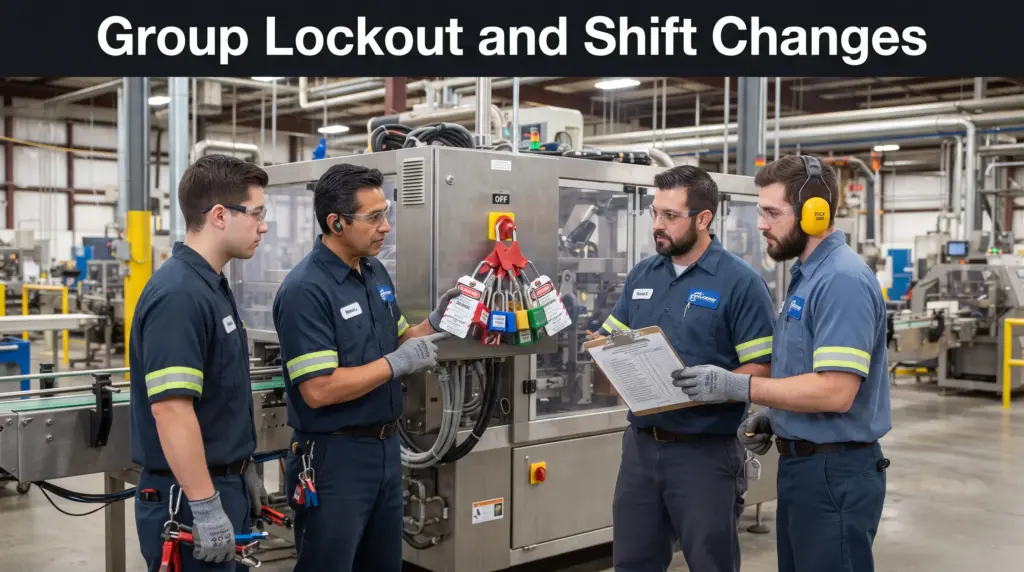
A single-person lockout is straightforward. Add a second worker, or a shift change mid-job, and the failure points multiply.
Group lockout uses a lock box or hasp: the energy-isolating device gets locked with one master lock, and every worker on the job adds their own personal lock to the box, not the machine. Nobody’s individual lock comes off until every worker involved has cleared the area and removed theirs. I’ve seen crews try to shortcut this with one “designated” lock for the whole group. That defeats the entire point. Each person’s safety should never depend on someone else remembering they’re still in there.
Shift changes are the other weak spot. The rule is simple even if plants rarely document it well: the incoming worker locks their device onto the equipment before the outgoing worker removes theirs. There should be zero gap where the machine sits unlocked, even for thirty seconds, between shifts.
Contractor jobs add a third layer. The host employer and the contractor are both required to inform each other of their respective energy control procedures under 1910.147(f)(2). In practice, this means before an outside crew touches your equipment, someone from your team needs to walk them through your specific isolation points, not just hand them a generic binder.
What an Inspector Actually Checks During a LOTO Audit
Annual review isn’t a formality. It has two required parts under 1910.147(c)(6): an inspection of each energy control procedure, and a review of every employee’s responsibilities under it. The inspection has to be done by an authorized employee who does not use that specific procedure themselves, so someone with fresh eyes.
The certification paperwork needs four specific fields, and this is where most companies get cited even when their actual lockout practice is solid:
- The machine or equipment the procedure was reviewed on
- The date of the inspection
- The names of employees included in the review
- The name of the person who performed the inspection
Missing paperwork is one of the most common citations OSHA issues under this standard, right alongside missing machine-specific procedures and gaps in training records. The lockout itself can be flawless and you can still get written up because nobody wrote down who checked it and when.
How LOTO Requirements Differ by Region
If you operate across borders, the core practice is nearly identical everywhere. The legal backbone isn’t.
| Region | Governing Standard | Written Program Mandatory? | Distinct Requirement |
|---|---|---|---|
| United States | 29 CFR 1910.147 | Yes | Annual documented audit with named authorized employee |
| Canada | CSA Z460 | Yes (per jurisdiction) | Defines “affected” vs. “authorized” persons explicitly in the standard text |
| European Union | Directive 89/655/EEC | Not always formally required | Requires visible isolation devices on equipment by design, not just procedure |
| United Kingdom | PUWER 1998 / BS 7671 | Not directly enforced | LOTO is best practice, referenced indirectly rather than named as a standalone rule |
Why Verification Isn’t Optional: A Real Case
A compost plant operator in Washington State was cleaning a jam on a rotating conveyor. The equipment had been shut off but not properly locked and verified. The belt restarted while he was clearing debris and caught him in the rotating mechanism. He didn’t survive.
The investigation afterward found the shutdown step had happened. The lockout and verification steps hadn’t. That’s the pattern in nearly every fatal LOTO incident I’ve come across: the visible part of the procedure gets done, and the part that actually confirms the machine can’t move gets treated as optional. It never is.
Frequently Asked Questions
What does LOTO stand for?
LOTO stands for lock out, tag out. It’s also referred to as “lock, tag, and try” when the verification step is emphasized as part of the name.
What is LOTO in safety, exactly?
In a safety context, LOTO refers to the specific hardware, procedure, and training combination used to isolate hazardous energy on a machine before service work begins. It’s not just a lock, it’s the entire documented process around applying and removing it.
Who is allowed to remove a lockout device?
Only the authorized employee who applied the lock can remove it, except under a documented employer procedure for situations like an abandoned lock, where specific steps must be followed and the affected employee notified before removal.
Can tagout be used without a physical lock?
Only when the energy-isolating device isn’t capable of accepting a lock. Tagout alone provides no physical barrier against re-energization, so OSHA treats it as a weaker substitute, not an equal option, whenever lockout hardware is available.
How often does a LOTO procedure need to be reviewed?
At least once every 12 months for procedures used regularly. A procedure used less than once a year only needs review before that specific use, not on a fixed annual schedule.
Does lockout tagout apply to equipment that’s simply unplugged?
No, as long as the plug is the only energy source and stays under the exclusive control of the person doing the work. If there’s a secondary energy source, like a battery backup or residual air pressure, unplugging alone doesn’t meet the exemption.
What’s the difference between an authorized and an affected employee?
An authorized employee performs the actual lockout and does the servicing work. An affected employee works in the area or operates equipment that’s locked out, but doesn’t perform the isolation themselves. Affected employees still need training to recognize an active lockout and never attempt to remove it.
What happens if a lock is left on a machine and nobody knows who placed it?
This is treated as an abandoned lock scenario. The employer must follow a specific documented procedure, which typically includes reasonable attempts to contact the employee, verification that the equipment is safe to operate, and supervisor authorization before removal, along with notifying the original employee once located.
Jack Henry has spent his career auditing energy control programs across manufacturing and utility sites, and writes here on practical safety compliance grounded in what actually happens on the floor, not just what’s written in the binder.
You May Also Like It:
Safety Equipment Inspection: A Practical Guide to What, When, and Who
Workplace Safety Equipment: A Complete Guide to Protecting Your Team
What Is PPE? A Complete Guide to Personal Protective Equipment
Personal Protective Equipment: The Complete Guide to Staying Safe at Work