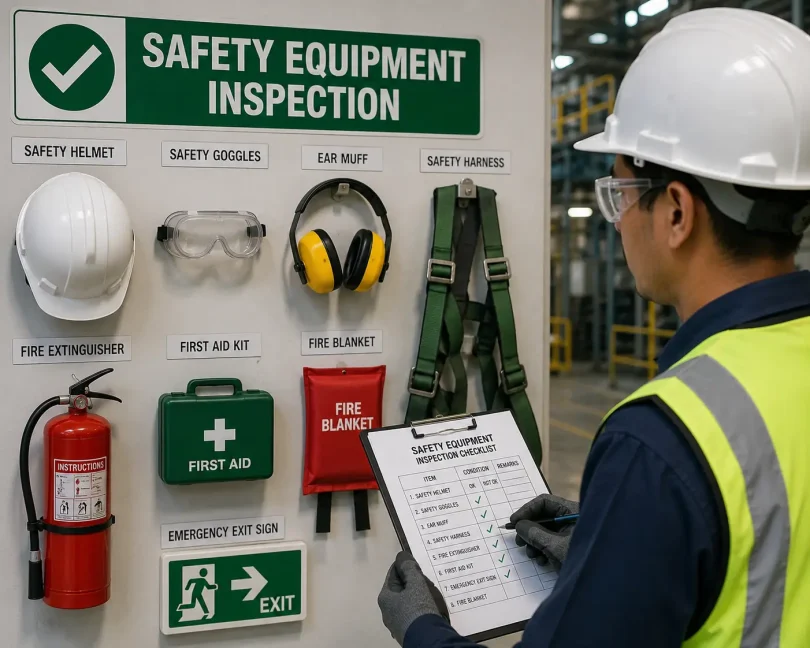

Safety equipment inspection is the process of checking PPE, fall protection, fire equipment, and other protective gear for damage or wear before it’s trusted to protect a worker again. Most items need a quick visual check before every use, plus a documented formal inspection on a set schedule, usually monthly or annually depending on the equipment type and how OSHA or the manufacturer classifies it. Skipping either step is one of the most common reasons safety gear fails at the exact moment someone needs it.
I’ve walked job sites where a harness looked fine from three feet away and had a frayed stitch line that would have failed under load. That’s the whole point of this guide: not just telling you inspections matter, but showing you what actually gets missed, how often different equipment types really need checking, and what to do the moment something fails.
Why Most Safety Equipment Failures Aren’t Really Equipment Failures
When gear fails on the job, the manufacturer usually gets blamed first. In reality, most failures trace back to a missed inspection step, not a defective product straight out of the box.
A 2023 review of fall protection incidents by the American Society of Safety Professionals found that a large share of harness and lanyard failures involved equipment that had visible, detectable damage before the incident. The damage was there. Nobody caught it, or nobody acted on it.
Three patterns show up again and again on real sites:
- The “it worked last week” assumption. Workers skip pre-use checks on gear they used yesterday, forgetting that UV exposure, chemical splash, or a single hard drop can degrade equipment overnight.
- Inspection fatigue on repetitive tasks. When the same worker checks the same harness every single morning for months, the check becomes a glance instead of a real inspection.
- Equipment shared across shifts. Nobody feels fully responsible for gear that gets handed between three different crews, so nobody inspects it properly.
None of this is about equipment quality. It’s about process discipline, and that’s fixable.
The Inspection Frequency Table Nobody Puts Together Properly
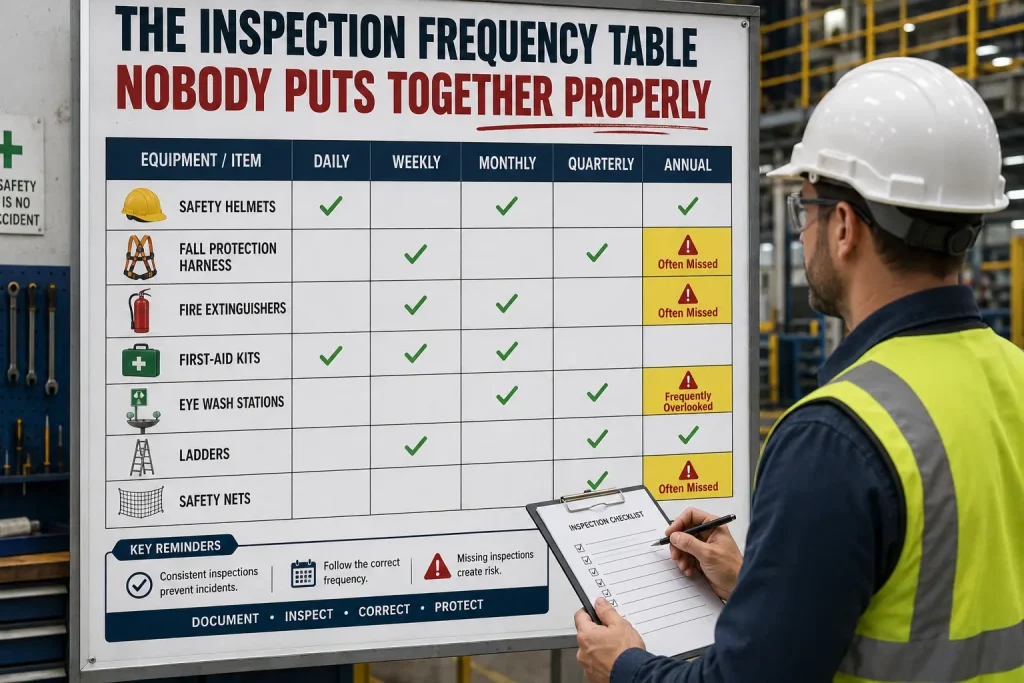
Every manufacturer publishes its own schedule buried in a PDF nobody reads. Here’s the frequency picture pulled together across the equipment categories most sites actually deal with, based on OSHA standards and the most common manufacturer guidance.
| Equipment Type | Pre-Use Check | Formal Documented Inspection | Governing Standard (US) |
|---|---|---|---|
| Fall protection (harness, lanyard, SRL) | Every use | Every 6-12 months by a competent person | OSHA 1926.502(d), ANSI Z359 |
| Hard hats / head protection | Every use | Replace at 5 years from manufacture regardless of appearance | ANSI Z89.1 |
| Respirators (SCBA/APR) | Every use | Monthly function check; annual flow test by a third party | OSHA 1910.134 |
| Fire extinguishers | Monthly visual | Annual maintenance check by a certified technician | OSHA 1910.157, NFPA 10 |
| Ladders | Every use | Documented periodic inspection per site policy | OSHA 1926.1053 |
| First aid kits / AEDs | N/A | Weekly inventory and expiry check | OSHA 1910.151, ANSI Z308.1 |
| Electrical PPE (insulated gloves, mats) | Every use | Electrical testing every 6 months | ASTM F496, OSHA 1910.137 |
Notice the gap between “pre-use” and “formal.” That gap is where most sites get sloppy. A pre-use check catches obvious damage. A formal inspection catches the stuff that’s only visible when someone takes the time to actually pull, flex, and stress-test the gear rather than just look at it.
What “Competent Person” Actually Means (And Why Sites Get It Wrong)
OSHA doesn’t require a certificate for someone to be a competent person. It requires demonstrated ability to identify hazards and the authority to fix them on the spot.
That second half gets ignored constantly. A worker can know exactly what a frayed lifeline looks like, but if they don’t have the authority to pull that equipment from service without asking a supervisor first, they’re not functioning as a competent person in the way OSHA intends. The role isn’t just knowledge. It’s decision-making power. Here’s a quick gut check for whether your site’s inspection assignments are actually working:
- Can the inspector remove equipment from service without needing sign-off from someone else first?
- Does the inspector understand the specific failure points for that equipment type, not just general damage signs?
- Has the inspector actually seen a failed or damaged unit before, either in training or in the field?
If the answer to any of those is no, you don’t have a competent person problem, you have an authority and training problem, and those get fixed differently.
The Six Failure Signs Inspectors Miss Most Often
Basic checklists cover cuts, tears, and corrosion. Here’s what gets missed even by trained inspectors, based on what actually shows up in field reports:
- UV degradation without discoloration. Synthetic webbing can lose significant tensile strength from sun exposure before it visibly fades. If gear lives outdoors or near a window, treat it as higher risk regardless of color.
- Internal fiber damage on ropes and lifelines. The outer sheath can look perfect while the core is compromised. Squeeze-testing along the full length, not just the ends, catches soft spots a visual pass won’t.
- Metal fatigue in carabiners and connectors from repeated cross-loading. A carabiner that’s been side-loaded repeatedly can develop micro-fractures invisible to the naked eye. Gate action alone isn’t a reliable test.
- Chemical exposure with no visible residue. Some solvents and acids weaken synthetic fibers without leaving a stain or smell. If equipment was near a chemical spill event, even a “clean” look doesn’t clear it.
- Buckle and hardware creep. Repeated flexing loosens rivets and stitching slowly over months. Compare hardware tightness against a new unit periodically, not just against last week’s version of the same item.
- Expired-but-unused inventory. Gear sitting in a storage locker still ages. Shelf life applies whether the item was used once or zero times.
What to Actually Do When Equipment Fails Inspection
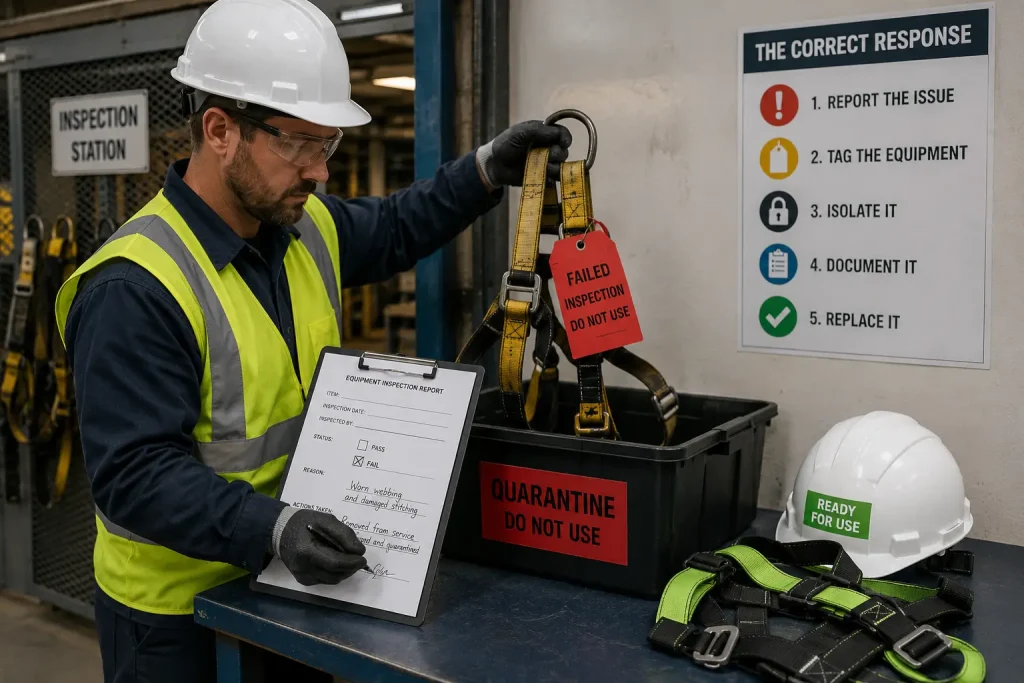
Most guides stop at “remove from service.” That’s step one, not the whole process. Here’s the full sequence that actually protects you legally and operationally:
- Tag it immediately, at the point of failure. Don’t set it aside mentally intending to tag it later. Equipment that “temporarily” sits untagged gets grabbed by someone in a hurry.
- Photograph the specific defect. This protects you if there’s ever a warranty claim, an insurance question, or a dispute about whether the failure was pre-existing or caused during use.
- Log the failure in your inspection record, not just a verbal note to the supervisor. Verbal handoffs are where documentation gaps start.
- Quarantine physically, not just administratively. A tag on equipment left in the same bin as working gear gets ignored under time pressure. Move it to a separate, clearly marked location.
- Route it for repair, recertification, or destruction based on manufacturer guidance, not a general assumption that it can be fixed. Some categories, like carabiners with any deformation, get destroyed, full stop.
- Close the loop with whoever normally uses that equipment. If Jake always grabs harness #14, tell Jake it’s out. Otherwise he’ll go looking for it and someone else will hand him a replacement without knowing why the original disappeared.
Building an Inspection Culture That Doesn’t Fade After Month Three
Most inspection programs start strong and quietly decay. The pattern is predictable: enthusiasm in week one, shortcuts by week eight, and a near-miss by month four that resets everyone’s attention for another few weeks.
What actually breaks that cycle on sites I’ve seen do it well:
- Rotate who inspects shared equipment. A fresh set of eyes catches what a familiar routine misses.
- Pair digital logs with physical tags. Digital records are great for tracking history, but a physical tag on the equipment itself is what actually stops someone from grabbing bad gear in the moment.
- Review near-misses tied to equipment condition, not just incidents. If someone noticed a defect right before it would have mattered, that’s data worth tracking, not a story to forget.
- Make the inspection interval visible on the equipment itself. A due-date sticker on a harness does more to prevent lapses than a spreadsheet nobody checks daily.
Frequently Asked Questions
How often should PPE be inspected by OSHA standards?
OSHA requires a visual check before each use for most PPE, with formal documented inspections on a schedule set by the specific standard governing that equipment type, ranging from monthly for fire extinguishers to annually for fall protection.
Who is legally allowed to inspect safety equipment?
Anyone with sufficient training and the authority to remove defective equipment from service can perform inspections. OSHA calls this a “competent person” and doesn’t require a specific certification, though many manufacturers recommend formal training for fall protection and respiratory equipment specifically.
Can safety equipment fail inspection but still be repaired?
Some items can be repaired by an authorized service provider, but items like carabiners with deformation, harnesses that arrested a fall, or fire suits with seam damage are typically destroyed rather than repaired, since the structural integrity can’t be reliably restored.
Does unused safety equipment still need to be inspected?
Yes. Materials degrade in storage from UV exposure, humidity, and simple age, so unused inventory needs the same shelf-life tracking as equipment in active rotation.
What’s the difference between a pre-use check and a formal inspection?
A pre-use check is a quick visual and functional scan done by the user right before wearing or operating the equipment. A formal inspection is a documented, more thorough examination, often including stress-testing components, performed by a trained or third-party inspector on a fixed schedule.
How long do fall protection harnesses last before they need replacing?
Most manufacturers set a maximum service life of 5 to 10 years from the date of manufacture, but real-world lifespan depends heavily on usage frequency and environmental exposure, so a harness used daily outdoors may need replacing well before that ceiling.
What should be documented in a safety equipment inspection record?
A solid record includes the inspection date, inspector name, specific equipment identifier (serial number or asset tag), pass/fail result, any defects found, and the corrective action taken, kept on file until the next scheduled inspection at minimum.
Is a visual inspection enough for fall protection equipment?
No. Visual checks miss internal fiber damage, metal fatigue, and UV degradation that hasn’t caused visible discoloration yet, which is why formal periodic inspections include physical stress-testing like flexing webbing and squeezing rope along its full length.