
An industrial fire safety checklist works best when it’s organized by inspection frequency (daily, weekly, monthly, annual) and tied to a specific standard for each item, not a generic list of “check the extinguishers” items. The checklist below covers the standard items every facility needs, plus the hazards most templates skip entirely: static electricity during flammable liquid transfer, industrial battery storage, and hot work in confined spaces.
I’ve reviewed dozens of these checklists over the years, and most of them read like they were written for an office building with a warehouse attached. That’s a problem, because a plant floor doesn’t behave like an office. Dust builds up in places nobody looks. Forklifts charge overnight unattended. Welders show up for a two-hour job and leave behind heat that lingers for an hour after the torch is off. A checklist that doesn’t account for that isn’t really protecting anyone, it’s just a compliance paper trail.
Why Most Industrial Checklists Fall Short
What Are Industrial Safety Standards?
The problem isn’t that facilities skip fire safety checks. Most do them religiously. The problem is what gets checked.
A checklist item like “fire extinguishers inspected” tells an auditor nothing useful. Inspected against what? By whom? What happens if the seal is broken but the gauge still reads green? The items that actually prevent fires are specific enough that two different inspectors would reach the same conclusion looking at the same equipment.
That’s the gap this checklist tries to close. Instead of vague prompts, every item below is tied to a real standard and a real frequency, so whoever is holding the clipboard knows exactly what “pass” looks like.
The Daily Checklist
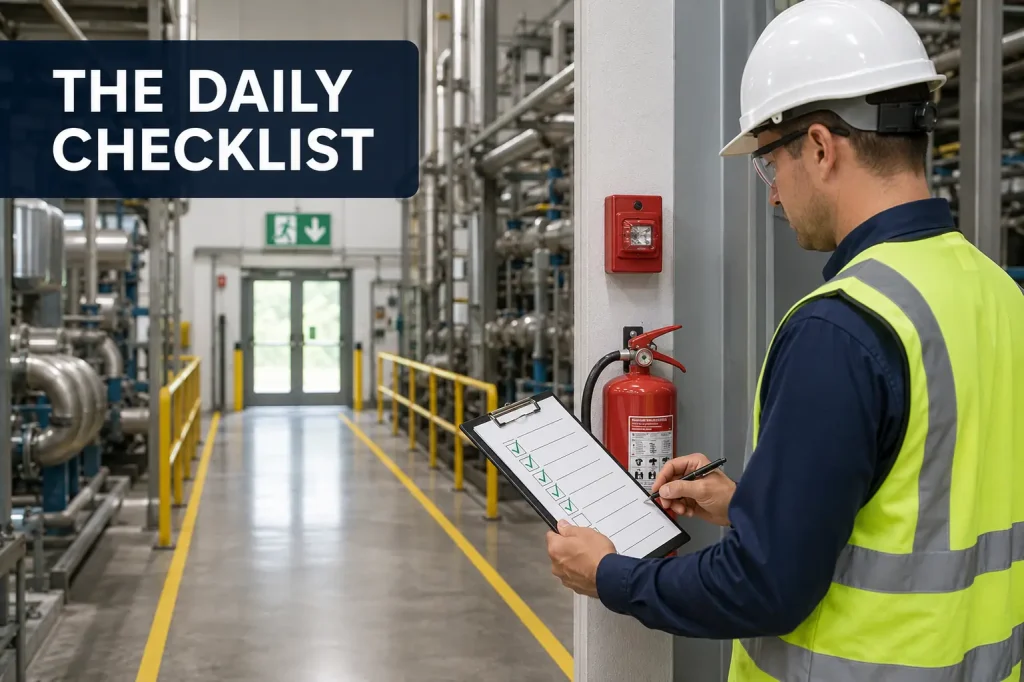
These take five to ten minutes and should happen at shift start, not once a week when someone remembers.
- Exit routes and doors: unobstructed, unlocked from the inside, fire doors not wedged open
- Extinguisher access: nothing stacked in front, pin and seal intact, gauge in the green
- Housekeeping: combustible waste, oily rags, and packaging cleared from work areas, not just swept into a corner
- Electrical cords: no daisy-chained power strips, no visible fraying near machinery
- Hot work in progress: if welding or cutting is happening, confirm a fire watch is actually posted, not just logged on paper
Most facilities skip the hot work line because it feels redundant with the permit system. It isn’t. A permit says the job was authorized. It doesn’t confirm anyone is standing there watching for smoldering material once the torch stops.
The Weekly Checklist
- Sprinkler clearance: minimum 18 inches between stored goods and sprinkler deflectors for standard commodities, 36 inches for high-hazard storage
- Flammable storage cabinets: closed, properly labeled, self-closing lids functioning
- Forklift and equipment charging areas: ventilation confirmed, no obstruction of the charging bay
- Aisle width: minimum clear width maintained, nothing encroaching from pallets or staged material
- Emergency lighting: test units function on battery backup
The sprinkler clearance rule catches more facilities than any other item on this list. Storage teams stack to the ceiling because that’s how you maximize cube space, and the sprinkler heads become an afterthought until an inspector points a laser level at them.
The Monthly Checklist
| Item | Standard | What “Pass” Actually Means |
|---|---|---|
| Fire extinguishers | NFPA 10 | Monthly visual check, annual professional service tag current |
| Electrical panel clearance | NEC / OSHA 1910.303 | 36 inches clear working space maintained, not just “reachable” |
| Fire alarm and detection | Local fire code | Pull stations and detectors tested, panel shows normal status |
| Forklift charging ventilation | OSHA 1910.178(g) / NFPA 505 | Hydrogen off-gassing dispersed, spill-flush station stocked |
| Fire pump (if present) | NFPA 25 | Churn test run, no-flow condition verified |
| Emergency generator | Facility protocol | Start-up test, minimum 30-minute run under load |
The electrical panel item is the one that surprises people. It’s not about whether the panel is reachable in an emergency, it’s about the working clearance being kept clear at all times, day to day, because arc flash incidents happen during routine maintenance, not just fires.
The Annual Checklist
- Full fire drill with timed evacuation and documented corrective actions
- Sprinkler system flow test, main drain and water flow alarm per NFPA 25
- Fire alarm certification by a licensed technician, full system
- Dust hazard analysis review for any facility handling combustible dust, required at minimum every five years under NFPA 652, but an annual internal review catches process changes before the five-year mark forces a surprise
- Emergency action plan review and retraining, especially after any layout change, new equipment, or process shift
The Three Hazards Almost Every Checklist Misses
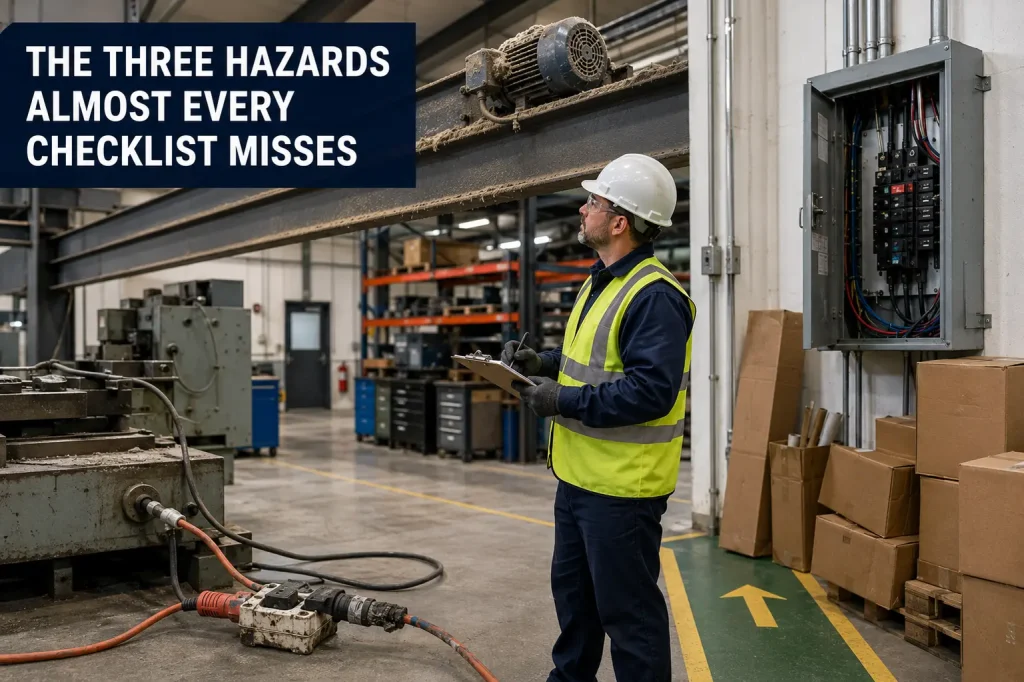
I went through five of the most-cited industrial fire safety checklists online while researching this piece. Every one of them covers extinguishers, exits, and alarms. Almost none of them cover what actually starts fires on a working plant floor.
1. Static Electricity During Flammable Liquid Transfer
Pouring or pumping a flammable solvent, especially through a funnel or a non-conductive hose, generates a static charge. If the container and the receiving vessel aren’t bonded and grounded to each other, that charge has nowhere to go except a spark right at the point where vapor concentration is highest.
This isn’t a rare industrial footnote. It’s one of the most common causes of flash fires in parts-washing and paint-mixing areas, and it almost never shows up on a checklist as its own line item. If your facility transfers solvents, adhesives, or thinners between containers, add this:
- Bonding cable connected between source and receiving container before transfer starts
- Grounding clamp attached to a verified ground point, not just a nearby metal surface
- Continuity checked periodically, not assumed because the clamp “looks” connected
2. Industrial and Stationary Battery Storage
Forklift charging gets covered often enough. What gets missed is the growing use of stationary lithium-ion battery energy storage systems (BESS) on industrial sites, backup power banks, forklift battery rooms with dozens of units charging simultaneously, and large-format battery packs for material handling equipment.
Thermal runaway in a lithium battery doesn’t behave like a normal combustible fire. It can reignite after appearing extinguished, and standard extinguishing agents don’t always stop the chain reaction inside the cell. If your site has any battery storage beyond a handful of forklifts, this needs its own risk assessment, not a line item borrowed from the forklift charging section.
- Battery storage rooms separated from other combustibles with fire-rated construction
- Charging areas monitored for off-gassing, not just visually inspected
- Damaged or swollen battery packs isolated immediately in a fire-resistant container, never left in the general charging area “until someone gets to it”
3. Hot Work in Confined or Semi-Enclosed Spaces
NFPA 51B’s 35-foot clearance rule assumes an open floor. In practice, a lot of hot work happens inside tanks, pipe galleries, mezzanine crawl spaces, or between racking where a 35-foot radius simply doesn’t exist as open space. The clearance rule doesn’t disappear just because the geometry is tight, it means the fire watch and the barrier protection have to work harder.
Checklist items that generic templates never mention:
- Combustible barriers or fire-resistant blankets used to compensate for reduced clearance
- Ventilation confirmed adequate for both heat and any fumes generated by the work
- Fire watch positioned with a clear line of sight, not just “in the area”
- Extended post-work monitoring specifically logged for confined spaces, since smoldering material in an enclosed area can go undetected far longer than on an open floor
Who Should Own Each Checklist Item
A checklist with no named owner per item is the single biggest reason items get skipped. Not laziness, just diffusion of responsibility. If three people could technically check the extinguishers, none of them will assume it’s their job on a busy Tuesday.
Split ownership roughly like this:
- EHS or safety officer: code compliance items, documentation, drill scheduling, DHA reviews
- Maintenance: physical condition of equipment, electrical panels, sprinkler heads, generator testing
- Shift supervisors: daily items, housekeeping, hot work permit verification during their shift
- Department leads: area-specific hazards like solvent bonding/grounding or battery charging in their zone
Field Notes: Where Checklists Break Down in Practice
A few patterns I’ve seen repeat across different facilities, worth knowing before you build your own version:
- The checklist gets completed but never reviewed. Someone signs off every week, but nobody looks at the trend. If the same extinguisher keeps showing a low gauge reading, that’s not a monthly fluke, it’s a slow leak that needs replacing.
- Seasonal blind spots. Heating equipment gets checked in winter and forgotten the rest of the year, even though the wiring behind it doesn’t stop being a risk in July.
- Contractors aren’t held to the same standard. A contractor doing hot work on-site often isn’t briefed on the facility’s specific fire watch requirements, they’re working from their own company’s checklist, which may not match yours.
- Digital records without photo evidence get disputed later. A checkbox that says “pass” with no photo is hard to defend during an insurance claim or an incident investigation. A timestamped photo attached to the inspection record settles the question in seconds.
Frequently Asked Questions
What is the most commonly missed item on an industrial fire safety checklist?
Static electricity bonding and grounding during flammable liquid transfer. It doesn’t show up on most templates because it’s specific to facilities that handle solvents, adhesives, or thinners, but it’s a leading cause of flash fires in those environments.
How often should a fire extinguisher be inspected in an industrial facility?
Visually every month by facility staff, per NFPA 10, and professionally serviced and tagged once a year by a certified technician.
Does OSHA require a written fire prevention plan for industrial facilities?
Yes, OSHA general industry standards require a fire prevention plan covering major fire hazards, storage and handling of flammable materials, and procedures for controlling ignition sources. Check your facility’s specific obligations under 29 CFR 1910 for exact requirements.
What’s the required clearance around a hot work operation?
NFPA 51B calls for a 35-foot combustible clearance radius in all directions, including through wall and floor openings. In confined spaces where that radius isn’t physically possible, fire-resistant barriers and a dedicated fire watch have to compensate.
How is combustible dust different from a normal fire risk?
Fine particulate suspended in air can flash or explode under the right concentration and ignition source, which is a different failure mode than a surface fire. NFPA 652 requires a documented dust hazard analysis for any facility that manufactures, processes, or handles combustible dust.
Can lithium-ion battery fires be put out with a standard extinguisher?
Not reliably. Thermal runaway inside a lithium cell can reignite even after the visible fire appears out, and standard agents don’t always stop the internal chain reaction. Facilities with significant battery storage need a specific response plan, not just a general-purpose extinguisher nearby.
Who is legally responsible for fire safety compliance in a manufacturing plant?
Responsibility is usually split between EHS staff for code compliance and facility management for physical upkeep, but the business owner or site operator carries the ultimate legal liability if a facility is found non-compliant during an inspection or after an incident.
How long should hot work fire watch continue after the job is finished?
NFPA 51B requires continuous monitoring for a minimum period after work stops, and the exact duration depends on your locally adopted edition of the code. In confined or enclosed spaces, extending that monitoring window beyond the code minimum is a reasonable field practice since smoldering material is harder to detect.