
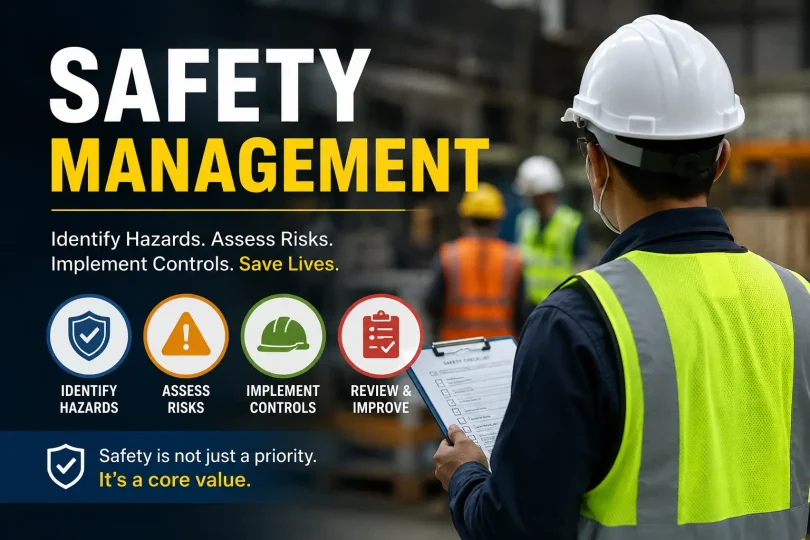

Safety management is the ongoing process of identifying workplace hazards, controlling the risks they create, and building the leadership, training, and reporting systems needed to keep that control working over time. It is not a one-time policy or a binder on a shelf. A functioning safety management system (SMS) combines four things: a clear hazard identification process, risk controls that are actually enforced, worker involvement at every level, and a feedback loop that catches failures before they become injuries.
I have walked into facilities with a 40-page safety manual and a fatality the same year. I have also seen a five-person roofing crew with two laminated pages and zero lost-time incidents in six years. The difference was never the paperwork. It was whether the system got used on the actual job site, on a Tuesday afternoon, when nobody from corporate was watching.
This guide skips the textbook definitions you have already read a dozen times. Instead, it covers what separates a safety program that looks good in an audit from one that actually prevents the incident.
Why Most Safety Management Systems Fail Within the First Year
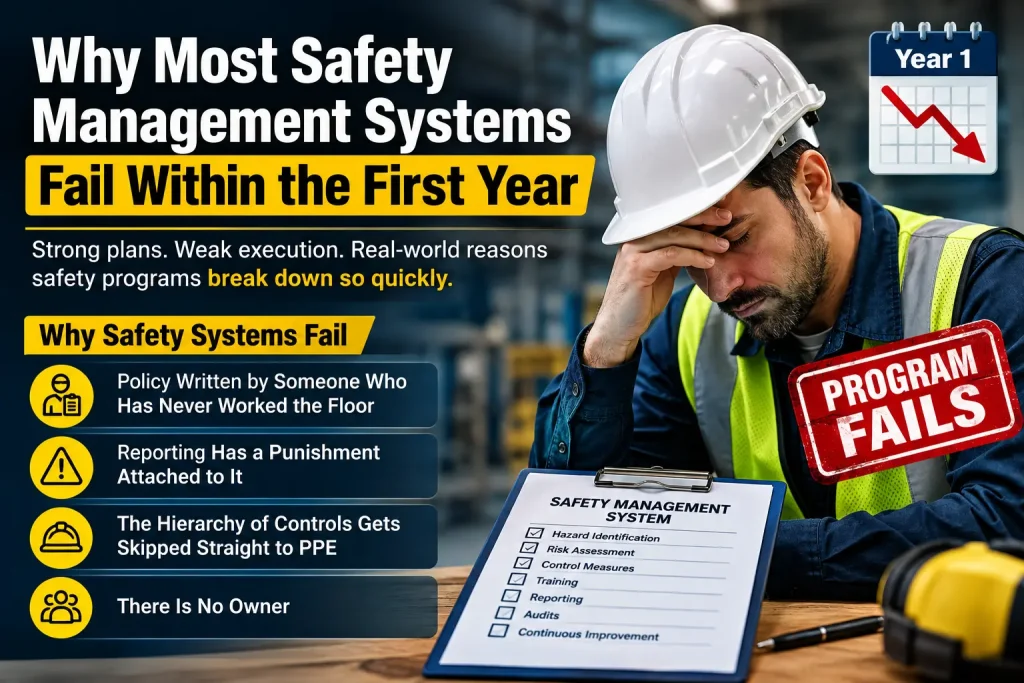
Every OSHA guide and every SMS framework tells you what the components are. Almost none of them tell you why organizations abandon those components within twelve months. Here is what I have seen kill programs in the field:
- The policy was written by someone who has never worked the floor. A safety manager who drafts procedures from an office, without walking the actual task, writes rules that get ignored because they do not match reality.
- Reporting has a punishment attached to it. If a near-miss report triggers a write-up, workers stop filing near-miss reports. Within a few months, leadership loses the early-warning data that near-misses are supposed to provide.
- The hierarchy of controls gets skipped straight to PPE. Handing out gloves and hard hats is the cheapest, fastest fix, so it is the one that gets chosen. It is also the least effective control, and relying on it as a first response instead of a last resort is the single most common mistake I see.
- There is no owner. When safety is “everyone’s responsibility,” it is functionally nobody’s responsibility. Programs that work have one named person accountable for each core element, even in a five-person company.
If your program is struggling, check these four points before you rewrite another policy.
The Hierarchy of Controls, Applied to Real Decisions
You have probably seen the hierarchy-of-controls triangle: elimination, substitution, engineering controls, administrative controls, PPE, ranked most to least effective. What most articles leave out is how to actually apply it under time and budget pressure, which is the only condition it ever gets applied under.
Here is a worked example from a fall-protection context, since that is where the stakes are highest and the shortcuts are most common:
- Elimination: Can the task be done from ground level instead of a roof? Extendable tools, drone inspections, and pre-assembly on the ground remove the fall hazard entirely instead of managing it.
- Substitution: If elimination is not possible, can a scissor lift replace a ladder for the same task? Same job, lower-risk method.
- Engineering controls: Guardrails, warning line systems, and permanent anchor points that do not rely on the worker remembering to do anything.
- Administrative controls: Rotating workers to limit exposure time, scheduling roof work outside wet or high-wind conditions, restricting access to trained personnel only.
- PPE: Harnesses, lanyards, and self-retracting lifelines. Last line of defense, not the plan.
The mistake I see constantly on job sites: a crew skips straight from “no control at all” to “wear a harness,” without ever asking whether the fall hazard could have been engineered out first. PPE only works if it is worn correctly, inspected regularly, and anchored properly, every single time. Engineering controls work whether or not anyone remembers.
Building the System: A Step-by-Step Approach That Fits Small and Mid-Size Teams
Most safety management frameworks are written for enterprises with dedicated EHS departments. If you are running a 15-person crew, here is a version that fits your actual bandwidth.
Step 1: Start With Your Injury and Near-Miss Data, Not a Template
Pull your last two years of incident reports, workers’ comp claims, and any near-misses that got mentioned verbally but never logged. This tells you where your real risk sits, not where a generic industry checklist assumes it sits. A warehouse and a roofing company will have almost nothing in common on this list.
Step 2: Assign One Owner Per Hazard Category
Not one safety manager for everything. One person accountable for fall protection, one for equipment lockout, one for chemical handling, matched to whoever actually understands that specific task best. Ownership spread across people who know the work beats a single generalist trying to cover it all.
Step 3: Build a Reporting Process That Rewards Honesty
Set up a near-miss reporting channel that takes under two minutes to use and never results in disciplinary action for the person reporting. Some of the best-run sites I have consulted for run a simple text-to-supervisor system: a photo and one sentence, no form to fill out. Friction kills reporting faster than any policy problem.
Step 4: Train for the Task, Not for the Certificate
A worker can hold an OSHA 30 card and still not know how to inspect a self-retracting lifeline correctly. Certification proves classroom knowledge. Competency proves the worker can do it on-site, under real conditions. Build in a hands-on verification step, not just a sign-in sheet, before someone is cleared for high-risk tasks.
Step 5: Audit on a Schedule That Matches Your Risk Level, Not a Calendar Default
High-hazard tasks (roof work, confined space, energized equipment) deserve monthly spot checks. Low-hazard office environments do not need the same cadence. Matching audit frequency to actual risk, instead of running everything on an arbitrary annual schedule, is what keeps the audit from becoming a box-checking exercise nobody takes seriously.
Standards That Actually Matter, and What They Each Cover
Safety content online tends to name-drop standards without explaining what they do differently. Here is the practical breakdown:
| Standard | What It Actually Governs | Who Needs It |
|---|---|---|
| ANSI/ASSP Z10 | Overall occupational health and safety management system structure, plan-do-check-act cycle | U.S. employers building a formal SMS from scratch |
| ISO 45001 | International OH&S management standard, certifiable, focused on worker participation and top management accountability | Companies with international operations or supply-chain certification requirements |
| OSHA 1910 / 1926 | Specific, enforceable federal regulations for general industry (1910) and construction (1926) | Every U.S. employer, regardless of size |
| ANSI/ASSP Z359 | Fall protection and fall restraint equipment specifications and use requirements | Any work at height, roofing, steel erection, telecom towers |
| ICAO SMS Framework | Four-pillar safety management model (policy, risk management, assurance, promotion) built for aviation, now referenced across other high-risk industries | Aviation operators, and any organization borrowing its structured risk-assurance model |
Note the difference between Z10/ISO 45001 and OSHA 1910/1926: the first two describe how to build and run a management system. The second two are the actual enforceable rules. You need both. A great management system built around regulations you are not following will not protect you in an inspection or, more importantly, will not protect your workers.
Industry-Specific Differences Nobody Talks About
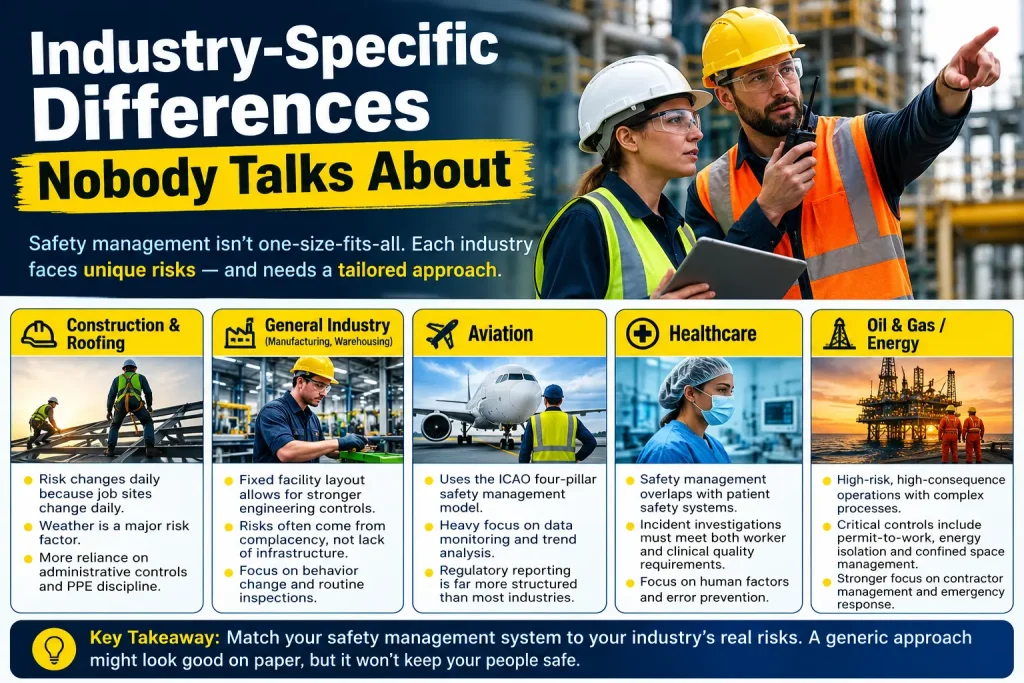
Generic safety management advice assumes every industry runs the same risk profile. It doesn’t. Here is where the approach genuinely diverges:
- Construction and roofing: Risk changes daily because the job site changes daily. Fixed engineering controls are harder to rely on, which pushes more weight onto administrative controls and PPE inspection discipline. Weather is a variable most other industries do not deal with.
- General industry (manufacturing, warehousing): Fixed facility layout means engineering controls (guarding, ventilation, fixed anchor points) can do far more of the work. The failure mode here is usually complacency, not lack of infrastructure.
- Aviation: Runs on the ICAO four-pillar model with heavy emphasis on Safety Assurance, meaning continuous data monitoring and trend analysis, not just periodic audits. Regulatory reporting requirements are far more structured than most general industry programs.
- Healthcare: Safety management overlaps with patient safety systems, so incident investigation processes often need to satisfy both worker-safety regulators and clinical quality bodies simultaneously.
If you are adapting a generic SMS template, adjust the audit frequency and control hierarchy weighting based on which of these categories your operation actually falls into. A one-size-fits-all rollout is one of the fastest ways to end up with a program that looks compliant on paper and fails on the ground.
Warning Signs Your Safety Program Is Failing (Before an Incident Proves It)
These are the early indicators I check first during a site consult, well before looking at the paperwork:
- Near-miss reports have dropped to zero over the last quarter. That almost never means conditions improved. It usually means people stopped reporting.
- PPE compliance is high, but incident rates have not moved. This suggests root causes are not being addressed, only symptoms.
- Safety meetings run the same script every month. If nothing has changed in the content, nobody is retaining it.
- New hires get the same training as five-year veterans. Experience level should change what gets emphasized.
- Supervisors cannot name the top three hazards on their own site without checking a document. If the person managing the risk cannot recall it, the workers under them will not either.
Quick Reference: What Changes at Each Stage of Program Maturity
| Program Stage | Primary Focus | Common Blind Spot |
|---|---|---|
| Starting out (0-1 years) | Basic hazard identification, written policy, PPE compliance | Over-relying on PPE instead of engineering the hazard out |
| Established (1-3 years) | Formal risk assessments, incident investigation process, regular training | Reporting culture stalling because near-misses get punished |
| Mature (3+ years) | Data-driven trend analysis, continuous improvement, leading (not just lagging) indicators | Complacency: assuming past success guarantees future performance |
Frequently Asked Questions
How often should a safety management system be reviewed?
High-hazard operations should review core controls monthly and do a full system review annually. Lower-risk environments can run a full review annually with quarterly spot checks. The trigger for an off-schedule review is any near-miss, incident, or change in equipment, process, or personnel.
Who is legally responsible for safety management in a small business?
Under OSHA regulations, the employer holds ultimate legal responsibility regardless of company size, even if no dedicated safety manager exists. Assigning a specific point person internally does not transfer that legal accountability, but it does make day-to-day execution far more consistent.
What is the difference between a safety policy and a safety management system?
A safety policy is a written statement of intent and commitment. A safety management system is the full operational structure: risk assessments, training records, reporting channels, audit schedules, and corrective action tracking, that turns that policy into daily practice.
Can a small crew realistically run a full SMS without a dedicated safety officer?
Yes, by distributing ownership of specific hazard categories across the most knowledgeable team members rather than centralizing it in one role. This works well for crews under 20 people, provided reporting and audit steps are actually scheduled rather than left informal.
What is a leading indicator versus a lagging indicator in safety management?
A lagging indicator measures what already happened, like injury rate or lost workdays. A leading indicator measures conditions that predict future risk, like near-miss report volume, PPE inspection completion rate, or overdue training percentage. Mature programs track leading indicators because they allow intervention before an injury occurs.
Does a safety management system need to be certified to be effective?
No. Certification against ISO 45001 or similar standards is optional and mainly useful for supply-chain requirements or international operations. An uncertified system built around OSHA’s core elements and consistently enforced will protect workers just as effectively as a certified one.
How do you get buy-in from workers who see safety rules as slowing down the job?
Involve them in writing the procedure, not just receiving it. Workers who helped design a control are far more likely to follow it, because it reflects how the task actually gets done rather than how someone in an office imagines it gets done.
What is the first thing to fix in a safety program that has stalled?
Check whether near-miss reporting has dropped off first. A stalled reporting culture is almost always the root cause behind a program that looks fine on paper but is quietly losing its early-warning capability.
Written by Jack Henry, safety systems engineer specializing in fall protection and industrial hazard controls.
